

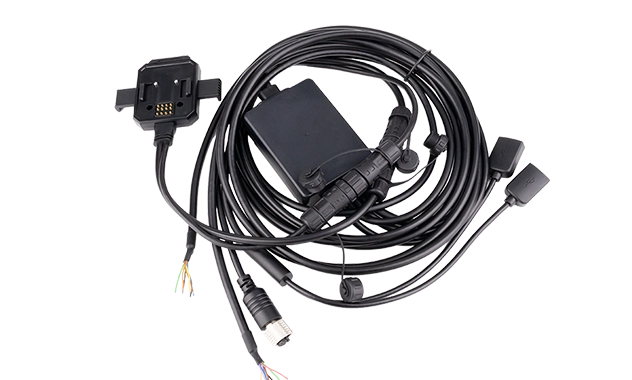
• Digital Inputs: 3x Digital Inputs (Input 1-3)
• Serial & Bus: RS232 / RS485 & Dual CAN-Bus
• Peripherals & Network: 2x USB-OTG & Optional RJ45 Ethernet
CRD680-REG Cradle with Direct-Wire Power Cable (9-36V DC Input)
Industrial vehicle cradle for the MDT680 rugged handheld terminal, supplied with a direct-wire power cable for 9-36V DC input. Beyond stable charging, the CRD680-REG acts as a hardware extension gateway — integrating 2 x CAN Bus, 1 x M12 Ethernet, 2 x serial channels, 2 x USB-A ports, and 3 x GPIO into a single fixed mounting solution.
Engineered for system integrators building advanced fleet telematics, the CRD680-REG eliminates the need for external third-party adapters. It bridges the MDT680 handheld directly to the vehicle's electronic systems, supporting real-time engine diagnostics, peripheral expansion, and hardware-level control.
Full I/O Configuration
Provides a comprehensive set of interfaces via a direct-wire harness, suitable for permanent installations in trucks, vans, and heavy equipment where the cradle is powered directly from the vehicle electrical system.
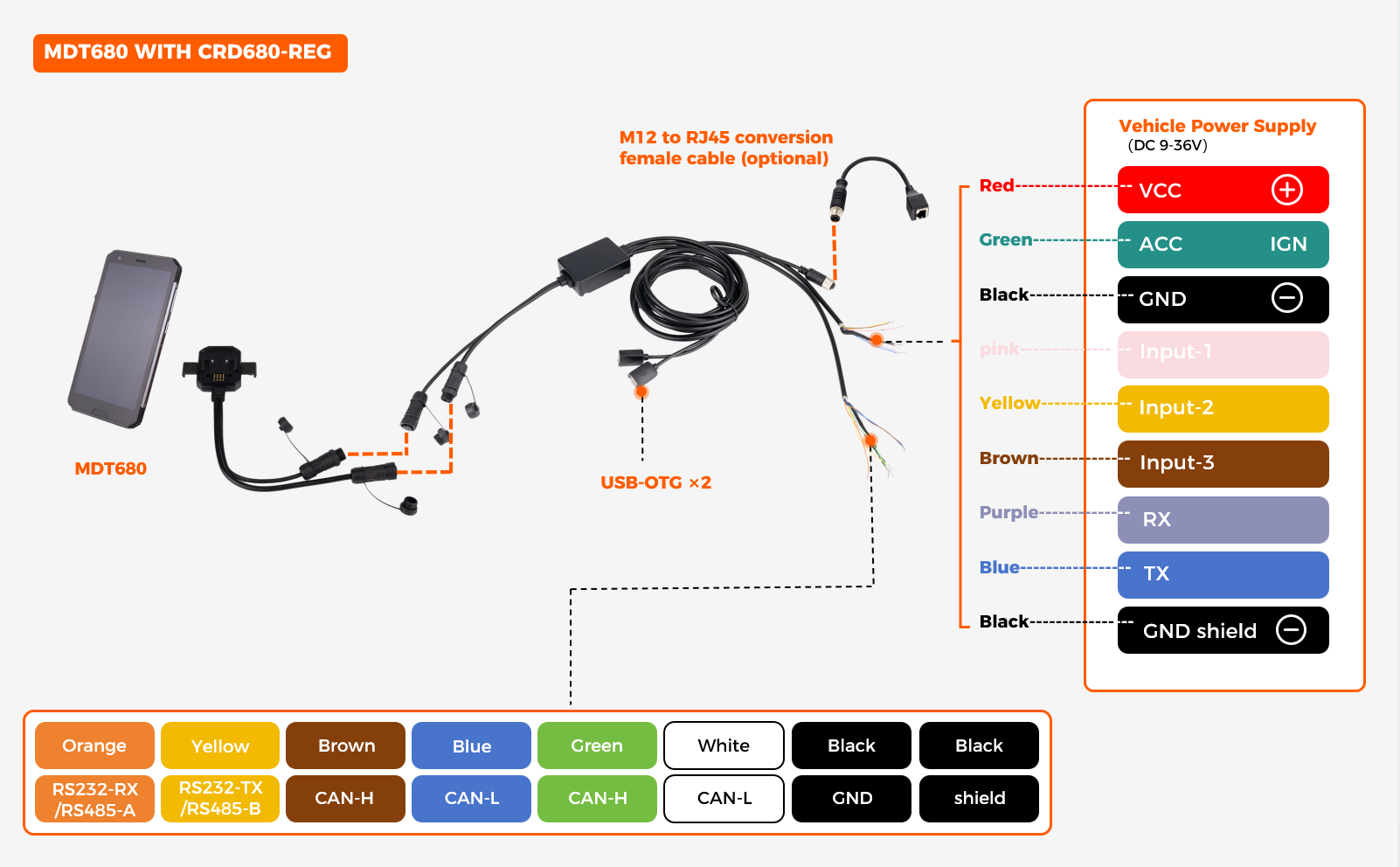
Interface Summary
Vehicle Network & Hardware Integration
The CRD680-REG acts as a hardware extension gateway, bridging the MDT680 handheld directly to the vehicle's electronic systems via dual CAN Bus, Ethernet, and industrial serial interfaces.
Dual Channel CAN Bus
The cradle supports two independent CAN Bus channels (CAN 0 and CAN 1), allowing simultaneous monitoring of separate vehicle networks (e.g., powertrain and body control).
* Developer support: CAN Bus demo application and source code are available. Contact our engineering team for SDK access. Note: The APK requires priv_app permission.
Dual Serial Channels (RS232 / RS485)
The CRD680-REG provides two distinct serial paths with different hardware architectures to support both low-power and high-demand peripherals.
Hardware Architecture Note:
• CPU Native (Purple/Blue): Works independently of external power supply. Ideal for low-power diagnostic tools.
• USB Converted (Orange/Yellow): Requires external power to the cradle. Default is RS232. RS485 requires custom hardware modification at the factory level. Please contact us when placing an order.
Ignition Switch Control
An internal physical switch determines how the cradle draws power from the vehicle.
Right Position (Default): Charging is independent of ignition ON/OFF. (Constant power)
Left Position: Charging is dependent on the ignition state. (Prevents vehicle battery drain)
* Developers can read the ignition wire (Green) status via API. Contact us for the Ignition Event APK.
3-Channel GPIO Input
The cradle includes three general-purpose inputs for hardware triggers, sensor states, or switch monitoring.
High-level input triggers state change (displays "true").
Supports MCU firmware upgrades via hardware button.
* A testing APK is available for validating GPIO logic. Engineering support is required for standard software integration.
Why Choose the Telematics Gateway Cradle?
By integrating dual CAN buses, Ethernet, and multiple serial ports directly into the charging cradle, the CRD680-REG eliminates the "cable spaghetti" of third-party adapters. The MDT680 becomes a fully-fledged vehicle computer when docked.
Simultaneous powertrain and body network monitoring, real-time fuel and fault code diagnostics.
M12 Ethernet for camera feeds or external screens, plus native CAN bus for heavy equipment.
Expandable USB-A ports for barcode scanners or RFID readers, GPIO for custom hardware triggers.

Wiring examples shown — not all configurations. Pin-out details, cable lengths, and cable part numbers may vary by production batch. For the full datasheet with dimensioned drawings and CRD680-REG cable specifications, contact our engineering team.
Compatible Handheld Platform
This telematics cradle is designed specifically for the MDT680 series
The CRD680-REG cradle supports the MDT680 mechanical and electrical interface, providing 9-36V DC power, dual CAN, M12 Ethernet, and dual serial channels through the direct-wire harness.
Compare cradle variants across the full lineup — interfaces, cable options, and configuration differences in one view.