Rugged Tablets for Construction Site Management: A Practical Guide
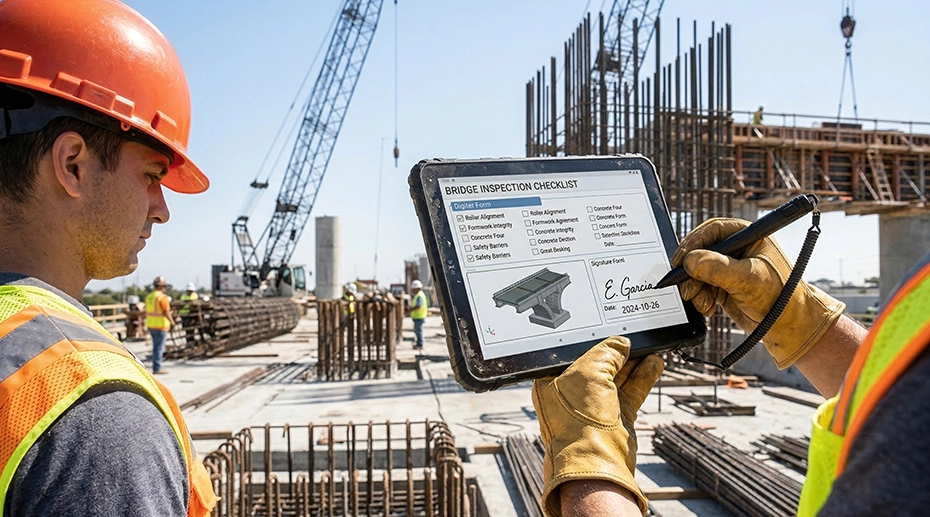 Despite the rapid advancement of construction technology, many job sites still rely on paper-based workflows for daily operations. Blueprints are printed, inspection forms are filled by hand, and equipment logs are maintained on clipboards. These manual processes create information delays, communication gaps between field teams and project offices, and inconsistent data across different contractors.
Rugged tablets for construction operations are transforming how construction sites manage work. By providing durable, connected devices that withstand harsh site conditions, these tablets enable real-time access to plans, digital reporting, and seamless communication between engineers, foremen, and equipment operators.
How Digital Tools Are Transforming Construction Sites
Construction site management encompasses the coordination and supervision of all activities on a job site — including personnel, equipment, materials, schedules, quality control, and safety compliance. Effective site management ensures that projects are completed on time, within budget, and to required specifications.
As construction projects grow in complexity, digital tools have become essential for managing information flow. From accessing up-to-date blueprints to tracking equipment utilization and logging safety inspections, site managers need reliable technology that works in the field, not just in the trailer.
How Rugged Tablets Improve Construction Site Management
Harsh Environment Compatibility
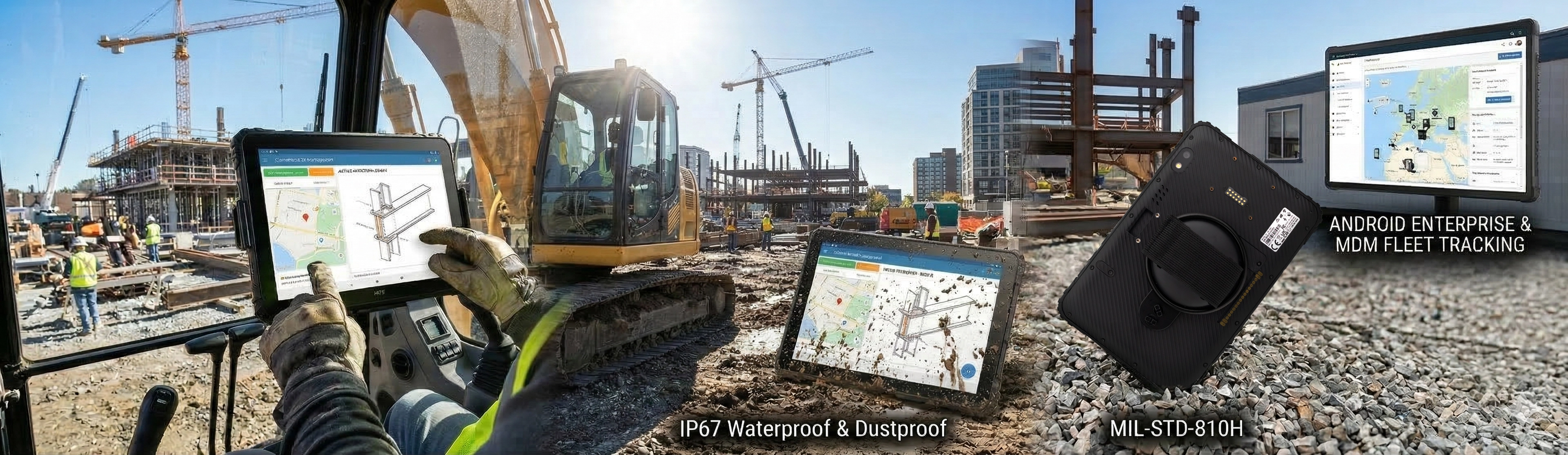
Construction sites expose devices to dust, rain, mud, vibration from heavy machinery, and temperature extremes. Consumer tablets typically fail within weeks under these conditions. Rugged tablets are engineered with IP67 sealing and MIL-STD-810H certification to operate reliably in harsh construction environments.
Real-Time Data Access
With cloud-connected rugged tablets, site teams can access the latest drawings, schedules, RFIs, and inspection forms instantly. No more confusion over outdated versions or waiting for printed updates to reach the field.
Improved Communication
Rugged tablets bridge the gap between field crews, site offices, and remote project managers. Instant messaging, photo sharing, and video calls enable faster problem-solving and reduce costly delays.
Mobility and Flexibility
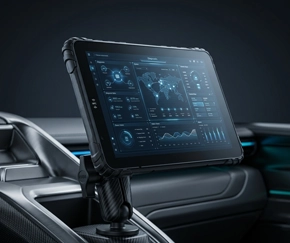
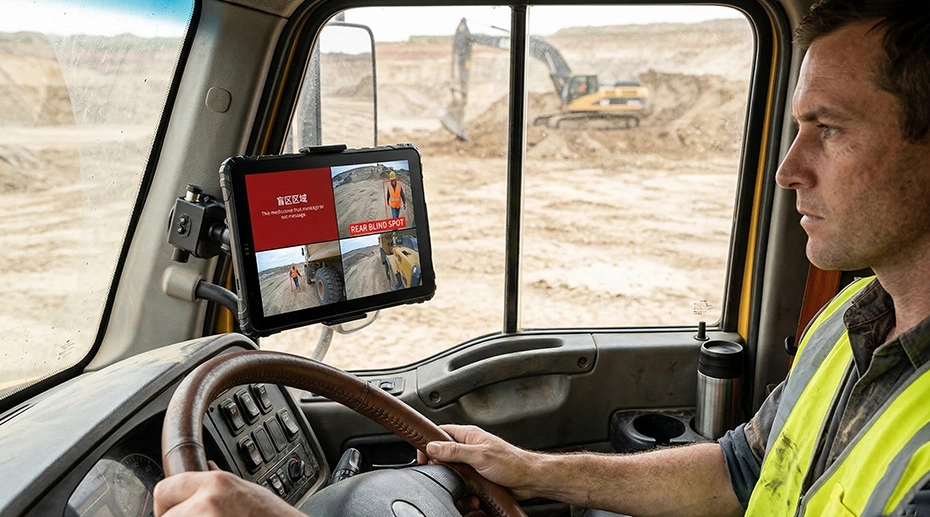
Unlike fixed workstations, rugged tablets move with workers across the job site. Supervisors can carry them from excavation areas to upper floors, while equipment operators can mount them in vehicle cabs. Construction tablet solutions provide computing power wherever it's needed.
Key Workflows Enabled by Construction Tablets
Managing Work Orders Digitally
Foremen receive daily work assignments digitally, and crews submit completion reports with photos directly from the field. With Android rugged tablets and MDM support, these workflows can be managed across the entire site workforce.
Conducting Site Inspections
Safety inspectors use tablets to complete digital checklists, document hazards, and track corrective actions. Photo and timestamp evidence creates auditable compliance records.
Coordinating Field Teams
Rugged tablets installed in heavy equipment cabins display real-time machine data — fuel levels, operating hours, diagnostic codes. Vehicle mount tablets serve as operator interfaces for telematics systems.
Monitoring Equipment in Real Time
Logistics teams use fleet management tablets to track material deliveries, coordinate concrete trucks, and optimize equipment utilization across multiple job sites.
What to Look for in a Construction Tablet

Durability
IP67 waterproof and dustproof rating, MIL-STD-810H certification for drops and vibration, and a sunlight-readable display (1000+ nits) for outdoor visibility.

Battery Life
All-day operation with 8-12 hour battery life, hot-swappable battery options for continuous use, and vehicle docking for uninterrupted power during shifts.

Connectivity
4G/5G cellular for remote sites, integrated GPS/GNSS for location tracking, WiFi 6 for high-speed data transfer, and I/O ports for equipment integration.
Compatible Software for Construction Tablets
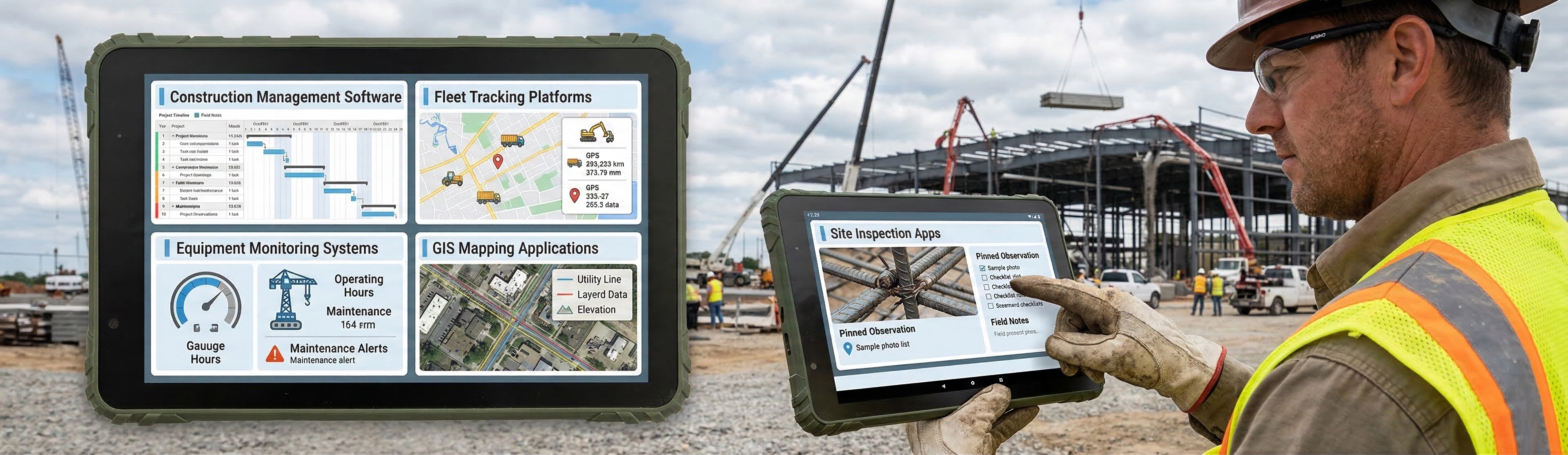
Rugged Android tablets run a wide range of construction and engineering applications:
Many fleets also use mobile data terminals alongside tablets for comprehensive equipment and logistics management.
Real-World Applications in Construction Projects
Road Construction
Surveying, grade checking, and asphalt temperature monitoring with rugged tablets.
Building Sites
Digital blueprints, punch lists, and quality inspections on upper floors.
Infrastructure
Bridge inspections, asset tagging, and structural monitoring in remote locations.
Best Practices for Deploying Tablets on Construction Sites
Choosing the Right Installation Method
Deployment success starts with proper installation. Consider:
Handheld use for supervisors and inspectors with protective cases and hand straps
Vehicle-mounted cradles for equipment operators with vibration-resistant docks
Fixed workstations in site trailers for project managers and coordinators
Universal mounting systems (RAM mounts, VESA plates) for multi-vehicle flexibility
MDM & Device Management
Centralized management is essential for fleet-scale deployments:
Use Android Enterprise with zero-touch enrollment for bulk provisioning
Implement kiosk mode to lock devices to specific construction apps
Configure remote monitoring and over-the-air (OTA) updates
Set geofencing policies to restrict device usage to job site boundaries
Worker Training & Adoption
Successful digital transformation requires user buy-in:
Provide hands-on training focused on daily workflows, not just device features
Designate site champions who can assist co-workers with common tasks
Create quick-reference guides with screenshots of key applications
Start with pilot users who can demonstrate success to the wider team
Software Integration
Tablets must connect seamlessly with existing systems:
Integrate with project management platforms (Procore, Autodesk, Bluebeam)
Connect to equipment telematics and fleet tracking systems
Sync with safety and inspection applications for real-time compliance
Ensure compatibility with BIM viewers and GIS/mapping software
Pro Tip: Start with a pilot deployment on a single project to identify workflow challenges and refine your training approach before rolling out across the entire organization. This phased approach reduces disruption and increases adoption rates.
Future Trends: Digital Construction & Smart Job Sites
The construction industry is rapidly digitizing. Rugged tablets are evolving to become central hubs for:
IoT integration: Connecting sensors on equipment, materials, and site conditions
AI-powered analytics: Predictive maintenance, safety monitoring, and progress tracking
Connected equipment: Tablets as interfaces for autonomous and semi-autonomous machinery
Conclusion
Rugged tablets have become the digital core of modern construction site management. By enabling real-time data access, seamless communication, and reliable operation in harsh conditions, these devices help project teams improve efficiency, enhance safety, and maintain better visibility across operations.
For construction firms ready to digitize their sites, rugged tablets provide the hardware foundation for project management software, fleet tracking systems, and field inspection applications.