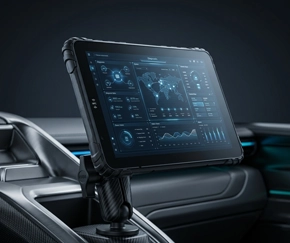
From PCB Layout to Thermal Simulation: How MDT Devices Handle Heat in 50°C Environments
Designing mobile data terminals for vehicle environments is not just about performance — it's about survival. In confined truck cabins, devices must operate reliably at 50°C and beyond, often without active cooling. Here's how professional-grade thermal engineering makes that possible.
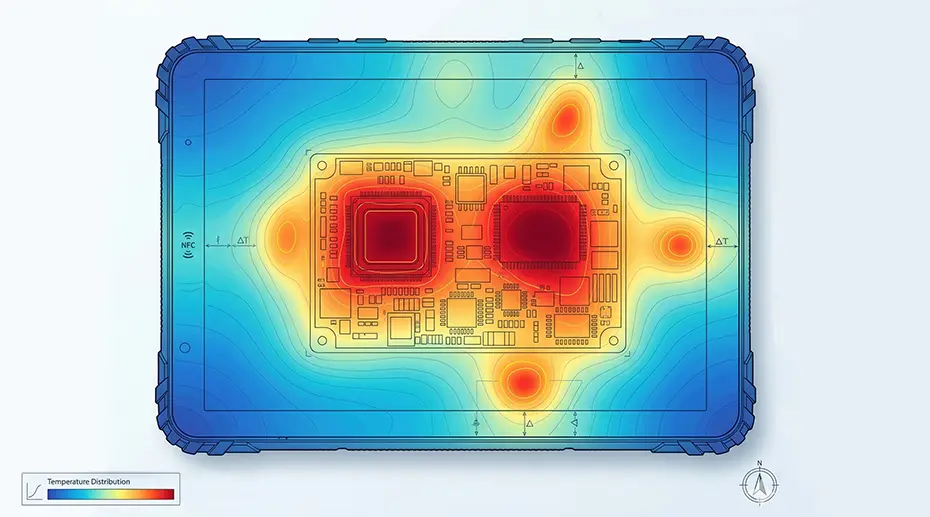
Table of Contents
1. Why Thermal Design Is Critical for MDT Devices
Poor thermal design can lead to multiple failures in rugged mobile data terminals, especially in demanding vehicle environments where a vehicle-grade data collection computer is expected to run continuously for years without degradation.

CPU Throttling
Performance drops, system lag, application crashes

System Instability
Unexpected reboots, data loss, communication failures

Battery Risk
Swelling, reduced lifespan, safety hazards

Display Failure
Screen blackout, touch malfunction, delamination
Key takeaway: Thermal design directly impacts reliability, lifespan, and safety of rugged vehicle terminals.
2. Thermal Challenges in Compact Vehicle Terminals

Enclosed Installation
Dashboard, dock, or panel mounting — no free air circulation. A fixed in-dash computing station traps heat that a freestanding device would dissipate.

No Airflow (Fanless Design)
Industrial terminals must operate without internal fans

Direct Sunlight Exposure
In-cab devices face additional radiant heat

Engine Heat
Proximity to vehicle engine or exhaust systems
These challenges are especially critical for: truck-mounted terminals, forklift tablets, construction vehicle displays, and fleet management MDTs.
3. PCB-Level Thermal Optimization
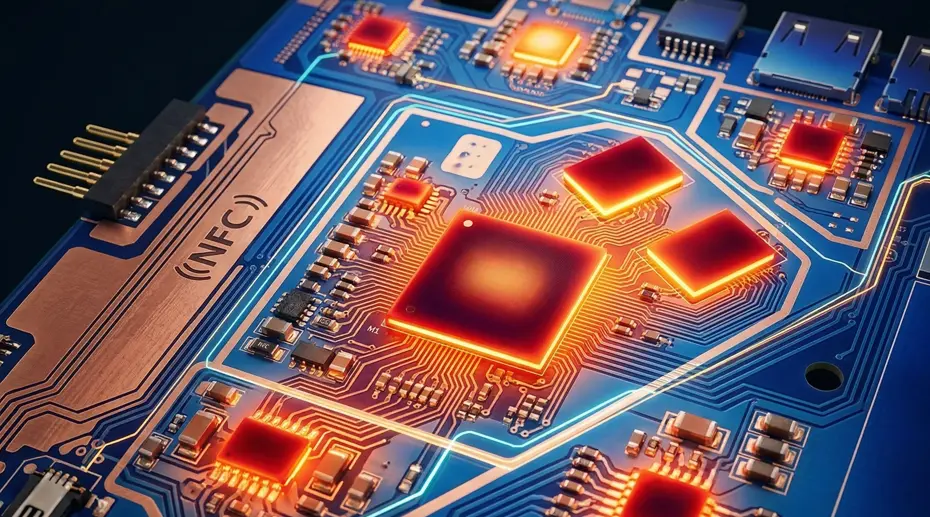
Effective thermal management starts at the PCB level. Here are three key strategies that separate industrial-grade hardware from consumer electronics:
1. Component Placement Strategy
Distribute high-heat components (CPU, power ICs) across the board to avoid localized hot spots.
2. Copper Layer Design
Use multi-layer copper planes and thermal vias to conduct heat away from critical components — a technique validated in every industrial mobile computing terminal designed for sustained high-load operation.
3. Power Management Optimization
Reducing power consumption = reducing heat source. Efficient DC-DC converters and low-power modes are essential.
4. Mechanical & Structural Heat Dissipation Design
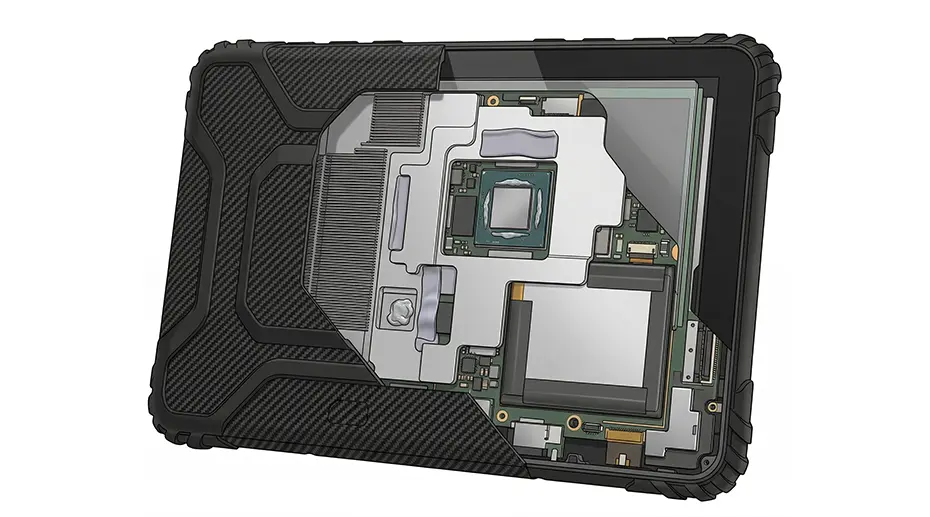
Aluminum Alloy Housing
Acts as a large heat spreader; conducts internal heat to outer surface
Heat Spreader / Heat Sink
Internal metal structures that transfer heat from CPU to chassis
Thermal Interface Materials (TIM)
Thermal paste or pads that eliminate air gaps between components and heat spreaders
Fanless Design Strategy
Passive cooling eliminates moving parts — ideal for dusty, vibration-heavy environments. Every rugged vehicle-dedicated computing unit in our lineup uses this approach for zero-maintenance thermal management.
5. Thermal Simulation & Validation
Before physical prototyping, thermal simulation helps engineers predict and optimize thermal performance:
CFD (Computational Fluid Dynamics) simulation for airflow and temperature distribution
Hotspot prediction before PCB fabrication
Design validation without costly re-spins
Key insight: Thermal simulation helps engineers identify risks before production, saving time and cost. A custom-engineered MDT project includes simulation data before the first prototype is built.
6. Real-World Performance in 50°C Environments
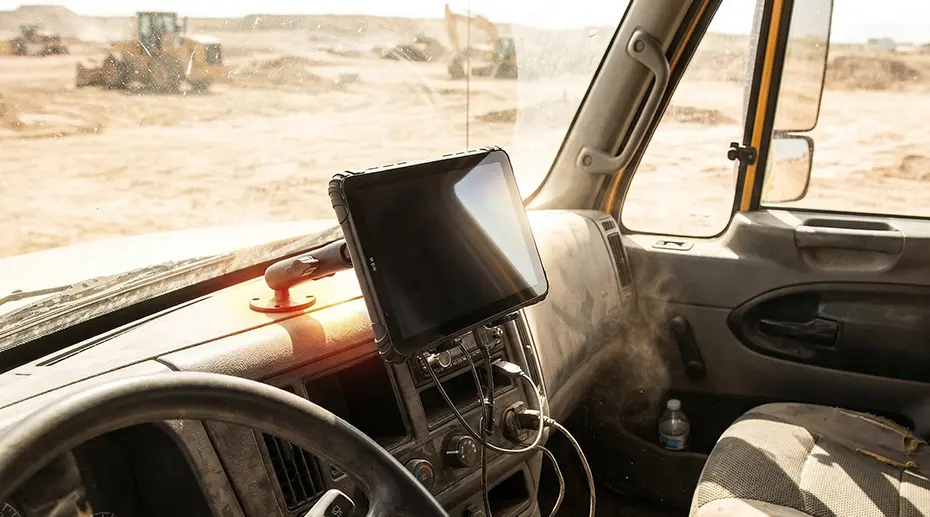
Well-designed MDT devices must maintain stable operation in extreme conditions without thermal throttling or shutdown:
Continuous operation test in 50°C chamber
Direct sunlight exposure (simulated or real-world)
In-vehicle enclosed cabin testing (no external airflow)
MDT devices must maintain stable operation without throttling or shutdown, ensuring driver safety and fleet uptime.
7. Active Cooling vs Passive Cooling in MDT Design
Conclusion: Rugged MDT devices rely on passive cooling for reliability in harsh environments — the same approach used in every fanless in‑vehicle processing terminal deployed in commercial fleets.
8. How to Choose a Rugged MDT for High-Temperature Environments
9. How TOPICON MDT Devices Solve Heat Challenges
✓ Optimized PCB thermal layout
✓ Aluminum alloy enclosure
✓ Advanced heat dissipation structure
✓ Fanless industrial design
✓ Stable performance in 50°C+ environments
✓ IP67 waterproof + vehicle docking — compatible with locking vehicle computing cradles
✓ OEM customization for system integrators
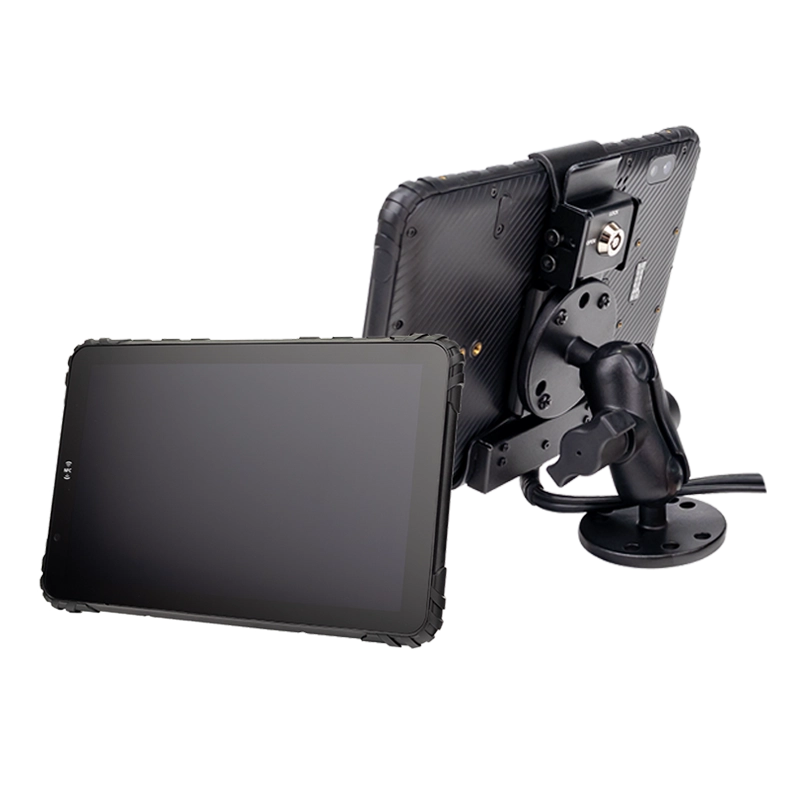
TOPICON Rugged MDT Devices
Designed for extreme heat, dust, and vibration in vehicle environments.
Source MDT Hardware →10. Frequently Asked Questions
What is thermal throttling in embedded systems?
Thermal throttling is when a processor reduces its clock speed to lower temperature and prevent damage. It's a common issue in poorly designed rugged devices.
How do rugged tablets dissipate heat?
Through aluminum alloy housings, internal heat spreaders, thermal interface materials (TIM), and optimized PCB copper layers — all without fans. A thermally validated vehicle computing platform maintains full performance even in direct sunlight.
Can MDT devices work in 50°C environments?
Yes, properly designed MDT devices with passive cooling and aluminum housings can operate reliably at 50°C and even higher temperatures.
Is fanless cooling reliable for industrial devices?
Yes, fanless cooling is more reliable in dusty, vibration-heavy environments because it eliminates moving parts that can fail over time.
What materials are best for heat dissipation in rugged devices?
Aluminum alloy for housing, copper for heat spreaders, and high-performance thermal interface materials (TIM) between components and heat sinks.
Thermal Design = System Reliability
Thermal design is more than just structural engineering — it's a system-level discipline. From PCB layout to enclosure design, material selection to thermal simulation, every decision directly determines how reliably a device performs in extreme heat.
Choosing an MDT device with proven thermal design ensures long-term reliability in demanding vehicle environments. Source thermally validated MDT platforms for your next fleet deployment.
Related MDT & Rugged Hardware Resources