Ambulance MDT Guide – Rugged Mobile Data Terminals for EMS & Emergency Response Vehicles
What hardware does an ambulance fleet need for patient data access, GPS navigation, hospital communication, and dispatch coordination? This guide covers MDT selection criteria, vehicle docking requirements, continuous power integration, and OEM options for EMS system integrators. For core computing platforms, our rugged in-vehicle terminal provides the processing backbone for ambulance deployments.
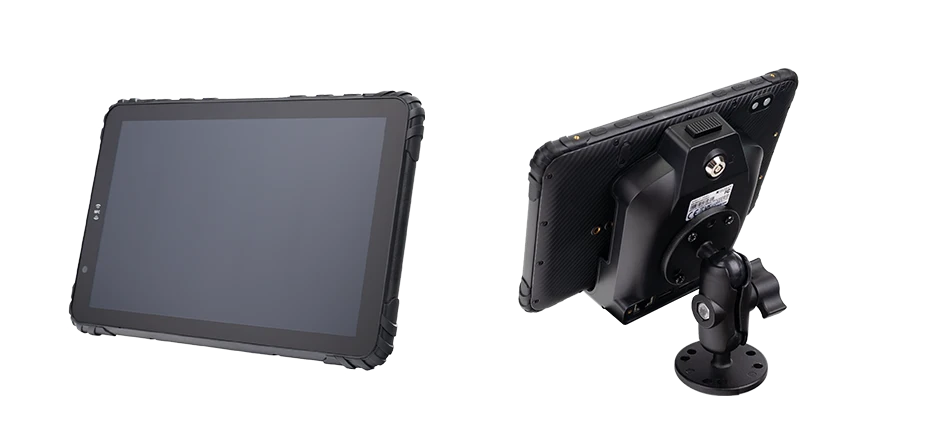
Table of Contents
Why Ambulances Need Purpose-Built MDT Hardware
An ambulance is not a standard vehicle. It operates at high speed through city traffic, idles in extreme heat or cold at emergency scenes, and carries the most critical cargo — patients whose outcomes depend on seconds. The computing device inside the cabin must support dispatch communication, GPS navigation, patient data access, hospital coordination, and electronic patient care reporting (ePCR) — all while surviving constant vibration, rapid acceleration and braking, and exposure to blood, fluids, and disinfectant chemicals.
Consumer tablets were not engineered for this. A device that overheats in a parked ambulance on a summer day, loses charge during a long multi-casualty incident, or can't be securely mounted during emergency driving doesn't inconvenience the crew — it compromises patient care. When paramedics can't access drug dosage information, allergy records, or hospital diversion status because the tablet failed, the cost is measured in clinical outcomes, not hardware replacement budgets. For these mission-critical environments, an ambulance-ready mobile data terminal is not optional — it is the central data hub connecting the vehicle, the crew, and the hospital.
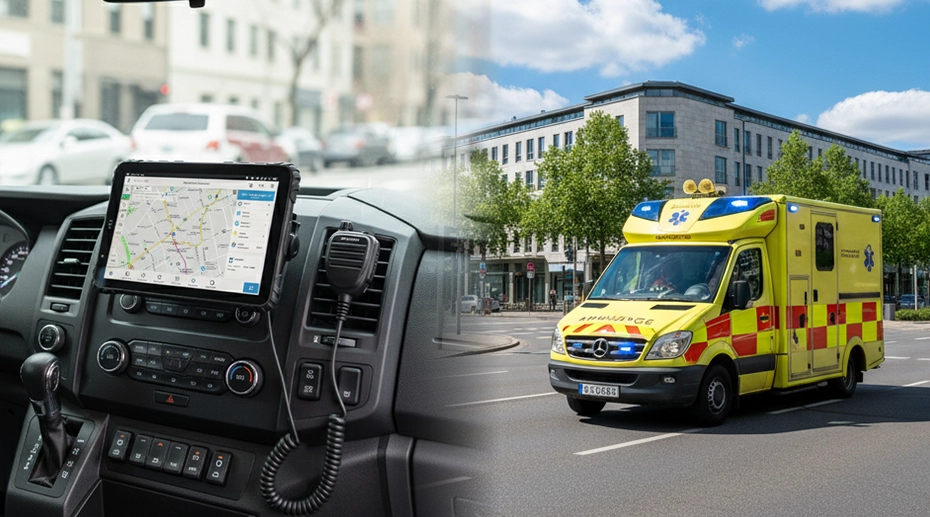
Key takeaway: An ambulance MDT is not a tablet in a case. It is a vehicle-integrated computing platform that connects to the ambulance's power system, stays securely mounted during emergency driving, survives disinfectant cleaning protocols, and provides instant access to patient data — reliably, every shift, for 5+ years.
Key Hardware Requirements for Ambulance MDTs
What to look for when selecting hardware for emergency medical service vehicles
1. Vehicle Docking with Continuous Power
9-36V wide voltage input with ignition sensing. Pogo-pin charging through the docking station keeps the tablet at full charge — no dead batteries when a critical call comes in. A vehicle mount docking station designed for emergency vehicles ensures a secure, powered connection at all times.

2. IP67 Rugged Protection
Sealed against dust, water, and bodily fluids. Survives regular cleaning with hospital-grade disinfectants without port corrosion or screen delamination.

3. Sunlight-Readable Display
1000-nit brightness minimum. Paramedics must read patient data, navigation maps, and dispatch messages in direct sunlight through the windshield — with gloved hands.

4. 5G + GPS + External Antenna
Multi-constellation GNSS with external antenna support maintains location accuracy in remote areas and urban canyons. 5G connectivity ensures patient data and hospital coordination data transfer without delay.

5. Quick-Release Docking
One-hand release from the vehicle dock — paramedics detach the tablet in seconds for patient-side documentation, then snap it back for charging and navigation during transport.

6. MDM + 5+ Year Lifecycle
Android Enterprise with MDM for remote fleet management. 5+ year hardware availability aligned with government procurement cycles — no mid-lifecycle model changes that force recertification.
The Real Risk: Your Ambulance MDT Is the Single Point of Failure
When the tablet fails in an ambulance, patient data, navigation, and hospital communication all stop — simultaneously. There is no paper backup during a code.
Patient Data Access Interrupted
A frozen screen means paramedics lose instant access to drug databases, allergy records, and treatment protocols. In a time-critical emergency, information delays translate directly to clinical risk.
Navigation Fails During Emergency Response
GPS navigation is how ambulances find the fastest route to the scene and the closest appropriate hospital. A dead tablet during a code 3 response means relying on radio directions — adding minutes that matter.
Hospital Communication Lost
Paramedics lose the ability to transmit patient vitals, ECG data, and arrival estimates to the receiving hospital. The ED team can't prepare for an incoming critical patient they don't know is coming.
Why it matters: A consumer tablet that fails during an ambulance shift doesn't just cost a replacement — it creates a gap in patient care, delays emergency response, and exposes the EMS agency to liability. The cost of a single adverse event caused by device failure exceeds the cost of equipping the entire fleet with rugged MDT hardware. Deploy a fleet management tablet built for emergency vehicles →
MDT vs Consumer Tablet for Ambulance Fleets
Why EMS agencies are moving to vehicle-integrated hardware
Why this matters for EMS agencies: Ambulances operate on 5-7 year replacement cycles for vehicle electronics. A consumer tablet that fails every 18 months creates procurement fragmentation — different models, different chargers, different failure modes across the fleet. A standardized MDT with a 5+ year lifecycle means every ambulance in the fleet runs the same hardware configuration, the same software image, and the same support process — critical for consistent patient care.
Vehicle Integration — Docking, Power, and Quick Release
What makes an ambulance MDT fundamentally different from a tablet in a case
Pogo-Pin Vehicle Docking
The docking station uses spring-loaded pogo pins for charging and data — no USB cables to wear out, no ports to break. The tablet charges every moment it's docked, and the connection withstands constant vehicle vibration and emergency driving forces.
Ignition-Sensing Auto Power
The MDT powers on when the ambulance engine starts and sleeps when it stops. No paramedic intervention needed. No dead batteries at the start of a critical call. The system manages power cycles automatically — reducing crew cognitive load.
One-Hand Quick Release
A single mechanical release detaches the tablet from the dock in under a second. The paramedic can grab the tablet for patient-side documentation at the scene, then snap it back into the dock for charging and navigation during transport to the hospital.
Integration note for system integrators: The vehicle docking station must support 9-36V DC input with ignition sensing, provide pogo-pin charging contacts rated for 10,000+ mating cycles, and include a locking mechanism that withstands emergency driving forces. The tablet must detach with one hand while remaining secure during high-speed cornering and sudden braking. Browse our vehicle mount tablet range →
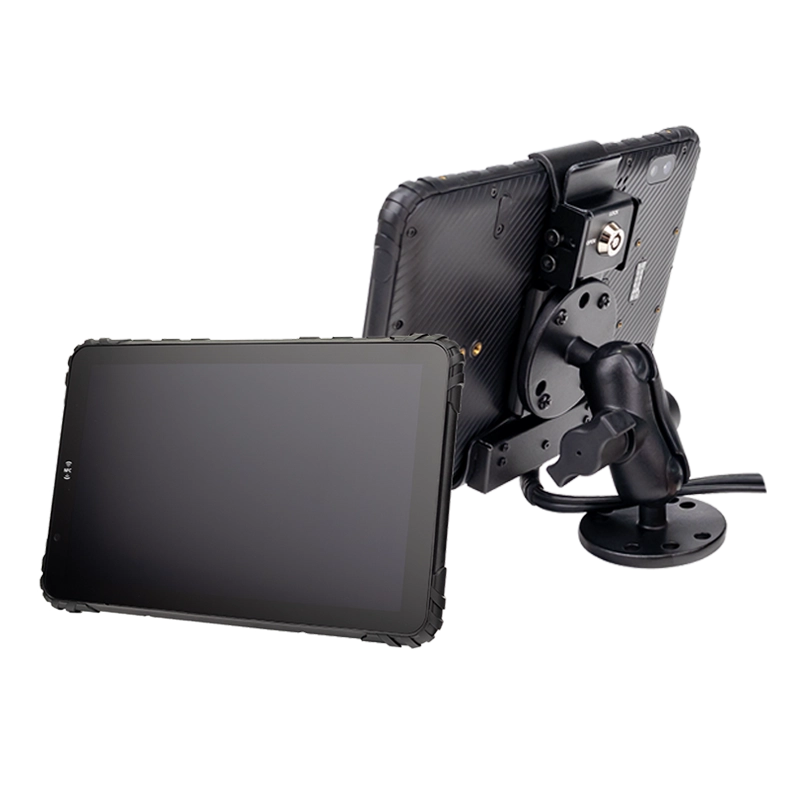
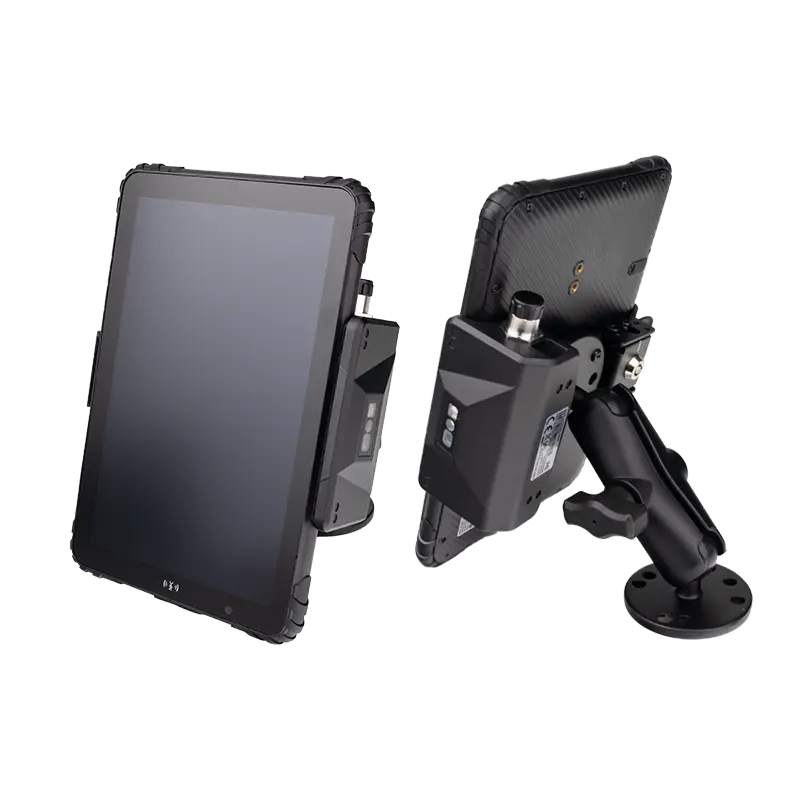
Recommended MDT Hardware for Ambulance Deployments
TOPICON MDT platforms designed for EMS vehicle integration and emergency response
OEM Customization for EMS Solution Providers
White-label hardware platforms for system integrators deploying ambulance and EMS fleet systems
White-Label Branding
Your EMS agency or company branding on the device and boot screen. No TOPICON branding visible. Start your private‑label MDT project →
Pre-Loaded ePCR & MDM
Tablets arrive with your ePCR application pre-installed and MDM-enrolled. Paramedics power on and access patient documentation — no setup needed.
Custom I/O Configuration
RS232 for legacy medical devices, GPIO for vehicle sensors, USB for additional peripherals — configured to your EMS system requirements.
5+ Year Lifecycle
Stable hardware supply aligned with government procurement cycles. No mid-deployment model discontinuations. Build your long‑life OEM tablet platform →
Frequently Asked Questions
What hardware do ambulances need for MDT deployment?
An ambulance MDT requires a rugged tablet with vehicle docking and continuous power (9-36V with ignition sensing), IP67 protection, sunlight-readable 1000-nit display, 5G/GPS with external antenna support, and quick-release docking. Source EMS‑ready MDT hardware →
Can ambulance MDTs withstand vehicle vibration and emergency driving?
Yes. Rugged MDTs with vehicle docking stations are engineered for continuous vibration, rapid acceleration, and emergency braking. Pogo-pin charging contacts maintain connection through high-speed cornering.
How does vehicle docking work for ambulance tablets?
A vehicle docking station is permanently installed in the ambulance cabin, connected to the 9-36V DC power system. The tablet snaps into the dock — pogo pins provide charging and data connection without cables. Explore our vehicle docking solutions →
Are rugged tablets required for EMS, or can iPads work?
Consumer tablets like iPads lack vehicle power integration, secure docking, disinfectant resistance, sunlight readability, and long lifecycles — all critical for ambulance operations.
Can we get white-label MDTs with our EMS agency branding?
Yes. TOPICON provides full white-label customization — your agency logo, custom packaging, pre-installed ePCR app, and MDM pre-enrollment. Discuss your OEM project →
Related Ambulance & MDT Resources
MDT Hardware Platform →
Rugged vehicle-mounted data terminals
Ambulance Case Study →
How an EMS agency deployed MDT880 tablets
Public Safety Solutions →
Rugged tablets for police, fire, and EMS
Police MDT Guide →
MDT selection for law enforcement
Vehicle Mount Tablets →
Vehicle docking and mounting solutions
OEM MDT Customization →
White-label hardware for EMS integrators
Equipping Your Ambulance Fleet with Reliable MDT Hardware?
TOPICON provides OEM-ready rugged tablets with vehicle docking, IP67 protection, and MDM — built for EMS and emergency response fleets.