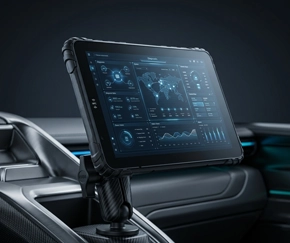
How System Integrators Build Recurring Revenue with White-Label Fleet Hardware
Selling fleet software subscriptions generates predictable monthly income — but it also creates a revenue ceiling. Every customer pays roughly the same fee, and if they leave, the revenue stops. A growing number of system integrators are adding white-label hardware to their offering — not because they want to be hardware companies, but because hardware transforms their unit economics, locks in customers, and creates revenue streams that software alone cannot reach.
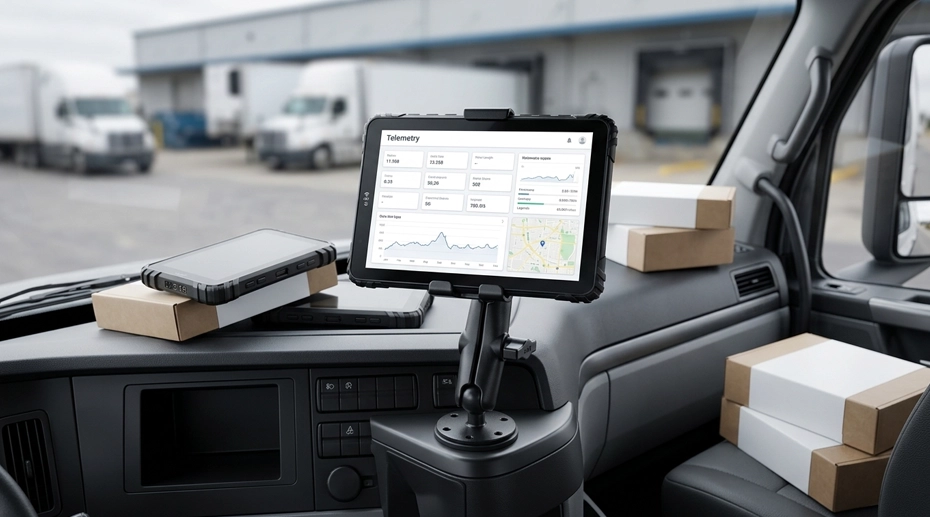
Table of Contents
The Software-Only Revenue Ceiling
A fleet ELD or telematics software company typically charges $15-30 per vehicle per month. With 500 vehicles under management, that is $90,000-180,000 in annual recurring revenue — a solid business. But the math also reveals the ceiling. To double revenue, the company must double the number of vehicles under management. Every new customer requires sales effort, onboarding, and support. Every lost customer removes revenue immediately — there is no residual hardware value, no refresh cycle, no asset that continues to generate returns after the initial sale.
This is the fundamental limitation of the software-only model: revenue is strictly proportional to active subscriptions. The SI captures value only from the software layer — the application code that runs on a device the customer bought from someone else. The hardware layer — the physical device in the vehicle cab, the docking station, the cables, the peripherals — represents additional value that the SI does not capture, even though the SI's software depends on that hardware functioning reliably every day.
Worse, when that hardware fails — a tablet overheats in the sun, a USB port wears out from vibration, a battery swells from continuous charging — the customer calls the SI. The hardware failure becomes the SI's support ticket, even though the SI did not choose the hardware, did not test it, and captured no revenue from it. The software-only model externalizes hardware revenue to consumer electronics companies while internalizing hardware support costs. That is not a sustainable asymmetry.
Key takeaway: Software-only SI businesses face a structural ceiling: revenue grows linearly with customer count, churn removes revenue instantly, and hardware support costs are borne by the SI while hardware revenue goes to third-party device manufacturers. Adding white-label hardware breaks all three constraints simultaneously.
Three Revenue Streams Hardware Unlocks
Adding branded hardware to a software business creates revenue in three distinct ways — none of which require acquiring new customers
Deployment Hardware Revenue
When a new customer signs up for your fleet software, they also purchase tablets from you — not from a third party. A 50-vehicle deployment at $250-400 per tablet generates $12,500-20,000 in one-time hardware revenue at the start of the contract. This is revenue that a software-only SI leaves on the table. The customer was going to buy tablets anyway. Now they buy them from you, pre-loaded with your software, carrying your brand, and supported by your team.
Hardware Refresh Cycle Revenue
Rugged vehicle tablets have a 3-5 year operational life. When the hardware reaches end-of-life, the customer needs replacements — and they buy them from you, the same vendor who provided the original devices and who already knows their fleet configuration. This creates a predictable 3-5 year hardware revenue cycle that is independent of customer acquisition. Unlike software subscriptions that can be cancelled monthly, hardware refresh revenue is structural — the devices will eventually need replacement regardless of whether the customer considers switching software providers.
Hardware-Tied Service Revenue
Branded hardware creates opportunities for additional service revenue: extended warranty programs, MDM management fees, pre-configuration charges, and hardware-as-a-service monthly billing. These services are only possible when the SI controls the hardware — they cannot be offered when the customer buys tablets from a third party. The hardware becomes a platform for recurring service revenue that sits alongside software subscriptions, increasing total revenue per customer without increasing customer acquisition cost.
The Churn Reduction Mechanism — Why Hardware Lowers Customer Loss
Customer retention is not about satisfaction surveys. It is about switching cost — and hardware creates switching cost that software alone cannot.
Software-Only Customer: Low Switching Cost
A fleet operator using your ELD software on their own tablets can switch to a competitor in days. Download the new app, log in, cancel your subscription. The tablets stay in the vehicles. The docks stay on the dashboards. Only the software changes. The switching cost is the time it takes to install a new app and migrate data — minimal. This is why software-only businesses experience higher churn rates: there is nothing physical anchoring the customer to the vendor.
Hardware + Software Customer: High Switching Cost
A fleet operator who purchased your branded tablets, installed your docks in their vehicles, trained their drivers on your hardware, and integrated your solution into their maintenance workflow faces a material barrier to switching. Changing software providers means replacing all the hardware — or at minimum, wiping and reconfiguring every device. The switching cost includes hardware replacement, reinstallation labor, driver retraining, and operational disruption. A competitor offering a $5/month lower subscription price cannot overcome this barrier. The hardware creates retention that no software feature can match.
Retention principle: Software features can be copied. Subscription prices can be undercut. But a fleet of 200 vehicles with your branded tablets physically installed in their cabs represents a switching cost that no competitor can eliminate. Join the TOPICON partner program for white-label hardware →
How the White-Label OEM Model Works — Without Building a Hardware Company
You do not need a hardware engineering team, a factory, or a supply chain. You need an OEM partner who already has all three.
What the SI Brings
Software platform: Your ELD, telematics, dispatch, or compliance application — the core product your customers pay for.
Customer relationships: Fleet operators, logistics companies, school districts, public safety agencies — your existing and future clients.
Industry expertise: You understand the regulations, the workflows, the pain points. The hardware is the vehicle for your software — not the product itself.
Brand: Your company name, your reputation, your customer trust. The hardware carries your brand, not the OEM's.
What the OEM Partner Brings
Hardware platform: Existing rugged tablet designs with vehicle-grade power, CAN Bus, RS232, IP67 sealing, MIL-STD certification — already engineered, already tested, already in production.
I/O customization: Configure CAN Bus channels, RS232 ports, GPIO, camera inputs, M12 connectors — exactly what your application needs.
Branding & pre-loading: Your logo on the device, your boot screen, your software pre-installed, your MDM policies applied — devices arrive ready for driver deployment.
Supply chain & warranty: Manufacturing, quality control, certifications, and hardware warranty — the OEM handles everything you do not want to build. Launch your private-label hardware →
The division of labor: The SI owns the software, the brand, and the customer. The OEM owns the hardware engineering, manufacturing, and supply chain. Neither tries to do the other's job. This is not outsourcing — it is a partnership where each side does what it does best.
What SI Can Capture — A 5-Year Revenue Comparison
A hypothetical but realistic SI with 200 vehicles under management, $25/month software subscription
Why this matters: The $180,000 difference over 5 years comes from the same 200 vehicles — not from acquiring new customers. Hardware revenue is captured from customers who already pay for your software. It is not a new business. It is a deeper monetization of the existing customer base. Understand why purchase price is the wrong metric for fleet hardware →
Getting Started — From Software to Branded Solution in Four Steps
Define Your Hardware Spec
Choose a tablet platform, configure the I/O your software needs, specify branding requirements. You are not designing hardware from scratch — you are selecting from existing, proven platforms and customizing the interfaces. Configure your custom tablet →
Validate with a Sample Unit
Test your software on actual hardware. Confirm I/O functionality, display performance, and overall fit before committing to production volume. Adjust specifications if needed.
Pre-Load Your Software
Your app is installed at the factory. Your MDM policies are applied. Your logo is on the device and boot screen. The tablet arrives at the customer site ready for immediate driver use — no sideloading, no IT setup.
Pilot, Then Scale
Deploy to a subset of your fleet first. Gather operational feedback. Refine. Then roll out to your full customer base. Each phase has its own order quantity — no requirement to commit to full volume upfront. Apply for partnership →
Frequently Asked Questions
What is white-label fleet hardware?
White-label fleet hardware is a rugged tablet or MDT manufactured by an OEM partner but sold under your company's brand. The device carries your logo, your boot screen, and your software pre-installed. The end customer sees your brand — not the manufacturer's. Build your white-label tablet →
Do I need to invest in hardware R&D to launch my own tablet?
No. The OEM partner provides the hardware platform — already engineered, certified, and in production. You configure the I/O, branding, and software pre-load. You do not need a hardware engineering team, a factory, or a supply chain. Explore the partner program →
What is the minimum order quantity for white-label tablets?
MOQ is project-based and depends on the tablet model and customization scope. TOPICON works with system integrators at different scales — from pilot deployments to full fleet rollouts. There are no rigid thresholds for qualified partners. Contact us with your project scope for a tailored proposal.
How does branded hardware reduce customer churn?
Branded hardware creates switching cost. A customer who has purchased your tablets, installed your docks in their vehicles, and trained their drivers on your hardware faces a material barrier to switching software providers — they would need to replace or reconfigure all their hardware. A software-only customer can switch by installing a different app. Read the OEM vs tier-1 analysis →
Can I pre-load my ELD or telematics software on the tablets?
Yes. TOPICON can pre-load your application at the factory, apply your MDM policies, and ship devices ready for immediate driver deployment. Your customers power on the tablet, log in, and start working — no setup, no sideloading, no IT tickets. Start your OEM project →
Related SI Business & OEM Resources
Partner Program →
Build your brand on our hardware platform
White-Label Tablets →
Your brand, our hardware engineering
OEM Customization →
Custom I/O, firmware, and branding
Why SI Choose OEM Over Tier-1 →
The economics of OEM vs big-brand hardware
True Cost of Fleet Hardware →
Why purchase price is the wrong metric
Software Companies & Hardware →
Why fleet software companies add hardware tiers
Ready to Add Recurring Hardware Revenue to Your Software Business?
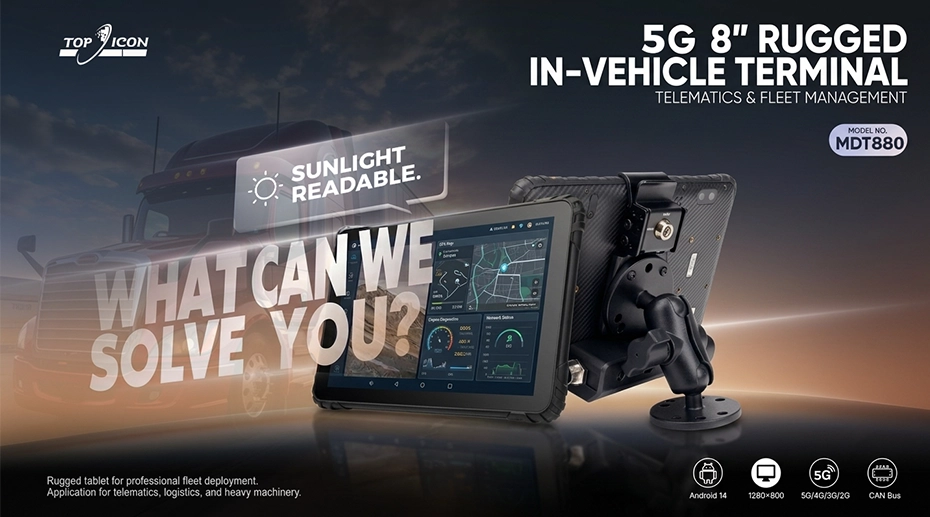
TOPICON provides white-label rugged tablets with custom I/O, pre-loaded software, and full OEM branding — so you can sell a complete solution under your own name, without building a hardware company.