When to Choose Fixed Vehicle Terminals vs Docked Tablets – An Engineering Decision Guide
The choice between a permanently installed vehicle terminal and a docked tablet is not about which device is better. It is about which architecture matches the vehicle's operational profile — vibration exposure, maintenance access, connector reliability, and whether the device ever needs to leave the cab. Here is how to make that decision based on engineering criteria, not marketing claims.
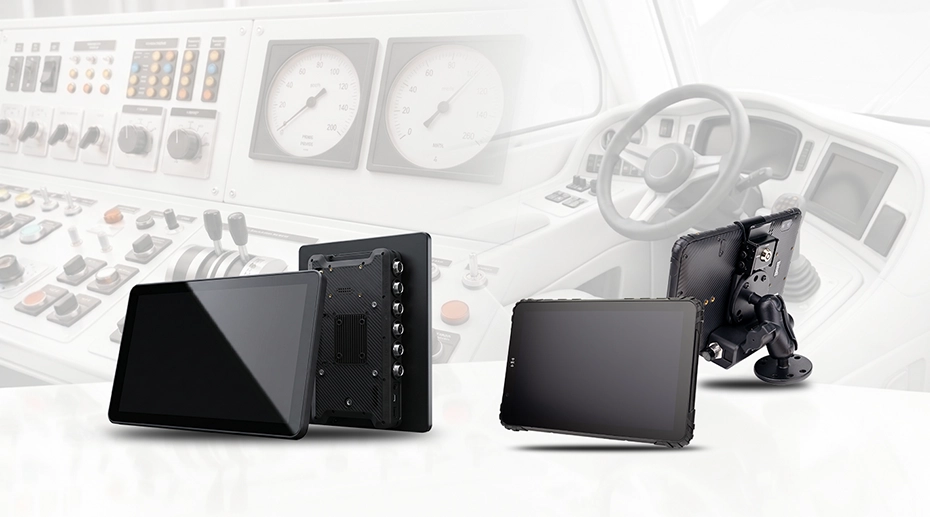
Table of Contents
Two Architectures, Two Engineering Philosophies
Every vehicle computing deployment starts with the same question: should the device be permanently installed, or should it dock and undock? The answer determines the connector type, the power management strategy, the mounting hardware, and the expected maintenance interval. Getting it wrong means replacing hardware prematurely — or worse, discovering the failure during operation.
The two architectures are not competing products. They are different solutions for different operational constraints. A mining haul truck that runs 20 hours a day on unpaved roads has fundamentally different requirements from a delivery van where the driver changes at every shift. The device that works perfectly in one environment will fail prematurely in the other — not because either device is poorly designed, but because the architecture was matched to the wrong operational profile.
Fixed Vehicle Terminal
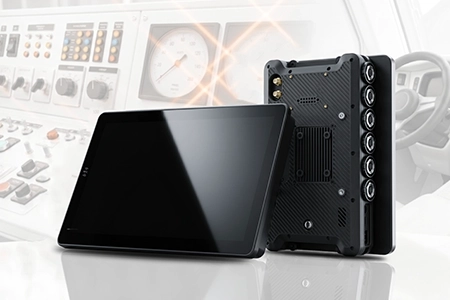
Physical architecture: The terminal is bolted to a VESA mount, a RAM mount that is tightened once and never adjusted, or a panel cutout. All cables connect via aviation connectors (M9, GX16, or M12) with threaded locking rings. Once installed, the device is never removed outside of scheduled maintenance — which may be years apart.
Connector philosophy: Every connection is permanent. Power, CAN Bus, RS232, Ethernet — each on a dedicated threaded connector that maintains constant contact pressure regardless of vibration amplitude. No connector can work loose. No connector can be accidentally disconnected. The wiring harness becomes part of the vehicle.
Typical deployment: Bus consoles, mining trucks, train cabs, industrial control cabinets, agricultural machinery dashboards.
Docked Tablet
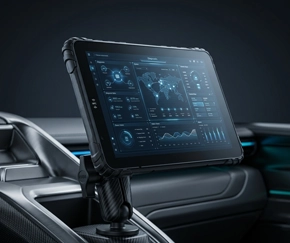
Physical architecture: A docking station is permanently installed in the vehicle — wired to power, CAN Bus, and external antennas. The tablet snaps into the dock via pogo-pin contacts and can be removed with one hand in under a second. The vehicle interface is handled by the dock. The tablet itself is a standard rugged device that can be used handheld when undocked.
Connector philosophy: The vehicle-facing connections — power, CAN Bus, antennas — are permanent and wired to the dock. The tablet-to-dock interface uses pogo-pin contacts rated for 10,000+ mating cycles. USB ports on the tablet are used only when undocked, for occasional peripheral connections.
Typical deployment: Truck fleets with shift changes, delivery vans requiring off-vehicle signature capture, forklifts where the tablet serves double duty as a handheld scanner, field service vehicles.
Key takeaway: The decision between fixed and docked is not about device quality. It is about matching the connector architecture to the vehicle's vibration profile, the operator's workflow, and the maintenance access window. Choose wrong, and the best tablet on the market will fail within months — not because of the tablet, but because of the connector. Explore vehicle mount terminal solutions →
When to Choose a Fixed Vehicle Terminal
Four conditions where a permanently installed terminal with aviation connectors is the correct engineering decision
1. Sustained High-Amplitude Vibration
Vehicles: Mining haul trucks, excavators, bulldozers, tracked vehicles, concrete mixer trucks.
Why fixed: These vehicles produce continuous broadband vibration from engines, drivetrains, and road/terrain interaction — not occasional bumps, but sustained vibration across 5-500Hz for 20+ hours per day. Under these conditions, pogo-pin contacts experience micro-motion that produces fretting corrosion over months. USB connectors — even ruggedized versions — fail within weeks. Threaded aviation connectors (M9/M12) maintain constant contact pressure regardless of vibration amplitude. The connector becomes part of the wiring harness, not a separable interface.
Failure consequence: A connector failure in a mining truck means the vehicle operates without telemetry for 200+ hours until the next maintenance window — creating gaps in production data that distort shift reports and mask equipment degradation.
2. No Maintenance Window
Vehicles: Long-haul trucks on multi-week routes, remote mining equipment, offshore platform vehicles, pipeline inspection vehicles.
Why fixed: When the vehicle operates continuously with scheduled maintenance only every 200-500 operating hours, any component that might need attention between scheduled intervals is a liability. A docked tablet that needs to be reseated, a USB cable that needs to be reconnected, a pogo-pin contact that needs cleaning — these are not possible when the nearest technician is 500 kilometers away. A fixed terminal with threaded connectors is designed to operate without any physical intervention between major service intervals.
Failure consequence: An inaccessible vehicle with a loose connector will operate without telemetry for the entire interval between maintenance windows — potentially weeks.
3. Public-Facing or Tamper-Prone Installation
Vehicles: Public transit buses, train cabs, passenger information displays, fare collection terminals, shared fleet vehicles.
Why fixed: A docked tablet can be removed in seconds — by the operator, by a passenger, by anyone with access to the vehicle cabin. For public-facing installations, this creates a theft and vandalism risk. A fixed terminal bolted to a VESA mount or panel cutout requires tools and deliberate effort to remove. For regulated environments (public transit, emergency vehicles), tamper-proof installation is often a compliance requirement — not a preference.
Failure consequence: A stolen or vandalized tablet in a public-facing installation creates a service gap and a replacement cost — and if the installation is repeated, a recurring operational expense.
4. Multiple Permanently Connected Peripherals
Vehicles: Concrete mixer trucks with PLC controllers, refrigerated trailers with continuous temperature monitoring, waste management trucks with onboard weighbridges, utility vehicles with multiple diagnostic sensors.
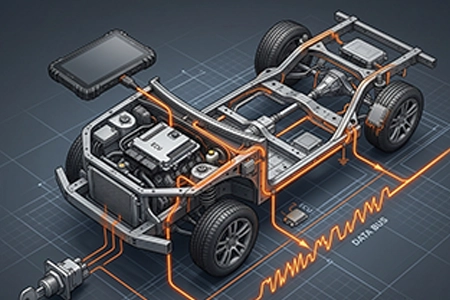
Why fixed: When the terminal must maintain permanent connections to multiple peripherals — a CAN Bus line to the engine ECU, an RS232 line to a weighbridge, an RS485 line to a temperature probe, an Ethernet line to a camera system — each of those connections is a potential failure point. A fixed terminal with aviation connectors consolidates all interfaces into threaded, sealed connections that are part of the vehicle wiring harness. A docked tablet routes some of these through pogo-pin contacts — which adds a separable interface for each signal. For multi-peripheral installations, every additional separable interface multiplies the probability of connection failure.
Failure consequence: A single loose peripheral connection — a temperature probe that disconnects, a weighbridge that stops reporting — can render the entire telemetry dataset unreliable. Spec a CAN Bus telematics tablet →
When to Choose a Docked Tablet
Four conditions where a docked tablet with pogo-pin charging is the correct engineering decision
1. The Device Must Leave the Vehicle Regularly
Workflows: Delivery drivers capturing signatures at the doorstep, field service technicians performing inspections away from the vehicle, forklift operators scanning barcodes on foot, shift-change handovers where the tablet accompanies the driver.
Why docked: A fixed terminal cannot leave the vehicle. If the workflow requires off-vehicle data entry, signature capture, barcode scanning, or inspection documentation, the device must be removable. A docked tablet provides exactly this: secure vehicle integration when docked, full handheld functionality when undocked. The same device serves both roles — eliminating the need for two separate devices (a fixed terminal in the cab and a handheld for field use).
Operational benefit: One device per operator, not two. Lower inventory, simpler MDM management, consistent user experience.
2. Moderate Vibration Environment
Vehicles: Delivery vans, light commercial trucks, forklifts, field service pickups, taxi/ride-hail vehicles.
Why docked: These vehicles experience vibration — all vehicles do — but not the sustained high-amplitude vibration of mining equipment or unpaved road operations. Pogo-pin contacts are engineered for exactly this environment: 10,000+ mating cycles with consistent contact pressure under moderate vibration. In these conditions, pogo-pin docks operate reliably for years without contact degradation. The convenience of one-hand dock/undock outweighs the marginal reliability gain of threaded connectors — because the reliability gain in this vibration regime is marginal, not essential.
Engineering principle: Choose the connector reliability level that matches the environment. Over-engineering adds cost without operational benefit.
3. The Tablet Doubles as a Handheld Tool
Workflows: Warehouse forklift operators who undock to scan pallet barcodes, construction site supervisors who carry the tablet for inspection walkthroughs, agricultural equipment operators who check field data on foot.
Why docked: These workflows use the same device in two modes: vehicle-mounted (for navigation, telemetry, dispatch) and handheld (for scanning, inspection, data entry). A fixed terminal cannot serve the handheld mode. A docked tablet serves both — and the operator only needs to learn one device, one OS, one application set. This reduces training time, simplifies IT support, and eliminates the "which device do I use for which task" confusion.
Operational benefit: Single device, dual role. The dock handles vehicle integration. The tablet handles both in-cab and out-of-cab tasks.
4. Fleet Flexibility and Device Reuse
Scenarios: Mixed fleets where tablets rotate between vehicles, seasonal operations where devices are redeployed, rental/leased vehicle fleets where the hardware stays with the operator, not the vehicle.
Why docked: A fixed terminal is married to the vehicle — removing it requires tools, time, and reinstallation. A docked tablet can be moved between vehicles in seconds, as long as each vehicle has a compatible dock installed. This enables device pooling, seasonal redeployment, and operator-assigned hardware strategies that are impractical with fixed terminals. For system integrators managing multiple client fleets, docked architecture simplifies hardware logistics.
Operational benefit: Hardware follows the operator or the project — not the vehicle. Lower total hardware count across the fleet.
Decision Matrix: Fixed Terminal or Docked Tablet
If you answer "yes" to three or more questions in a column, that architecture is the correct engineering choice for your deployment.
Recommended Hardware for Each Architecture
TOPICON platforms purpose-built for fixed installation and docked deployment
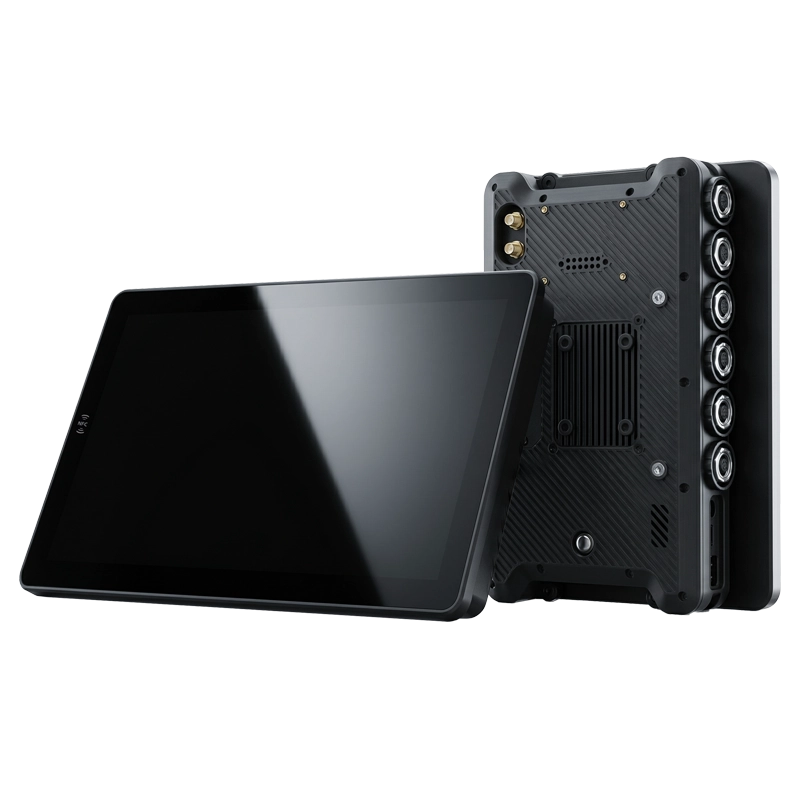
PC1080
8" Android Panel PC · 6× M9 Aviation Connectors · VESA mount
✓ 6× M9: Power · USB · RS232 · RS485 · CAN · Ethernet
✓ 4G · WiFi · GPS · LTE-M · GPIO
✓ Threaded connectors — permanent installation
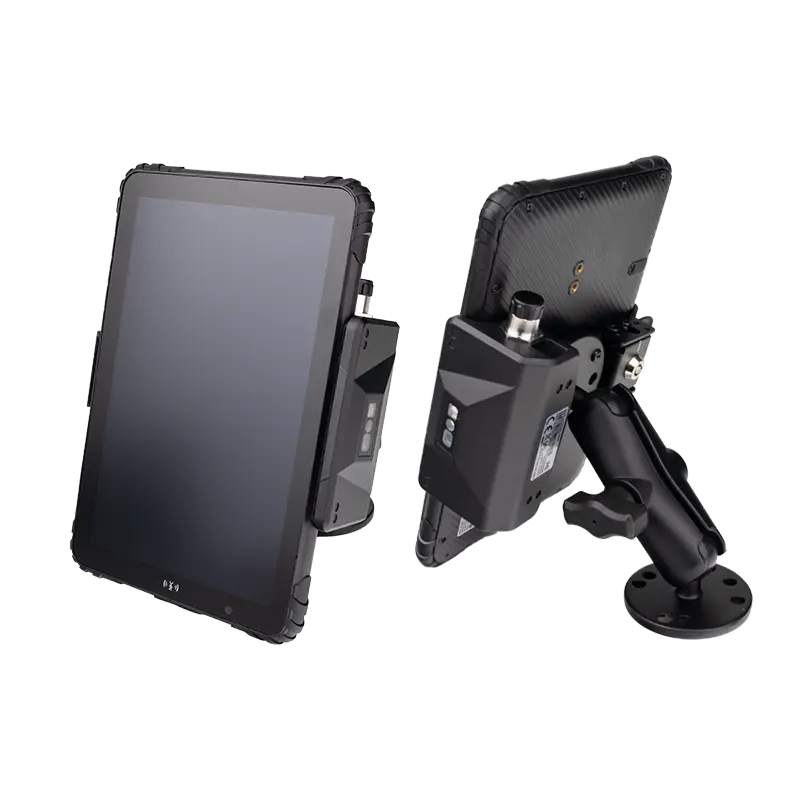
MDT865
8" Rugged Tablet · Vehicle Dock with Pogo-Pin
✓ Dual CAN Bus · 4G LTE · GPS
✓ 9-36V power via dock · ignition sensing
✓ One-hand dock/undock — 10,000+ cycles
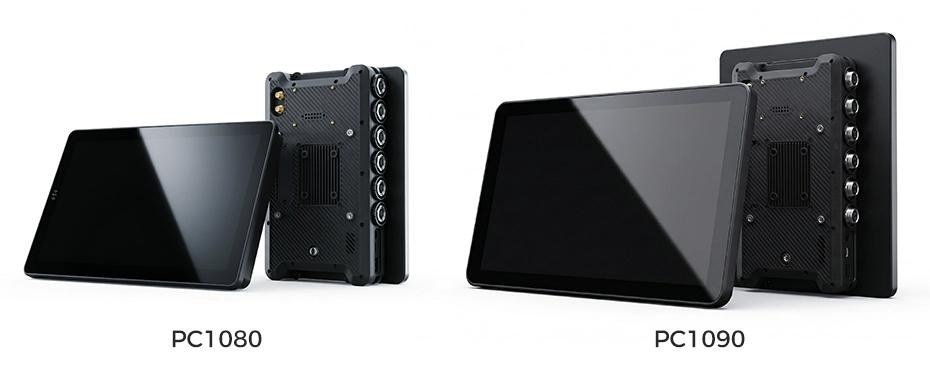
PC1080 and PC1090 are fixed-mount Panel PCs with M9 aviation connectors — built for permanent installation. MDT865 and MDT880 use docked architecture — built for vehicles where the tablet must undock regularly. Explore all vehicle mount terminals →
Frequently Asked Questions
Can I mix fixed terminals and docked tablets in the same fleet?
Yes — and this is common. A mining fleet might deploy fixed PC1080 terminals on haul trucks (permanent, high-vibration) and docked MDT865 tablets on supervisor vehicles (moderate vibration, occasional undocking for inspections). Both run Android OS with the same MDM and SDK — one management platform for the entire mixed-architecture fleet.
Does a fixed terminal support CAN Bus and RS232 like a docked tablet?
Yes. PC1080 and PC1090 fixed terminals provide the same interfaces — CAN Bus, RS232, RS485, USB, Ethernet — through M9 aviation connectors rather than through a dock. The difference is in the connector type and the installation architecture, not in the data interfaces available. Explore CAN Bus telematics →
How long does it take to install a fixed terminal vs a docked tablet?
A docked tablet installation typically takes 1-2 hours — mount the dock, connect power and antennas, insert the tablet. A fixed terminal installation takes longer — 2-4 hours — because each M9 connector must be threaded and torqued, and the VESA mount must be precisely positioned. However, the fixed terminal will not need to be touched again for years. The docked tablet may need occasional reseating or cleaning of pogo-pin contacts.
Can a fixed terminal be upgraded without replacing the entire unit?
Currently, fixed terminals are self-contained units — upgrading the computing platform means replacing the terminal. However, the M9 wiring harness remains in place. A future terminal with the same M9 pinout can be swapped in without rewiring the vehicle. This is one of the advantages of aviation connectors: the vehicle wiring is independent of the terminal generation.
Can I get OEM customization for either architecture?
Yes. Both fixed terminals and docked tablets support full OEM customization — custom I/O pinout, white-label branding, pre-loaded software, and MDM pre-enrollment. The customization scope is the same for both architectures. Start your OEM terminal project →
Related Vehicle Computing Resources
Vehicle Mount Terminals →
Fixed and docked vehicle computing platforms
Aviation Connectors vs USB →
Why M9 connectors replace USB in fixed terminals
Vehicle Mount Tablets →
Docked tablet solutions with pogo-pin charging
RS232 in Fleet Telematics →
5 applications where serial still matters
Ground Loops & CAN Bus →
How electrical noise corrupts vehicle data
OEM Hardware Customization →
Custom I/O for your vehicle terminal project
Deploying Vehicle Terminals — Fixed or Docked?
TOPICON provides both fixed Panel PCs with M9 aviation connectors and docked rugged tablets with pogo-pin charging — one Android platform, two architectures, full OEM customization.