RS232 in Fleet Telematics – 5 Applications Where Serial Still Matters
RS232 is a 60-year-old serial communication standard. In an era of 5G, CAN Bus, and Bluetooth, why are fleet telematics providers still specifying it for new deployments? Because serial does five things in vehicle environments that newer protocols cannot — or cannot do reliably enough for industrial operations. Here's where RS232 still matters, and why removing it from your hardware specification is a larger risk than keeping it.
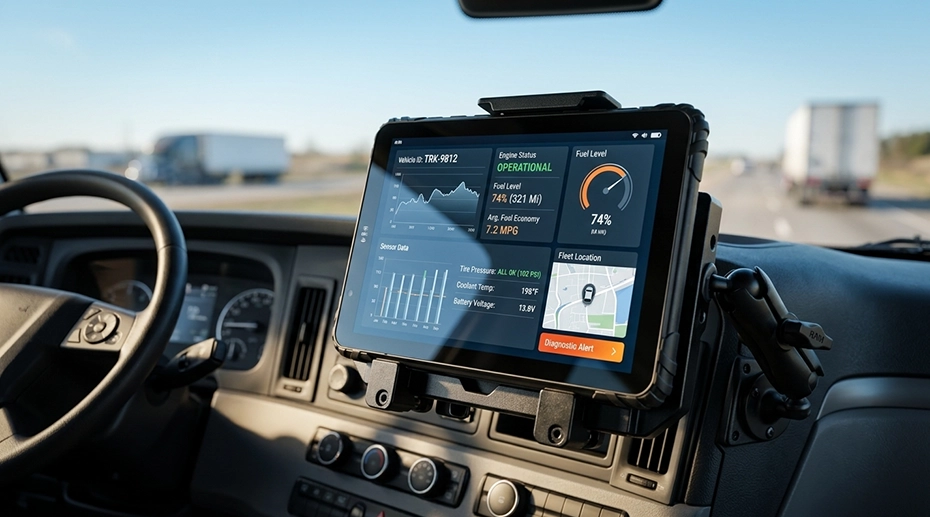
Table of Contents
The Serial Port That Refuses to Die
RS232 was introduced in 1960. It predates the internet, mobile phones, and most of the semiconductor industry. By every measure of technological progress, it should have been retired decades ago. Yet walk into any fleet maintenance depot, any logistics hub, any agricultural equipment dealer — and you will find RS232 ports on equipment that was manufactured last year.
This is not inertia. It is not resistance to change. RS232 persists in fleet telematics because it solves a specific set of engineering problems that newer protocols — USB, Bluetooth, even CAN Bus — solve differently, and sometimes inadequately, in the vehicle environment.
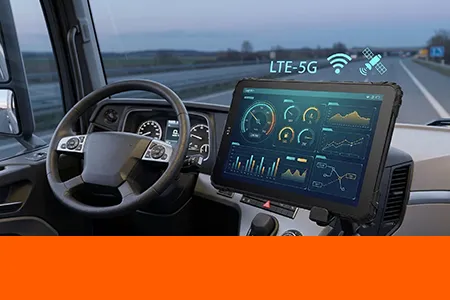
A USB connection to a weighbridge fails when the cable works loose from vibration. A Bluetooth connection to a temperature sensor drops when the trailer blocks line-of-sight. A CAN Bus network requires every device to speak the same protocol. RS232 does none of these things. It is point-to-point, unencrypted, electrically simple, and deterministic — characteristics that become advantages, not limitations, when the application is a fixed connection between a vehicle computer and a single peripheral that must work every time, for years, without intervention. For an in-vehicle computing terminal tasked with aggregating data from multiple sensors, a dedicated RS232 channel often forms the backbone of peripheral connectivity.
Key takeaway: RS232 survives not because fleet operators are conservative, but because the physical and electrical characteristics of serial communication — deterministic timing, point-to-point topology, noise immunity through voltage swing — remain uniquely suited to specific vehicle integration tasks that newer protocols handle poorly or not at all.
RS232 Telematics Communication Architecture
Standard DB9 Serial Cross-Connection for Reliable Vehicle Data Exchange
Topicon Rugged MDT
Master Device (DTE) Pin 3: TXD (Transmit) Pin 2: RXD (Receive) Pin 5: GND (Ground) |
Serial Data Out ──▶
◀── Serial Data In
◀── Signal Ground ──▶ |
Vehicle Peripherals
Slave Sensors (DCE) RXD: Connects to Pin 3 TXD: Connects to Pin 2 GND: Connects to Pin 5 |
1. Legacy Vehicle Data Interfaces — J1708, J1587, and Pre-CAN Fleets
Not every vehicle speaks CAN Bus. For mixed fleets with older equipment, RS232 is not optional — it is the only available data interface.
The Problem
Heavy-duty trucks and buses manufactured before 2010, and many specialty vehicles manufactured well into the 2010s, use SAE J1708/J1587 protocols — serial communication standards that run over RS232/RS485 physical layers. These vehicles do not have a standard OBD-II CAN Bus connector. Their engine ECUs, transmission controllers, and ABS modules communicate over serial lines. A telematics device without RS232 cannot read data from these vehicles at all — there is no adapter, no gateway, no workaround.
The Solution
RS232 ports on the MDT connect directly to the vehicle's J1708 data bus via a simple level converter. The MDT reads engine RPM, coolant temperature, fuel rate, and fault codes directly from the serial data stream — the same data that CAN Bus provides on newer vehicles, accessed through a different physical layer. For mixed fleets with both pre-2010 and post-2010 equipment, a single MDT with both CAN Bus and RS232 can interface with every vehicle in the fleet without requiring different hardware for different vehicle vintages.
Why it matters: Municipal bus fleets, school bus operators, and military vehicle pools routinely operate vehicles spanning 15-20 model years. A telematics hardware platform that cannot interface with the older half of the fleet creates a data gap that undermines the entire fleet management system. RS232 closes that gap. Compare CAN Bus vs RS232 for mixed fleets →
2. Specialized Peripherals — When USB and Bluetooth Are the Wrong Answer
Thermal printers, weighbridges, barcode scanners, temperature probes — these devices speak RS232 natively. Connecting them via USB adds failure points, not functionality.
Thermal Printers
Delivery fleets print receipts and waybills at the point of delivery. Thermal printers in vehicle cabs use RS232 — not USB — because the serial connection is deterministic: the printer receives exactly the data it expects, in the order it expects, without USB handshaking delays. A USB printer in a vibrating vehicle cab disconnects and reconnects unpredictably. RS232 does not.
Weighbridges & Load Cells
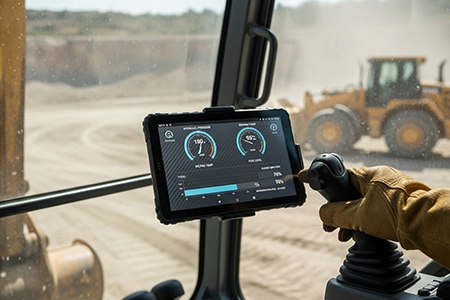
Quarries, waste management, and agricultural operations use onboard weighbridges to measure payload weight. These systems output RS232 serial data — continuous weight readings at fixed intervals. Connecting via USB-to-serial converter adds a failure point at the converter itself. A native RS232 port on the MDT eliminates that failure point and reads the data stream directly.
Temperature & Environmental Sensors
Cold chain logistics requires continuous temperature monitoring inside refrigerated trailers. The temperature probes connect via RS232 to the in-cab MDT. The serial connection provides continuous data without pairing, without signal loss through the trailer wall, and without battery changes. It is a permanent wired connection — which is exactly what compliance-grade temperature monitoring requires.
Engineering principle: RS232 is the common language of industrial peripherals. These devices were designed with serial interfaces because serial is simple, reliable, and electrically robust. Connecting them via USB or Bluetooth introduces protocol conversion, driver dependencies, and additional failure modes that the original equipment was not designed to handle. For fleet operators building a reliable fleet telematics platform, native RS232 ensures these devices stay online shift after shift.
3. Industrial Protocol Bridge — Modbus RTU, PLC Communication, and Machine Control
Fleet vehicles that operate as mobile industrial equipment need to talk to industrial controllers — and industrial controllers speak Modbus over RS232 or RS485.
The Problem
Concrete mixer trucks, crane trucks, vacuum tankers, and mobile pumping units are not just vehicles — they are industrial machines with PLCs (Programmable Logic Controllers) that control the equipment on the truck. These PLCs communicate via Modbus RTU over RS232 or RS485. They do not speak CAN Bus. They do not have USB ports. Connecting a telematics system to these machines requires a serial interface that can speak the industrial protocol directly — or the telematics data from the machine simply does not exist.
The Solution
An MDT with RS232/RS485 ports can function as a protocol bridge: reading Modbus RTU data from the PLC over serial, translating it into structured telematics data, and transmitting it to the fleet management platform over 4G/5G. The MDT becomes the interface between the industrial machine and the cloud — a role that requires the physical serial connection to exist. No serial port, no bridge.
4. External GPS/GNSS Receivers — Precision Positioning via Serial
When meter-level accuracy isn't enough, external GNSS receivers provide centimeter-level positioning — and they output NMEA sentences over RS232.
The Problem
Built-in GNSS receivers in most tablets provide 2-5 meter accuracy — adequate for fleet tracking and navigation. Precision agriculture, autonomous mining haul trucks, and survey vehicles require sub-meter or centimeter-level positioning. These high-precision GNSS receivers — from Trimble, NovAtel, Septentrio, and others — output position data as NMEA 0183 sentences over RS232. They do not output over USB. They do not output over Bluetooth in a vehicle environment where the receiver is mounted on the roof and the MDT is in the cab.
The Solution
An RS232 port on the MDT connects directly to the external GNSS receiver via a shielded serial cable. The MDT reads the NMEA data stream at the baud rate configured on the receiver — typically 115,200 bps — and processes the position data locally or forwards it to the fleet management platform. The serial connection is permanent, wired, and immune to the interference that degrades Bluetooth signals in metal vehicle cabins.
5. CAN Bus Redundancy — When Serial Backs Up the Primary Data Link
In mission-critical telematics, a single data path is a single point of failure. RS232 provides a parallel path that keeps data flowing when CAN Bus goes down.
The Problem
CAN Bus is the primary vehicle data interface in modern fleets — but it is not infallible. CAN Bus transceivers can fail. CAN Bus wiring can be damaged during vehicle maintenance. CAN Bus networks can be taken offline by a single malfunctioning ECU. For emergency vehicles, mining equipment, and hazardous material transporters, losing vehicle data during operation is not acceptable — the telematics system must maintain data continuity regardless of CAN Bus status.
The Solution
An MDT equipped with both CAN Bus and RS232 can be configured for data path redundancy. Critical vehicle parameters — engine hours, vehicle speed, odometer — are read from CAN Bus as the primary source and simultaneously from J1708 serial as the backup. If CAN Bus communication is lost, the MDT automatically fails over to the serial data stream. When CAN Bus is restored, the primary path resumes. The operator never sees a data gap.
Why this matters: Data path redundancy is standard engineering practice in aviation, military, and industrial control systems. Fleet telematics — particularly for emergency services and hazardous materials — increasingly adopts the same principle. RS232 provides that redundant path at near-zero additional cost when the MDT already includes the port. Deploy a rugged MDT with dual‑path data redundancy →
RS232-Equipped Hardware for Fleet Telematics
TOPICON MDT platforms with native RS232/RS485 for vehicle integration and peripheral connectivity
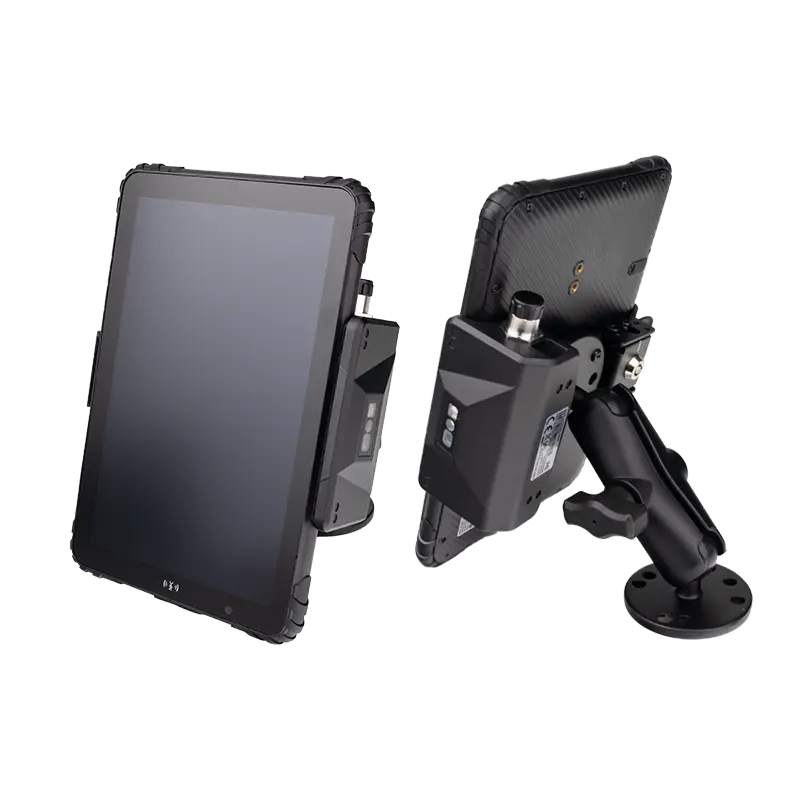
MDT865
8" Rugged Tablet · Docked Architecture
✓ CAN Bus · 4G LTE · GPS
✓ 9-36V power · IP67 · MIL-STD-810G
✓ Android 12/14
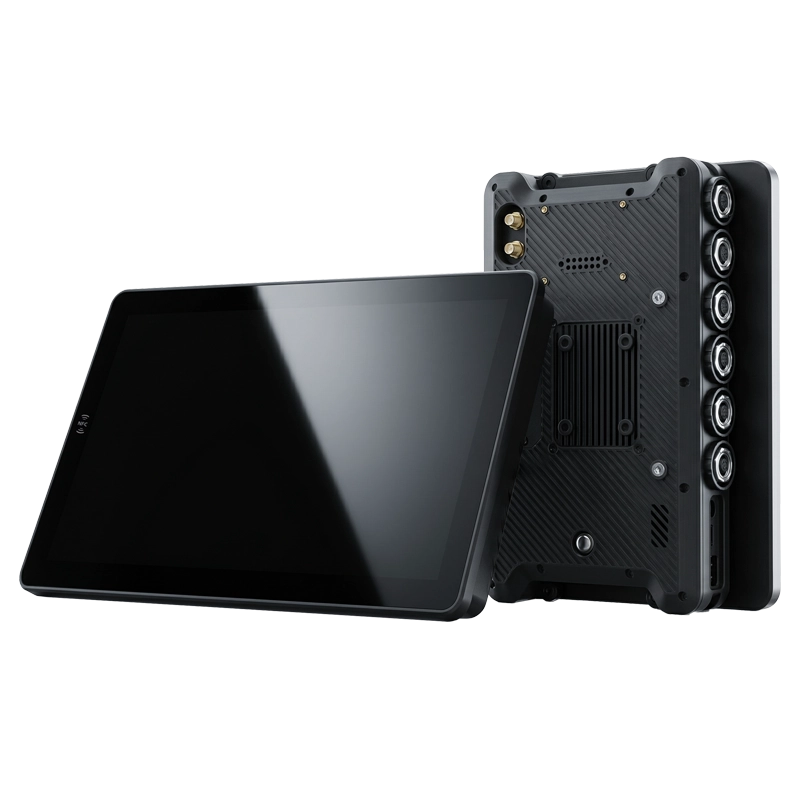
PC1080
8" Android Panel PC · Fixed Architecture
✓ CAN Bus · USB · Ethernet · GPIO
✓ 4G · WiFi · GPS · LTE-M
✓ Android 16 · VESA Mount · IP67
MDT865 uses docked architecture with RS232 via the vehicle cradle — suitable for trucks, delivery vans, and forklifts. PC1080 is a fixed-mount Panel PC with RS232/RS485 on M9 aviation connectors — built for permanent installation in buses, mining equipment, and industrial machinery. Explore all RS232 tablet solutions →
Frequently Asked Questions
Why not just use a USB-to-serial adapter instead of native RS232?
USB-to-serial adapters introduce three failure points: the USB connector itself (friction-fit, no locking), the adapter chip (susceptible to electrical noise and driver issues), and the serial connector at the adapter output. In vehicle environments with sustained vibration, these adapters fail within months. Native RS232 ports eliminate all three failure points — the serial connection is direct from the MDT's UART to the peripheral, with no intermediate components. Configure a rugged vehicle terminal with native RS232 →
How do RS232 and CAN Bus work together in a fleet MDT?
They serve different purposes on the same device. CAN Bus reads vehicle engine and chassis data. RS232 connects to peripherals — printers, weighbridges, external GPS receivers, and legacy vehicle data buses (J1708). They are not alternatives; they are complementary interfaces that together provide complete vehicle connectivity. Compare CAN Bus vs RS232 →
What is the difference between RS232 and RS485 for fleet applications?
RS232 is point-to-point — one device connects to one peripheral over shorter distances (up to 15 meters). RS485 is multi-drop — multiple devices can share the same bus over longer distances (up to 1,200 meters). For connecting a single printer, weighbridge, or GPS receiver in a vehicle cab, RS232 is the simpler and more common choice. For connecting multiple sensors across a trailer or tanker, RS485 is preferred. TOPICON MDTs support both protocols.
Can RS232 connect to multiple devices simultaneously?
Not directly. RS232 is a point-to-point protocol — one transmitter, one receiver per port. To connect multiple RS232 devices, the MDT needs multiple RS232 ports. TOPICON MDTs provide dual RS232 channels through the vehicle dock or M9 connectors, allowing simultaneous connection to two independent serial peripherals.
Can you customize the RS232 baud rate and pinout for specific peripherals?
Yes. TOPICON provides OEM customization for RS232 baud rates (from 300 bps to 921,600 bps), custom pinout configurations, and pre-configured serial settings matching your specific peripheral requirements. Start your RS232‑enabled OEM project →
Related Serial & Vehicle Integration Resources
RS232 Tablet Solutions →
Explore RS232-equipped rugged tablets
CAN Bus vs RS232 →
Which communication protocol for vehicle telematics
Aviation Connectors vs USB →
Why M9 connectors replace USB in fixed terminals
CAN Bus Telematics →
Hardware-level CAN Bus for fleet data logging
Vehicle Mount Terminals →
Fixed and docked vehicle computing platforms
OEM Hardware Customization →
Custom RS232 pinout for your peripherals
Deploying Fleet Telematics with Serial Peripherals?
TOPICON MDTs feature dual native RS232/RS485 ports — built for printers, weighbridges, GPS receivers, and legacy vehicle data buses without USB adapters or external gateways.
```