```html
Mining Vehicle Computer Guide – Rugged Computing for Surface & Underground Operations
A haul truck spends 20 hours a day on unmaintained roads, vibrating at frequencies that loosen connectors, fatigue solder joints, and degrade unsealed electronics within months. A consumer tablet lasts weeks. A standard rugged tablet lasts months. A purpose-built mining vehicle computer with aviation connectors, isolated power, and sustained vibration certification lasts years — which is the minimum acceptable lifespan when a single day of downtime costs more than the hardware.
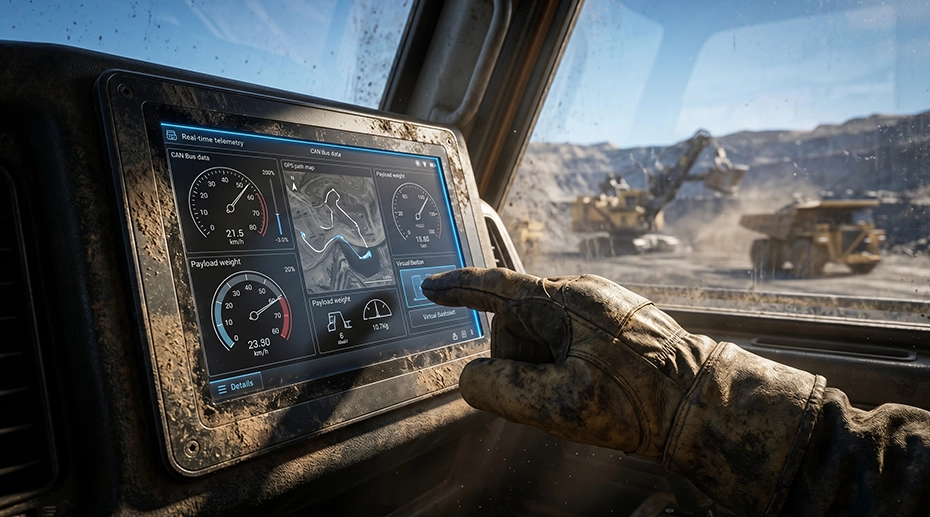
Table of Contents
Why Mining Needs Purpose-Built Vehicle Computers
A surface mine operates 24 hours a day, 365 days a year. Haul trucks carry 300-ton payloads over roads that are graded but unpaved. The vibration is continuous — not occasional bumps, but a sustained broadband frequency spectrum from engine, drivetrain, and road surface interaction. Underground, the environment adds high humidity, corrosive dust, and confined spaces where maintenance access is measured in minutes per week.
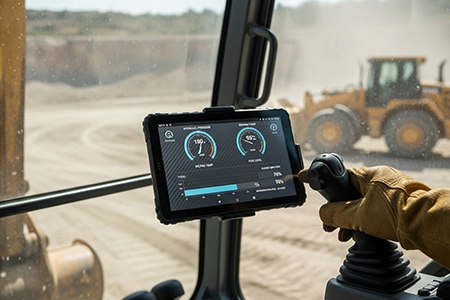
In this environment, a computing device is not a convenience. It is the interface between the operator and the mine's fleet management system — providing haul route navigation, equipment health telemetry, payload monitoring, and safety alerts. If it fails, the vehicle continues to operate, but the mine loses visibility. Production data stops. Predictive maintenance goes blind. Safety systems lose their in-cab display.
A consumer tablet in a protective case fails within weeks. The vibration transmits through the case to the device. The battery swells from heat trapped by the enclosure. The USB port wears from the single cable that carries power and data. A standard rugged tablet lasts longer — months, not weeks — but its connectors are still USB, its vibration certification is tested to generic MIL-STD profiles rather than sustained mining equipment profiles, and its internal components are secured with the same methods used for tablets that operate in delivery vans and forklifts, not 300-ton haul trucks.
Key takeaway: Mining vehicle computers are a separate hardware category. They are distinguished not by faster processors or brighter screens, but by connector architecture, vibration certification methodology, power isolation design, and thermal management engineered for sustained extreme conditions — not occasional exposure.
Key Hardware Requirements for Mining Vehicle Computers
What separates a mining-grade vehicle computer from a standard rugged tablet

1. Sustained Vibration Resistance
MIL-STD-810G/H certification is the baseline — but mining applications require sustained vibration profiles that exceed typical MIL-STD test durations. Look for equipment certified to operate continuously at vibration levels matching haul truck, excavator, and drill duty cycles — 5-500Hz broadband with resonance dwell testing, not a single-axis shock test.
2. Aviation Connectors — M9/M12
USB connectors are the single most common failure point in mining vehicle installations. Threaded aviation connectors (M9, GX16, M12) maintain constant contact pressure regardless of vibration amplitude. They are IP67 sealed, rated for 10,000+ cycles, and integrate cable strain relief. Learn more: M9 connectors explained →

3. IP67/IP68 Dustproof Sealing
Mining dust is not ordinary dust — it is fine, abrasive, often conductive (coal dust, metallic particles). IP67 provides dust-tight sealing and protection against water immersion. For underground operations with high humidity and potential water exposure, IP68-rated devices provide additional protection against continuous immersion.

4. Wide Temperature (-30°C to 70°C)
Surface mines in northern latitudes operate at -30°C in winter. Engine bays and sun-exposed cabins reach 70°C in summer. Consumer electronics fail at both extremes. Mining vehicle computers use industrial-rated components, passive cooling, and wide-temperature LCD panels that function across the full range without performance degradation.

5. CAN Bus + J1939 for Equipment Telematics
Modern mining equipment generates continuous CAN Bus data — engine load, hydraulic pressure, brake wear, tire temperature, payload weight. The vehicle computer must interface directly with these networks via isolated CAN Bus controllers. J1939 compatibility ensures data interoperability across mixed fleets of Caterpillar, Komatsu, Hitachi, and Liebherr equipment. Explore CAN Bus telematics →

6. 24/7 Power System with Surge Protection
Mining equipment electrical systems are harsh — voltage spikes from starter motors, load dumps from alternators, and sustained brownouts during heavy equipment startup. The vehicle computer must accept 9-36V DC input with isolation, surge suppression, and ignition sensing. It must survive continuous power-on for weeks without reboot — because the maintenance window may not come for another 200 operating hours.
The Real Risk: When the Vehicle Computer Fails, the Mine Loses Visibility
A haul truck keeps running. But the mine's fleet management system loses an eye — and that blind spot compounds by the hour.
Payload Data Goes Missing
Every haul truck cycle unmeasured is production unaccounted. Over a 12-hour shift, a failed vehicle computer creates gaps in payload records that distort shift production reports, delay billing, and mask underperforming equipment.
Predictive Maintenance Goes Blind
CAN Bus data from engines, hydraulics, and brakes stops flowing. The predictive maintenance system loses input for the hours the computer is down — and the failure it was supposed to predict may occur during those blind hours.
Haul Route Optimization Stops
Real-time dispatch and route optimization rely on continuous data from every vehicle. A single haul truck without a functioning computer degrades the efficiency of the entire fleet — not just that vehicle.
Why it matters: In a mine with 50 haul trucks, a 5% vehicle computer failure rate means 2.5 trucks are invisible to the fleet management system at any given time — every day. The cost is not the hardware replacement. It is the cumulative production data loss across the fleet, compounded by the hours until the next maintenance window.
Fixed vs Docked — Which Architecture for Mining Vehicles
Two installation architectures, two different connector strategies, one engineering principle
Fixed Installation with Aviation Connectors
For: Haul trucks, excavators, drills, draglines — equipment where the computer is permanently installed and never removed.
Connector strategy: M9/M12 aviation connectors with threaded locking. Power, CAN Bus, RS232, Ethernet — each on a dedicated threaded connector. Zero USB ports exposed to vibration. The connectors become part of the vehicle wiring harness.
Typical MTBF: 5-7 years without connector-related failure.
Docked Installation with Pogo-Pin Dock
For: Light support vehicles, supervisor trucks, mobile maintenance vehicles — equipment where the tablet may be undocked for inspections or shift handovers.
Connector strategy: Vehicle interface through pogo-pin docking station (10,000+ cycles, constant contact pressure). USB on tablet used only when undocked.
Typical MTBF: 3-5 years with proper dock maintenance. Explore vehicle mount tablets →
Recommended Vehicle Computers for Mining Operations
TOPICON hardware platforms built for surface and underground mining environments
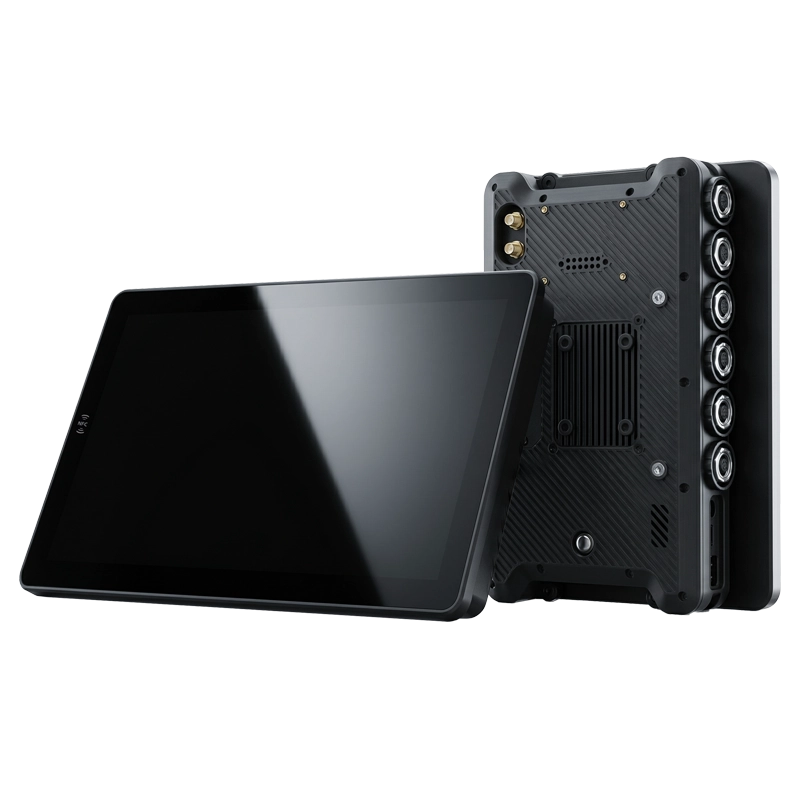
PC1080
8" Android Panel PC · 6× M9 Aviation Connectors
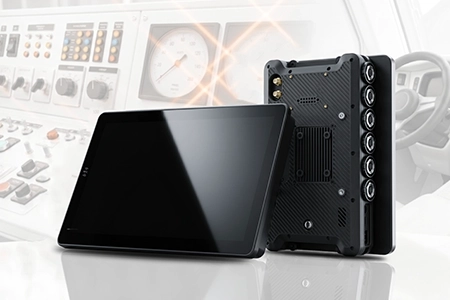
✓ 6× M9: Power · USB · RS232 · RS485 · CAN · Ethernet
✓ 4G · WiFi · GPS · LTE-M · GPIO
✓ VESA Mount · IP67 Sealed
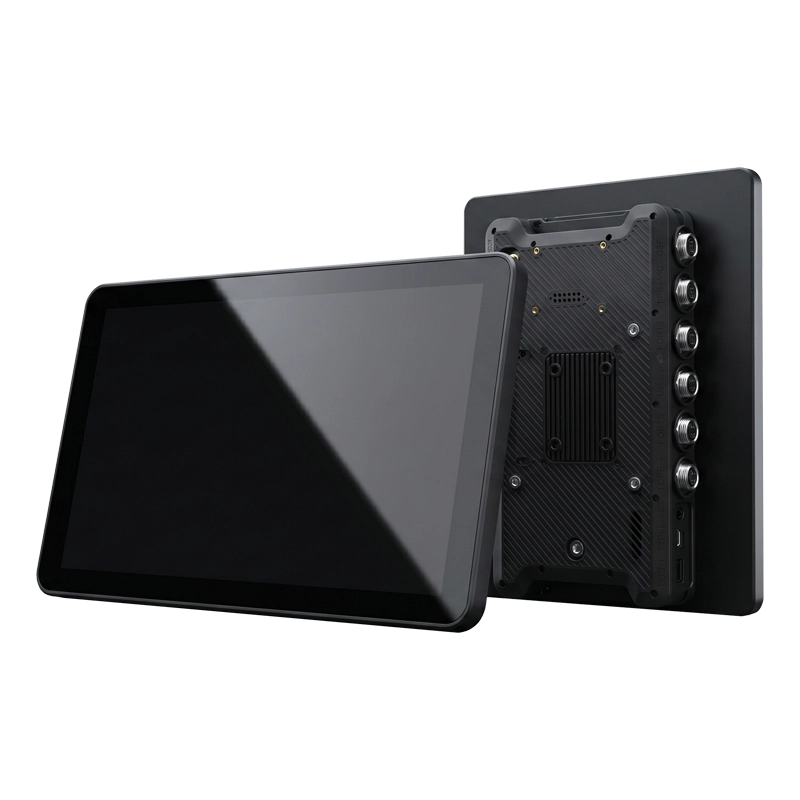
PC1090
10" Android Panel PC · 6× M9 Aviation Connectors
✓ 6× M9: Power · USB · RS232 · RS485 · CAN · Ethernet
✓ 4G · WiFi · GPS · LTE-M · GPIO
✓ VESA Mount · IP67 Sealed
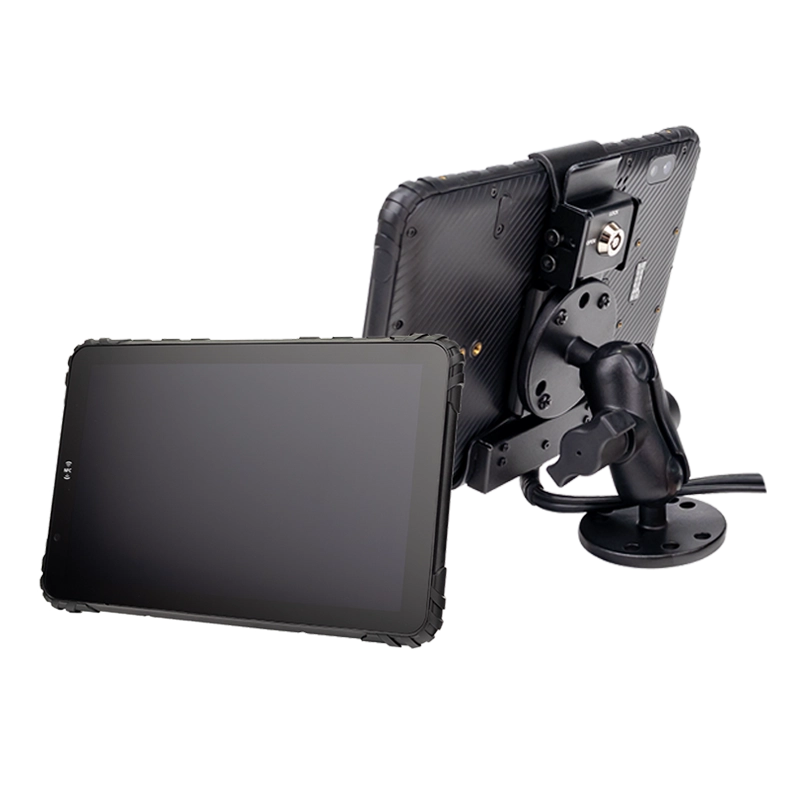
MDT880 5G
8" 5G Fleet Tablet · Docked Architecture
✓ Dual CAN Bus · 4-Ch AHD
✓ MIL-STD-810G certified
✓ Vehicle dock with pogo-pin charging
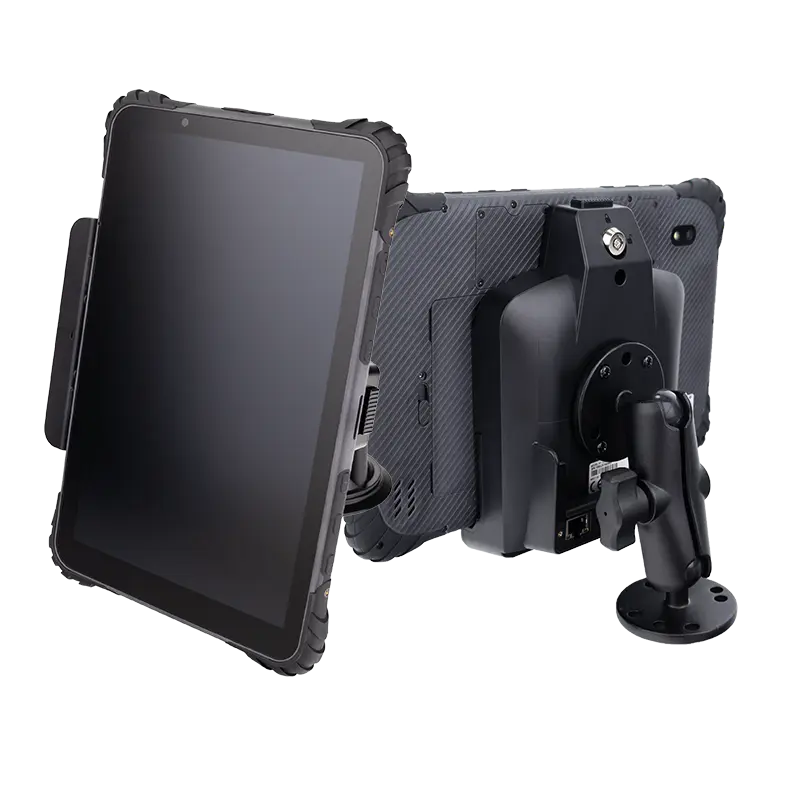
MDT1065
10" Large Screen · Docked Architecture
✓ GPS + 4G LTE + RS232
✓ GPIO + M12 Ethernet
✓ Vehicle dock compatible
PC1080 and PC1090 are fixed-mount Panel PCs with M9 aviation connectors — purpose-built for permanent installation in heavy mining equipment. MDT880 and MDT1065 use docked architecture — suitable for supervisor vehicles and mobile maintenance trucks. View full product line →
OEM Customization for Mining System Integrators
White-label hardware platforms for fleet management and equipment telematics providers
M9 Pinout Customization
Custom M9 connector pinout configured to your equipment telematics system — specific signal assignments for CAN Bus, RS232, GPIO. Pre-wired cable harnesses matching your installation specification.
White-Label Branding
Your company branding on the device, boot screen, and packaging. Your fleet management software pre-installed. No TOPICON branding visible to mine operators or procurement teams.
Pre-Loaded Software & MDM
Your mine management application pre-installed. MDM pre-enrolled. Devices arrive ready for installation — power on, connect to the mine network, start collecting data.
5+ Year Lifecycle
Mining equipment operates on 5-10 year replacement cycles. Stable hardware supply with guaranteed availability — no mid-deployment model changes that force recertification with mine safety systems.
Frequently Asked Questions
Why do standard rugged tablets fail in mining equipment?
Standard rugged tablets are typically tested to MIL-STD-810G/H shock and vibration profiles that simulate occasional impacts — not the sustained, broadband vibration produced by haul truck engines, drivetrains, and unpaved road surfaces operating 20+ hours per day. The connectors (USB) are the most common failure point, followed by internal component fatigue from continuous resonance.
What connector type should a mining vehicle computer use?
Aviation connectors — M9, GX16, or M12 — with threaded locking rings. These connectors maintain constant contact pressure regardless of vibration amplitude and are IP67 sealed against mining dust. USB connectors, even ruggedized versions, are not designed for permanent vehicle installation in high-vibration environments.
Can a mining vehicle computer integrate with Caterpillar, Komatsu, and Hitachi equipment?
Yes, via CAN Bus with J1939 protocol. Modern mining equipment from all major manufacturers provides standard J1939 data interfaces. A mining vehicle computer with isolated CAN Bus controllers can read engine data, hydraulic pressures, payload weights, and diagnostic codes from mixed fleets without manufacturer-specific gateways.
What is the typical lifespan of a mining vehicle computer?
A purpose-built mining vehicle computer with aviation connectors, isolated power, and proper vibration certification should operate for 5-7 years without connector-related or vibration-induced failure. This matches the typical maintenance cycle of the mining equipment it is installed in.
Can the M9 connector pinout be customized for our mine's equipment telematics system?
Yes. TOPICON offers custom M9 pinout configuration for OEM projects — specific signal assignments, pre-wired cable harnesses, and connector layouts matching your telematics system architecture. Contact our OEM team →
Related Mining & Vehicle Computing Resources
Aviation Connectors vs USB →
Why M9 connectors replace USB in fixed terminals
CAN Bus Telematics →
Hardware-level CAN Bus for equipment data logging
Vehicle Mount Terminals →
Fixed and docked vehicle computing platforms
Construction Tablets →
Heavy equipment computing solutions
Ground Loops & CAN Bus →
How electrical noise corrupts equipment data
OEM Hardware Customization →
Custom M9 pinout for mining telematics
Deploying Vehicle Computers in Mining Operations?
TOPICON provides fixed-mount Panel PCs with M9 aviation connectors and docked rugged tablets — built for surface and underground mining environments with CAN Bus telematics, isolated power, and full OEM customization.
```