When Fleet Tablet Batteries Swell — Causes, Prevention & Hardware Specs That Prevent Thermal Runaway
A swollen battery in a vehicle cab is not just a warranty claim — it's a fire hazard that puts drivers at risk and takes vehicles out of service. Here's what causes lithium-ion battery swelling in fleet deployments, how to prevent it through hardware selection, and why fixed vehicle computing solutions with 9-36V direct-wire power eliminate the root cause entirely.

Field Experience
Battery swelling in fleet tablets is rarely a manufacturing defect. It's almost always an installation problem:
Continuous trickle charging while cabin temperatures exceed 60°C
Low-cost pouch cells without pressure relief mechanisms
Missing ignition-sense power that would stop charging when the engine is off
About the Author
TOPICON Hardware Engineering Team
Specialists in vehicle-grade power architecture, lithium-ion battery management for industrial deployments, and rugged tablet hardware engineering for fleet, logistics, and field service applications across extreme thermal environments.
This Is Different from Thermal Shutdown
Before diving into battery swelling, it's important to distinguish it from a related but different problem: thermal shutdown. When a fleet tablet overheats, the SoC throttles performance, the screen may dim or go black, and applications crash — but the device recovers when it cools down. That failure mode is covered in detail in our guide to fleet tablet heat failure and thermal management in vehicle cabs.
Battery swelling is different. It's a chemical reaction — the decomposition of electrolyte inside lithium-ion cells, producing gas that permanently deforms the battery housing. The device doesn't recover. The battery must be replaced. And if a swollen cell is punctured, it can ignite inside a confined vehicle cab. For fleet computing hardware with ignition‑sense power, this failure mode is virtually eliminated by design.
The Problem: A Tablet That No Longer Fits Its Case
A fleet manager opens the truck door on a summer afternoon and finds the in-cab tablet's screen has separated from the housing. The back cover is bulging outward. The device still powers on, but the touchscreen no longer sits flush against the frame — there's a visible gap where gas pressure has pushed the display assembly away from the chassis.
This is lithium-ion battery swelling — a physical deformation caused by gas buildup inside the battery cells. For fleet operators, the consequences are immediate and severe:
Immediate Device Removal
The tablet cannot stay in the vehicle. A swollen lithium battery is chemically unstable and must be removed from the cab immediately for driver safety.
Vehicle Out of Service
No backup device means no ELD logs, no dispatch communication, no proof of delivery capture. The vehicle is effectively grounded until a replacement arrives.
Fire Risk
A punctured swollen cell can vent flammable electrolyte and ignite. In a confined vehicle cab with flammable materials, this is a serious safety hazard.
Root Cause: Why Batteries Swell in Vehicle Cabs
Three factors combine inside a parked fleet vehicle to create the conditions for battery swelling. None of them exist in an air-conditioned office — which is why consumer-grade tablets fail in ways their designers never anticipated.
Factor 1: Continuous Charging + High Ambient Temperature
Most fleet tablets remain docked and charging 24/7. When the vehicle is parked under direct sunlight, cabin temperatures can exceed 65°C (149°F). At these temperatures, the electrolyte inside lithium-ion cells begins to decompose, releasing CO₂ and other gases.
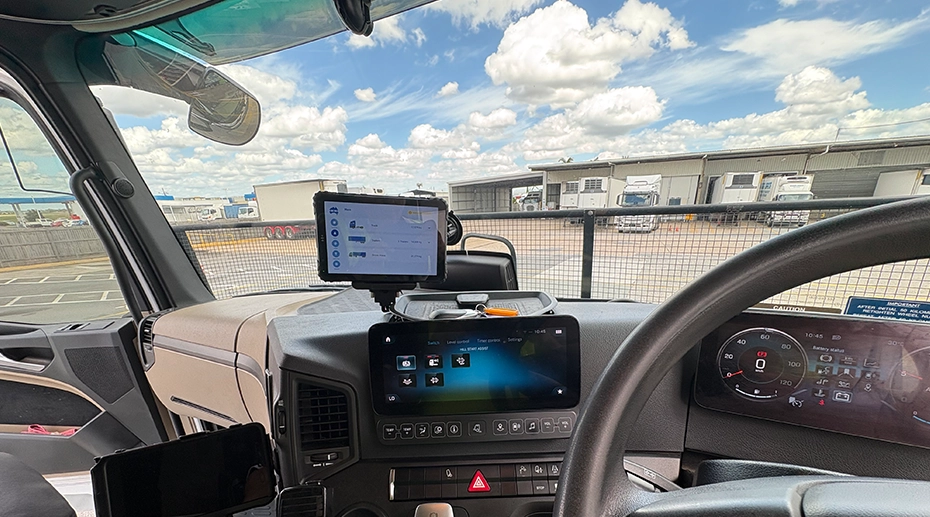
The critical failure point: charging while hot. A tablet pulling 5V USB power in a 65°C cabin is undergoing accelerated electrolyte breakdown. The battery management system on consumer-grade devices lacks temperature-compensated charging — it charges at full current regardless of ambient conditions. Permanently installed vehicle computing stations with 9-36V direct-wire power solve this differently: the device is powered directly from the vehicle electrical system, not through a battery charge-discharge cycle. When the ignition is off, the device sleeps — no charging, no heat buildup, no electrolyte stress.
Factor 2: Low-Cost Pouch Cells Without Pressure Relief
Consumer tablets use pouch cells optimized for cost and thinness, not safety. These cells lack three critical safety features found in industrial-grade cylindrical cells (18650, 21700):
Pressure relief vents — mechanical vents that release gas before swelling deforms the housing
Rigid external casing — cylindrical cells contain internal pressure within steel shells; pouch cells swell outward immediately
Thermal runaway barriers — separator layers that melt and shut down ion flow at critical temperatures
When gas builds up inside a pouch cell, there is nowhere for it to go. The cell expands like a balloon, pushing against the tablet's internal components until something gives — usually the display assembly.
Factor 3: No Charging Cutoff Above Safe Temperature
The charging circuit on consumer tablets is designed for room-temperature operation. It does not measure ambient temperature and has no threshold for suspending charge current. At 60°C, it continues to push power into a battery that is actively decomposing.
Industrial-grade rugged fleet terminals with smart power management include battery management systems with thermal cutoff at 45°C. When the cabin temperature exceeds safe charging limits, the BMS suspends charge current — even if the device is docked. This single feature prevents the majority of battery swelling incidents.
Hardware Specs That Prevent Battery Swelling
The difference between a swollen consumer tablet and a fleet tablet that survives 5+ summers comes down to four engineering decisions. These are not software settings — they are physical hardware specifications that must be selected before deployment.
What This Means for Fleet Deployments
Ignition-Sensing Power Eliminates Continuous Charging
Direct‑wire vehicle terminals connect directly to the vehicle's 9-36V electrical system. When the engine stops, the tablet enters suspend mode — not trickle charging. The battery is not cycling while the vehicle bakes in the sun.
Wide-Temperature Battery Chemistry
Industrial tablets use lithium iron phosphate (LiFePO₄) or modified NMC cells rated for -20°C to 60°C — not just storage, but active charging and discharging across the full range.
Customizable Charging Profiles for OEMs
For OEM fleet hardware projects, charging behavior can be modified at the firmware level — maximum charge voltage, temperature cutoff thresholds, and charging schedules matched to the fleet's operating environment.
Single Point of Failure
A swollen battery is not a maintenance issue — it's a single point of failure that removes the vehicle from service. When the tablet is the ELD log, the GPS navigator, the dispatch terminal, and the proof-of-delivery capture — one swollen battery shuts down every function simultaneously. The driver can't log hours. Dispatch can't route. The customer doesn't get their delivery confirmation. Unlike a cracked screen or a loose dock connector, a swollen battery cannot be field-repaired. The device must be removed immediately for safety, and the vehicle operates blind until a replacement arrives.
Frequently Asked Questions
Can a swollen tablet battery be safely discharged and reused?
No. Once a lithium battery has swollen, the internal structure is permanently damaged. The SEI (Solid Electrolyte Interphase) layer has decomposed, and the cell is chemically unstable. Continued use risks thermal runaway. The device should be removed from the vehicle immediately and the battery replaced by a qualified technician.
Does storing the tablet outside the vehicle at night prevent swelling?
Partially. Removing the tablet from a hot cabin reduces exposure to peak temperatures, but the root cause is charging during high-temperature conditions. If the tablet is charged overnight in a non-climate-controlled depot, the same risk exists. The only reliable prevention is ignition-sensed power that stops charging when the vehicle is off — a standard feature on direct‑wire powered vehicle terminals.
Are there warning signs before a battery swells?
Sometimes. Early indicators include: the rear cover feeling unusually warm during charging, reduced battery life (sudden drop from 100% to 80% in minutes), or the screen appearing slightly raised on one side. However, swelling can occur rapidly — a battery that appears normal in the morning can be visibly deformed by end of day. Regular physical inspection during pre-trip checks is recommended for all fleet deployments.
Can OEM customization prevent battery swelling for specific fleet environments?
Yes. TOPICON provides OEM battery charging profile customization for system integrators deploying in hot climates. Charging voltage limits, temperature cutoff thresholds, and charging schedules can be configured at the firmware level to match the specific thermal profile of your fleet's operating environment. Discuss your thermal requirements with our team →
Specifying Fleet Tablets for Hot Climates? Start with the Right Power Architecture.
If your fleet has experienced battery swelling — or you're specifying hardware for deployment in high-temperature environments — the power architecture is the first thing to audit. USB-charged tablets will eventually fail in hot vehicle cabs. Direct-wire, ignition-sensed power eliminates the charge-discharge cycle that triggers electrolyte decomposition.