One Device, Two Jobs — How a 17mm Quick-Release Tablet Eliminates the Second Device in Last-Mile Delivery
A parcel delivery driver in a European city makes 120 stops per day. At each stop, they navigate to the address on a dash-mounted display, park, then reach for a separate handheld device to scan the package, photograph any damage, and capture a signature. Two devices. Two batteries. Two MDM enrolments. The reason is not operational necessity — it is that the in-vehicle tablet used for navigation cannot be removed from its dock without tools. A 17mm quick-release tablet changes that equation at the mechanical level.
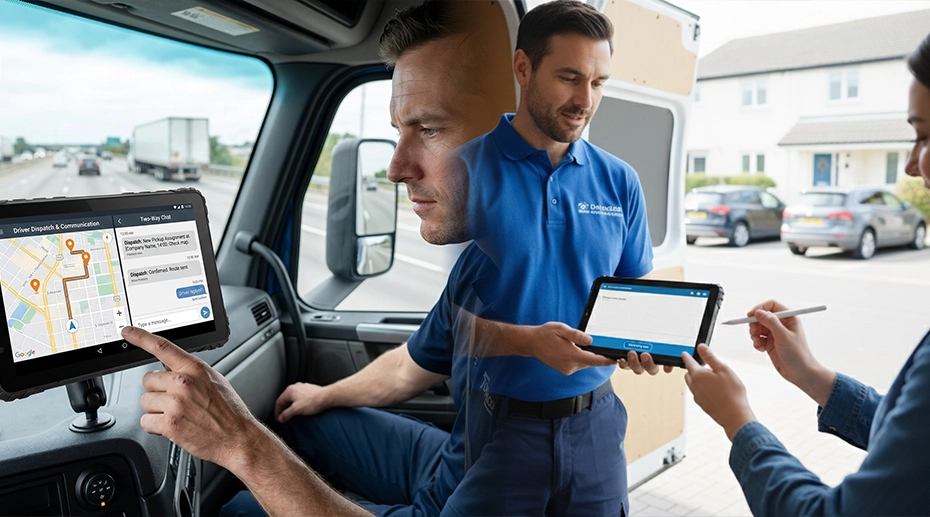
Table of Contents
Field Observation
Last-mile fleets consistently report that the second device — the handheld used outside the cab — is the one that gets dropped, lost, or left on a customer's counter. The failure chain is predictable:
Separate handheld handles barcode scanning and signature capture
Handheld battery dies mid-route because it wasn't docked properly overnight
Driver reverts to paper delivery notes and personal phone photos
About the Author
TOPICON Hardware Engineering Team
Hardware deployment specialists working with parcel, courier, and last-mile logistics fleets on integrated vehicle-to-curb workflows. Focus on single-device architectures that reduce hardware count, simplify MDM, and eliminate data sync failures between in-cab and handheld devices.
The Workflow That Creates the Second Device
A delivery driver's workflow has two distinct phases. Phase one happens in the cab: navigation to the next stop, route updates from dispatch, traffic rerouting. Phase two happens at the curb or the customer's door: package identification via barcode scan, damage photography, electronic signature capture, and delivery confirmation upload. A fixed vehicle-mounted computer bolted to the dashboard can only serve phase one. The driver must have a second device for phase two — or use paper.
This is not a software limitation. The same Android OS that runs navigation also runs barcode scanning and signature capture applications. The limitation is physical: a tablet that cannot be removed from its dock cannot follow the driver to the point of delivery. The second device exists because the dock design made it necessary, not because the workflow inherently requires two separate pieces of hardware.
For fleet hardware deployments in parcel and courier operations, the device count per vehicle directly determines the total cost of ownership. Two devices means two procurement cycles, two sets of spare batteries, two MDM licences, and two replacement schedules. Reducing the device count from two to one halves the hardware management burden before any operational efficiency gain is counted.
The Mechanical Solution: One-Hand Undock, One Device, Two Phases
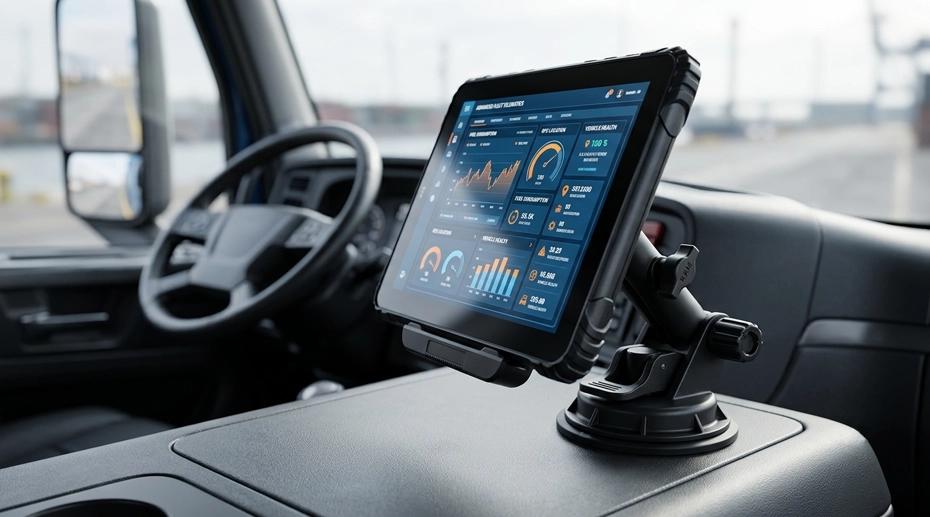
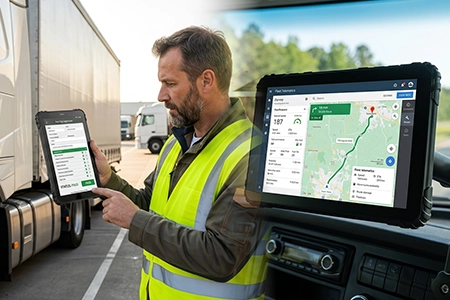
A 17mm tablet with a one-hand quick-release dock removes the physical barrier between phase one and phase two. The driver arrives at the delivery address with the tablet docked, running navigation. Parks the vehicle. Undocks the tablet with one hand in approximately one second. Walks to the point of delivery carrying the same device that was navigating seconds earlier. Scans the barcode using the integrated imager or rear camera. Photographs any package damage. Captures the recipient's signature directly on the screen. Re-docks the tablet upon returning to the cab, where it resumes navigation to the next stop.
The workflow data never leaves the device. The barcode scan, the delivery photo, and the signature capture all reside on the same hardware that uploaded the delivery confirmation. There is no Bluetooth pairing between two devices to fail. No cloud sync to time out on a weak cellular signal. No handheld battery that dies mid-route because the charging cradle contact was dirty. The docked vehicle tablet that also serves as the handheld delivery terminal eliminates the data handoff that is the most common failure point in two-device delivery workflows.
In field deployments across European parcel fleets, drivers reported that the single-device workflow reduced per-stop time by an average of 8–12 seconds. Across 120 daily stops, that is 16–24 minutes of recovered driving time — equivalent to an additional 5–8 delivery stops per shift without extending the driver's hours.
Why 17mm Matters for Delivery Workflow
Tablet thickness determines whether a driver treats the device as vehicle equipment or personal equipment. At 25–28mm, the device feels like it belongs to the vehicle. Drivers leave it in the dock because carrying it is awkward — it does not fit in a jacket pocket, it is uncomfortable to hold for extended periods, and it feels disproportionate to the task of scanning a small parcel. At 17mm, the device feels like a consumer tablet. Drivers carry it without thinking, just as they carry their personal phone.
This psychological threshold is the difference between a device that gets undocked at every stop and a device that stays in the cab while the driver reaches for paper forms. It is not a specification that appears on a comparison sheet — no procurement manager filters tablets by thickness in millimetres — but it is the variable that determines whether the single-device workflow actually happens in daily operation or remains a theoretical capability that drivers ignore.
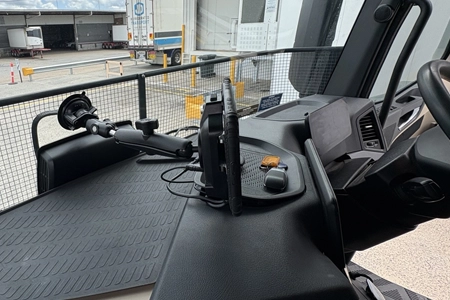
For delivery driver tablets deployed in high-stop-count urban routes, the combined thickness of the tablet, the dock, and the RAM mount arm also affects cab ergonomics. A 17mm tablet on a short-arm RAM mount protrudes roughly 75mm from the dashboard surface — within the acceptable range for most commercial vehicle cabs. A 28mm tablet on a standard arm approaches 130mm, which can interfere with the driver's knee space during frequent entry and exit. In a vehicle that is entered and exited 120 times per day, that interference compounds into driver fatigue and mounting hardware stress.
Integrated Imaging and Scanning: The Hardware That Replaces the Handheld
A tablet that replaces a dedicated handheld must match its core capabilities: barcode scanning speed, camera image quality for damage documentation, and screen responsiveness for signature capture in wet or gloved conditions. These are not software features — they are hardware specifications that must be present in the tablet platform.
A 40-megapixel rear camera with autofocus and flash — as found on current-generation industrial-grade tablet platforms for field data capture — produces delivery documentation photos with sufficient resolution to resolve package label text and damage detail in a single frame. This eliminates the need for a separate digital camera or a smartphone used in parallel with the delivery device. The same camera that photographs a damaged parcel also scans a 1D or 2D barcode through the device's software interface, providing scan performance comparable to a dedicated handheld imager for standard delivery workflows.
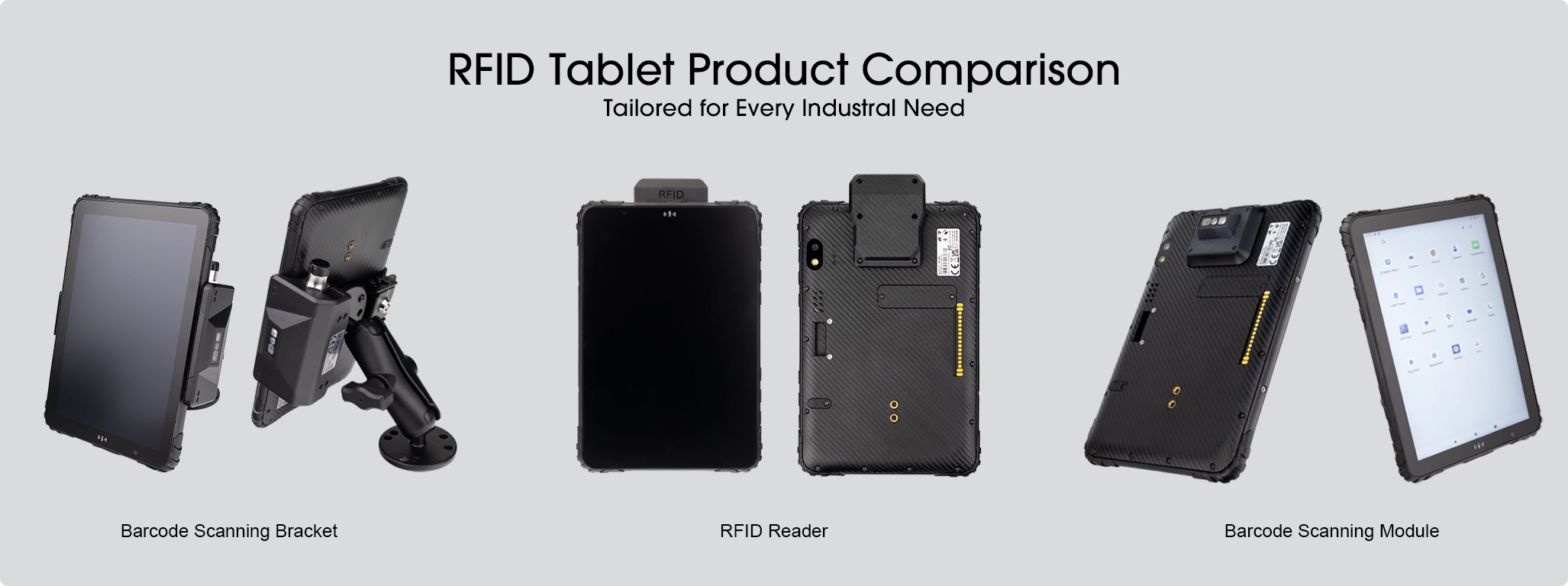
For operations that require high-volume scanning — such as depots where every package is scanned before loading — a dock variant with an integrated 1D/2D barcode imager provides dedicated scan optics without adding a separate device to the driver's kit. The scanner is built into the dock, not the tablet, so it does not add weight or bulk to the device the driver carries. The tablet undocks for delivery, redocks for high-speed depot scanning. One hardware platform, two scanning modes, zero additional devices.
Rain, Gloves, and Drop Survival: The Environmental Side of Single-Device Workflow
A device that moves between the cab and the curb experiences both environments. In the cab, it is protected from direct weather. At the delivery point, it is exposed to rain, snow, and the risk of being dropped on concrete. If the tablet cannot survive these conditions, the single-device workflow fails — not because the concept is flawed, but because the hardware is not specified for outdoor handheld use.
IP67 sealing means the device can be used in heavy rain without water ingress through the charging port, speaker grille, or dock connector. A glove-compatible touchscreen — specified as a capacitive panel with wet/glove mode — means the driver can capture a signature without removing their gloves in sub-zero temperatures. A 1.2-metre drop rating to MIL-STD-810H means the device survives a waist-height fall onto a concrete loading dock without case fracture or screen delamination. These specifications are not optional for a device that is handled outside the cab 120 times per day.
The waterproof tablet specifications required for all-weather delivery operations are the same as those required for outdoor industrial use. The difference in a last-mile context is the frequency of handling. A tablet that is undocked and handled once per shift — for a pre-trip inspection, for example — has a lower probability of being dropped than a tablet that is handled at every delivery stop. High-frequency handling demands a drop rating and sealing level that account for the cumulative probability of an incident across thousands of handling cycles per year.
Single Point of Failure
The data handoff between the in-cab device and the handheld device is the single point of failure in a two-device delivery workflow. A barcode scanned on the handheld must sync to the in-cab device before the delivery confirmation can be uploaded. If the handheld battery dies, the sync fails. If the Bluetooth connection drops, the sync fails. If the driver forgets the handheld at the previous stop, the sync is impossible. Each of these failures produces the same outcome: a delivery that was physically completed but not digitally confirmed. The package was delivered. The system does not know it. Customer service inquiries begin. Driver logs show a discrepancy. The single-device workflow eliminates this handoff entirely — the device that scans the barcode is the device that uploads the confirmation.
Frequently Asked Questions
How does a tablet camera compare to a dedicated barcode scanner for delivery scanning?
A 40-megapixel rear camera with software-based barcode decoding provides scan speeds comparable to an entry-level handheld imager for standard 1D and 2D barcodes in good lighting. It is sufficient for the per-package scan at the point of delivery. For high-volume depot scanning — where hundreds of packages are scanned per hour — a dock variant with an integrated dedicated barcode imager provides faster, hands-free scan performance. The tablet platform supports both modes without adding a separate handheld device to the driver's equipment list.
What happens to the delivery workflow if the tablet is dropped and damaged during a delivery stop?
A tablet specified for 1.2-metre drop resistance to MIL-STD-810H on concrete is designed to survive the most common delivery-stop accident: a waist-height fall while undocking or carrying the device. If the device is damaged beyond operation, the driver loses both navigation and delivery confirmation capability — the same as losing a fixed terminal in a two-device setup. The difference is that a quick-release dock allows the driver to carry a spare tablet in the vehicle. Swapping the damaged tablet for the spare takes seconds and requires no tools. The dock is unaffected. The vehicle returns to operation immediately.
Does the single-device workflow work with existing delivery management software?
The single-device workflow requires no changes to delivery management software. The tablet runs the same Android OS and the same applications as the two devices it replaces. The navigation app, barcode scanning app, and signature capture app all run on a single Android instance. No software integration between devices is required because there is no second device to integrate. The MDM platform manages one device per driver instead of two, reducing licence count and simplifying policy enforcement. For fleets looking to streamline device management, a centralised MDM server provides zero-touch enrollment and remote policy control across the entire fleet.
Can the tablet be customised with delivery-specific I/O or accessories?
Yes. For OEM hardware customization for delivery fleet deployments, the tablet platform supports custom I/O configuration, private label branding, and pre-loaded application images. Dock variants can be specified with integrated barcode scanners, RFID/NFC readers for contactless delivery confirmation, or additional battery charging contacts for extended shift operation. The 17mm form factor and quick-release mechanism remain consistent across all configurations.
Running Two Devices Per Vehicle? The Dock Is the Reason.
A 17mm quick-release tablet that undocks in one second turns the in-cab navigation device into the handheld delivery terminal — eliminating the second device, the data sync between devices, and the battery management overhead. One Android platform, one MDM enrolment, one device to procure and maintain per driver.