17mm vs 28mm — How Tablet Thickness, Dock Depth, and RAM Mount Offset Affect A-Pillar Visibility and Airbag Safety
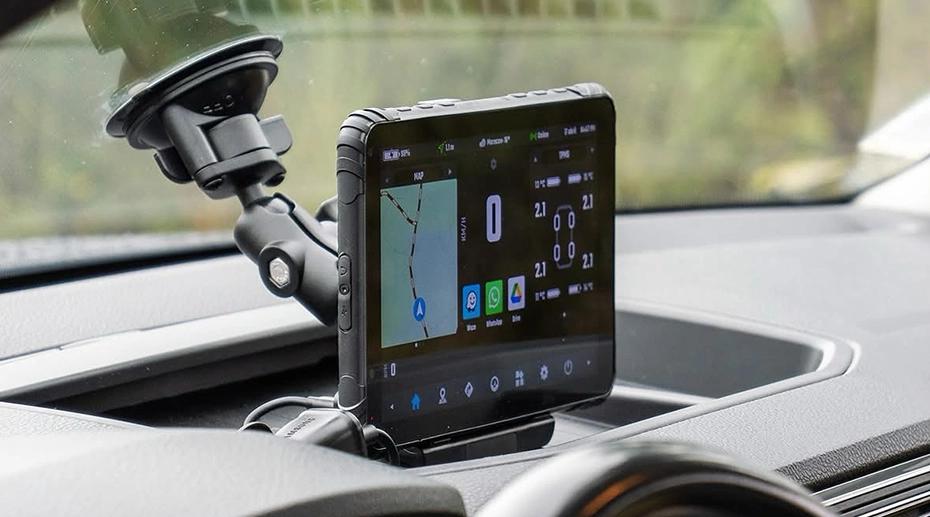
A municipal fleet operator in Germany failed a vehicle safety audit. The issue was not the tablet's performance, but its installation: a 28mm-thick device bolted to a RAM mount that pushed the screen 140mm forward of the dashboard surface. The auditor measured the protrusion and flagged it as an obstruction to the driver's forward field of view. Here is why the combined depth of the tablet, dock, and mount — not the tablet alone — determines whether an installation passes or fails.
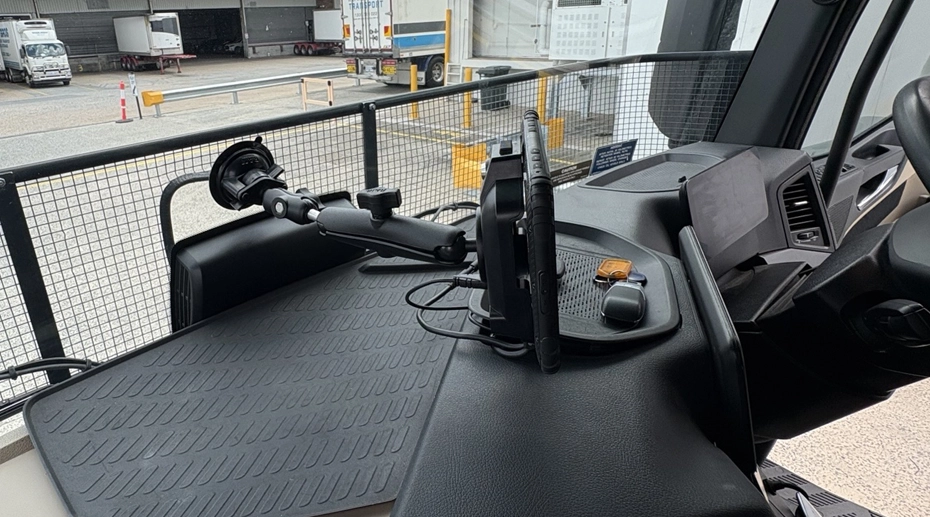
Table of Contents
Field Observation
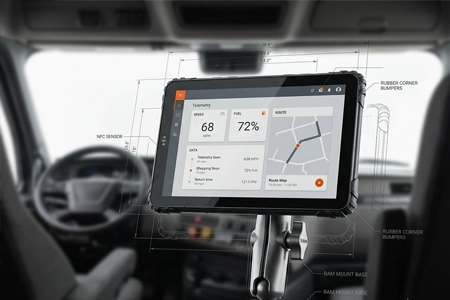
Safety auditors measure from the dashboard surface — not from the mounting point. A tablet that looks compact in isolation may create a substantial protrusion once the dock depth and RAM arm offset are included:
Dock base + hand-latch mechanism: 18–22mm
RAM mount ball and arm offset: 40–80mm
Total dashboard-to-screen distance: 75–130mm
About the Author
TOPICON Hardware Engineering Team
Specialists in vehicle mount installation compliance, ECE R21 interior projection regulations, and cab ergonomic design for municipal, transit, and heavy commercial vehicle deployments across European and North American markets.
What the Auditor Measures Is Not What the Spec Sheet Shows
A tablet spec sheet lists device thickness: 17mm, 22mm, 28mm. That number describes the tablet housing. It does not describe the distance from the dashboard surface to the tablet screen. That distance is what matters for cab safety.
In a typical vehicle tablet installation with docking, the total protrusion is the sum of four layers: the RAM mount base clamp thickness, the RAM arm offset, the dock body depth, and the tablet housing depth. A 17mm tablet on a low-profile dock with a short RAM arm can keep the screen within 75mm of the dash. A 28mm tablet on a deep dock with a standard arm pushes past 130mm — nearly double.
The difference — 55mm — is the width of an adult hand. In a vehicle cab where the A-pillar already obscures several degrees of the forward field, adding a 130mm projection into the remaining visible area creates a blind spot where a pedestrian, cyclist, or low obstacle can disappear. At 30 km/h in an urban environment, a cyclist crossing from the right can travel through that blind spot in under half a second.
ECE R21 and Interior Projection Requirements
UN Regulation No. 21 — ECE R21 — governs interior projections in commercial vehicles sold in the EU. The regulation defines how far objects may protrude from the dashboard, what radii are required on exposed edges, and where devices may be mounted relative to the driver's head impact zone. The specifics vary by vehicle category, but the principle is consistent: any aftermarket installation that projects beyond the dashboard plane must be assessed for its impact on occupant safety in a collision.
A tablet installed on a RAM mount is an interior projection. If that projection extends into the driver's forward field of view, it is not only a visibility issue — it is a compliance issue. Fleet operators running municipal vehicles, public transit, and heavy trucks in EU member states may be subject to roadworthiness inspections that include interior cab assessments. A failed inspection means the vehicle cannot operate until the installation is corrected.
For fixed vehicle mount terminals installed in municipal and transit cabs, the mounting architecture should be evaluated against ECE R21 requirements during the deployment planning phase — not after an auditor flags the violation. Slimmer tablets with low-profile docks and short RAM arms reduce the total projection without compromising mounting stability.
Airbag Deployment Zones and Seatbelt Pretensioner Clearance
The A-pillar is not the only zone affected by a protruding tablet installation. In modern commercial vehicles, curtain airbags deploy from the headliner along the side glass line. Knee airbags deploy from below the steering column. Seatbelt pretensioners fire within milliseconds of a collision signal. Any aftermarket installation that encroaches on these deployment paths alters the designed safety dynamics of the cabin.
A tablet mounted with a long RAM arm that places the device near the A-pillar may interfere with curtain airbag deployment. The airbag fabric expands at over 200 km/h — if it catches the edge of a tablet housing, the deployment trajectory is deflected. The occupant receives partial coverage. The tablet becomes a projectile.
The combined thickness of the tablet, dock, and mount arm determines how far the device intrudes into the passenger compartment. A 17mm tablet on a short-arm mount keeps the device within a few centimetres of the dashboard profile — close enough that it does not materially alter the airbag's designed deployment volume. A 28mm tablet on a standard arm pushes the device into the zone where it can interact with a deploying curtain or knee airbag.
This is not a theoretical concern. Vehicle manufacturers define exclusion zones around airbag modules, and aftermarket installers are expected to verify that their mounting locations do not violate these zones. In a bus tablet installation for transit use, where the device may be mounted near the driver's side window line, the curtain airbag clearance is particularly relevant.
Municipal Vehicles: Tighter Cabs, Less Tolerance
Municipal vehicles — street sweepers, refuse trucks, small buses — have cabs that are smaller and more tightly packaged than long-haul truck cabs. The dashboard is closer to the driver. The windscreen is more vertical. The A-pillar is narrower but positioned closer to the driver's eye point. In these cabs, every millimetre of protrusion consumes a larger percentage of the available field of view.
A 130mm projection that might be tolerable in a long-haul truck with a deep dashboard and a reclined driving position becomes a significant obstruction in a street sweeper where the driver sits upright, close to the glass, with the A-pillar already occupying a substantial portion of the forward-left quadrant. The same tablet, the same dock, the same RAM arm — different cab geometry, different safety outcome.
This is why transportation tablet installations in municipal fleets should be evaluated with the specific cab geometry in mind. A deployment architecture that works for a highway tractor may not work for a compact municipal vehicle. The variable that matters is not the tablet's screen size or processor speed — it is the total protrusion from the mounting surface, measured in millimetres.
Single Point of Failure
A tablet that blocks the driver's view of a pedestrian crossing is a single point of failure that no software can correct. The device that manages compliance, navigation, and communication becomes the reason the vehicle is in an incident. The cost is not measured in hardware replacement — it is measured in liability, insurance premiums, and regulatory penalties. A failed safety audit means the vehicle is grounded until the installation is corrected. In a fleet of 50 municipal vehicles, one systemic mounting error can pull an entire vehicle class out of service.
Frequently Asked Questions
Does a 17mm tablet make a measurable difference compared to a 28mm tablet once the dock and RAM arm are included?
Yes — but the tablet thickness is only one variable. A 17mm tablet combined with a low-profile dock (18mm) and a short RAM arm (40mm offset) produces approximately 75mm total protrusion. A 28mm tablet with a deeper dock (22mm) and a standard arm (80mm) produces approximately 130mm. The 11mm difference in tablet thickness accounts for roughly 20% of the total protrusion difference. The larger contributors are the dock depth and arm offset. A complete installation must consider all three layers together.
Is ECE R21 compliance mandatory for all fleet vehicles in Europe?
ECE R21 applies to new vehicle type approvals for categories M1 (passenger cars) and N1 (light commercial vehicles). For heavy commercial vehicles (N2, N3) and buses (M2, M3), the regulation may be referenced in national roadworthiness inspection criteria. Fleet operators should consult their specific vehicle category requirements — but as a general principle, any interior projection that obstructs the driver's forward field of view or encroaches on airbag deployment zones is likely to be flagged during a safety audit regardless of the specific regulatory reference.
Can a short RAM arm provide sufficient adjustability compared to a standard arm?
A short RAM arm (typically 40–50mm centre-to-centre) provides adequate adjustability for most dashboard and windscreen mounting positions. The trade-off is reduced articulation range: the arm can tilt and rotate, but cannot bridge large offsets between the mounting point and the desired screen position. For installations where the mounting point is already close to the driver's natural line of sight — such as a dashboard ball mount adjacent to the instrument cluster — a short arm is sufficient and reduces total protrusion by 30–40mm compared to a standard arm.
How does the hand-latch dock depth compare to a standard quick-release dock?
The all-metal hand-latch dock and the standard quick-release dock share a similar mounting depth when installed — both add approximately 18–22mm behind the tablet. The hand-latch mechanism does not increase depth; it adds a manual locking screw on the side or top face of the dock. The primary dimensional variable across dock types is not the latch mechanism but the dock's internal connector arrangement and any additional modules such as an integrated barcode scanner, which may extend the dock body by a further 10–15mm.
Specifying Vehicle Tablet Installations? Start with the Total Protrusion, Not the Spec Sheet.
The combined depth of the tablet, dock, and mount arm determines whether the installation passes a safety audit. A 17mm tablet with a low-profile dock and short RAM arm keeps the total protrusion under 80mm — minimising the risk of A-pillar blind spot creation and airbag deployment interference.