One Tablet, Multiple Vehicles — How a Detachable Hardware Architecture Cuts Fleet CapEx by 30–50%
A winter maintenance fleet operator in Sweden runs 40 snowploughs from November to March, then 25 street sweepers from April to October. With fixed terminals, every vehicle needs its own device — 65 tablets, of which 25 sit idle at any given time. After switching to a separable hardware architecture where the in-vehicle computing platform moves with the driver across vehicles, the fleet eliminated 25 redundant devices in one procurement cycle.
Table of Contents
Field Observation
The 1:1 device-to-vehicle ratio is an artefact of fixed installation, not a fleet requirement. When the hardware is permanently bolted in, every vehicle gets a device regardless of utilisation:
Seasonal equipment — harvesters, snowploughs, salt spreaders — may sit idle 6–9 months per year
Backup vehicles maintained for breakdown coverage carry hardware that may never be powered on
About the Author
TOPICON Hardware Engineering Team
Hardware procurement specialists working with fleet operators and system integrators on total cost of ownership modelling, multi-vehicle deployment architectures, and scalable dock infrastructure across municipal, agricultural, and logistics fleet environments.
The 1:1 Device-to-Vehicle Ratio Is a Hardware Constraint, Not an Operational Requirement
Fixed terminals create a forced relationship: one vehicle, one device. The device is installed, wired, and configured for that specific vehicle. Removing it requires tools, reinstallation requires configuration. The operational overhead of transferring a device between vehicles exceeds the cost of buying a second unit — so the fleet buys a second unit. Over an entire fleet, this logic compounds into tens or hundreds of underutilised devices.
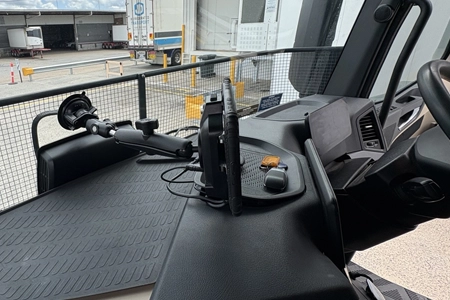
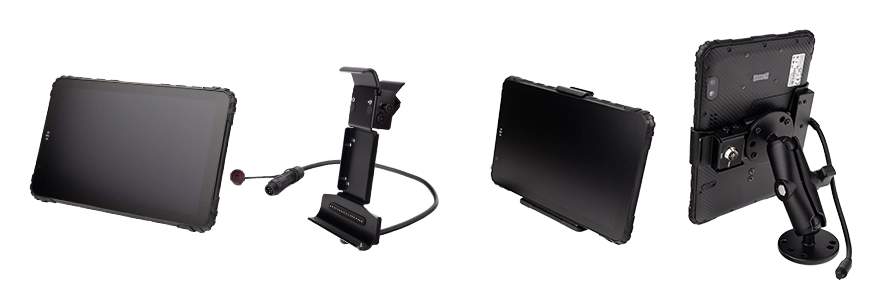
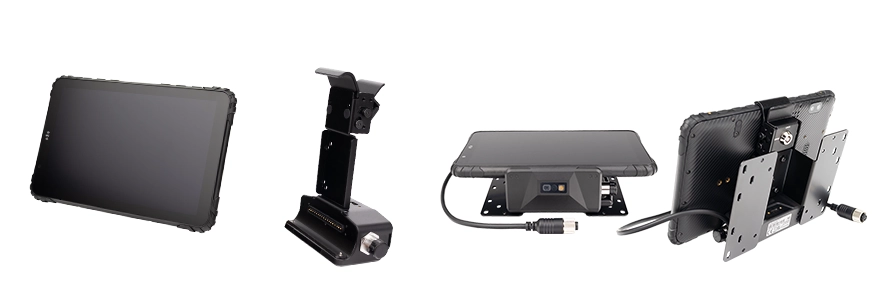
This is not an inventory management failure. It is a direct consequence of the hardware architecture. A permanently installed vehicle mount terminal cannot follow the driver across vehicles. A quick-release dock architecture removes that constraint. The dock stays with the vehicle — a passive mechanical component with no electronics, no configuration, and no depreciation beyond the initial installation cost. The tablet moves with the driver, docking into whichever vehicle they are assigned that shift.
For a fleet with 100 vehicles averaging 60% daily utilisation, the one-device-per-vehicle model requires 100 tablets. A detachable architecture requires 60 — the number of active drivers, not the number of registered vehicles. The 40 vehicles that sit in the yard still have docks. They do not need tablets until they are assigned a driver. That difference — 40 devices — at a typical fleet management hardware unit cost represents a six-figure CapEx saving in a single procurement cycle.
The Dock as Infrastructure: Low-Cost, Zero-Maintenance, Vehicle-Specific
The dock is the component that stays with the vehicle. It is bolted to the RAM mount once, wired to vehicle power once, and remains in place for the vehicle's service life. It contains no processor, no storage, no battery, and no software. It is a mechanical interface with electrical pass-through. Its installed cost is a fraction of the tablet's unit price.
From a procurement perspective, the dock is infrastructure — like the RAM mount arm, the vehicle wiring harness, or the antenna cable. It is purchased once per vehicle and amortised over the vehicle's 7–10 year life. The tablet is a consumable asset — purchased per driver, upgraded on a 3–5 year cycle, and replaced when damaged or obsolete. Separating the two in the procurement budget changes the financial model of the fleet hardware deployment.
This separation also simplifies maintenance. A dock failure — rare, since the component is passive — affects one vehicle. A tablet failure affects one driver. Neither failure cascades. Compare this to a fixed fleet tablet deployed as a single integrated unit: a tablet failure takes the vehicle out of service until the replacement is installed and configured. A dock failure may require the same. In the separable model, a driver with a failed tablet can dock a spare in seconds and resume operations.
Where 1:N Deployment Shows the Largest Savings
Three fleet types capture disproportionate savings from a separable hardware architecture:
Seasonal Equipment Fleets
Snowploughs in winter, street sweepers in summer. Agricultural sprayers in spring, harvesters in autumn. The vehicles change by season. The driver pool remains relatively constant. A dock installed on every vehicle, with tablets assigned to drivers rather than vehicles, eliminates seasonal hardware duplication. One municipal fleet in Northern Europe reduced device count by 38% across a 65-vehicle seasonal rotation using this approach.
Mixed Vehicle Pools with Variable Utilisation
A logistics depot with 80 vans but only 55 daily delivery routes runs 55 tablets. The remaining 25 vans have docks and are ready for peak-season expansion or breakdown substitution. When demand increases, additional tablets are procured — but only when additional drivers are hired. The hardware scales with the workforce, not the vehicle count.
Multi-Shift Hot-Desking Operations
Waste collection, long-haul relay, and 24-hour distribution centres run multiple shifts per vehicle. Three drivers may share one cab. With a fixed terminal, all three share one device. With a quick-release dock, each driver carries their own tablet. The device count matches the driver count, not the vehicle count — but more importantly, each driver maintains a personal device with their own settings, credentials, and app configurations. No shared logins. No Bluetooth conflicts.
One Tablet Across Different Vehicle Types: The Dock Variant Matters
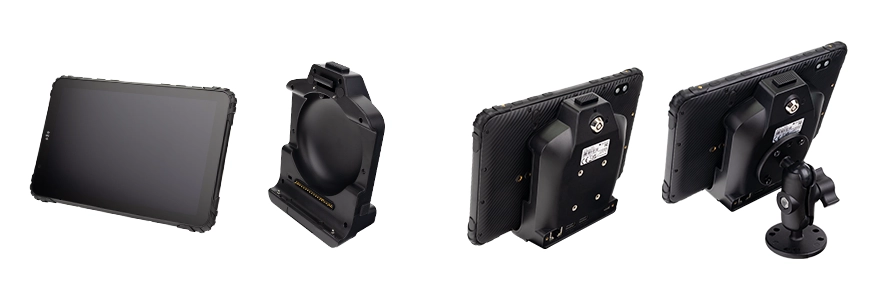
The 1:N model assumes that the same tablet can dock into different vehicles. This requires dock standardisation across the fleet. The dock must provide the same mechanical interface — the same physical mounting pattern, the same connector arrangement, the same power and I/O passthrough — regardless of which vehicle it is installed in.
For fleets where all vehicles share a common chassis type — a fleet of identical delivery vans, for example — a single dock variant covers the entire vehicle pool. For mixed fleets where vehicles have different cab geometries, vibration profiles, or I/O requirements, different dock variants may be needed for different vehicle classes. A refuse truck with an all-metal hand-latch dock and IP67 waterproof connector may require a different dock variant than a light delivery van with a standard quick-release dock — even though both accept the same tablet.
The tablet remains the common denominator. The dock adapts to the vehicle. This is the inverse of the fixed-terminal model, where each vehicle receives a complete, vehicle-specific hardware package. In the separable model, the fleet standardises on one or two tablet models and deploys the appropriate dock variant per vehicle class. The procurement efficiency comes from standardising the tablet, not the dock. For the full range of dock configurations available, refer to the docking station configuration matrix →.
The CapEx Arithmetic: A Worked Example
Consider a municipal fleet with the following profile:
100 vehicles total: 40 winter-only, 30 summer-only, 30 year-round
Average daily vehicle utilisation: 60%
Peak seasonal driver count: 65
Under a fixed-terminal model, the fleet purchases 100 tablets — one per vehicle. The 40 winter-only vehicles carry hardware that is unused for 7 months per year. The 30 summer-only vehicles carry hardware that is unused for 7 months per year. At any given time, roughly 40 devices are installed in vehicles that are not in service. Their batteries are ageing. Their MDM licences are active. Their replacement cycles are ticking.
Under a separable model, the fleet installs docks on all 100 vehicles and purchases 65 tablets — one per active driver. The 35 vehicles without assigned drivers have docks but no tablets. When a seasonal vehicle rotates into service, the driver brings their tablet. When the season ends, the tablet follows the driver to the next vehicle.
The tablet savings alone: 35 devices. At a unit price typical for an industrial-grade rugged computing platform with vehicle dock integration, the CapEx reduction exceeds the total cost of all 100 docks by a factor of 2–3. The dock infrastructure pays for itself in the first procurement cycle, and the savings compound with each subsequent hardware refresh — because the docks do not need replacement. They remain in the vehicles across multiple tablet generations.
Single Point of Failure
A fixed terminal architecture makes every idle vehicle an idle asset carrying a depreciating device. The device ages whether the vehicle operates or not. Its battery degrades. Its MDM licence consumes budget. Its replacement clock runs. When the vehicle eventually enters service, the device may be one year closer to end-of-life — or already obsolete. In a separable architecture, the device ages in proportion to its actual use. A tablet assigned to a driver accumulates operational hours. A dock installed in a seasonal vehicle that sits idle for seven months accumulates nothing. Separating the two lifecycles eliminates the silent cost of hardware depreciation on parked vehicles.
Frequently Asked Questions
Does the 1:N model require that all vehicles use the same tablet model?
Not necessarily. The dock provides the physical and electrical interface. As long as the tablet is mechanically and electrically compatible with the dock, different vehicle types can use different tablet models — for example, a 10-inch device for highway tractors and an 8-inch device for compact municipal vehicles. The key requirement is that the dock connector arrangement and mechanical retention mechanism are consistent across the fleet. Standardising on one dock family — such as the hand-latch dock with a common connector pin-out — enables tablet interchangeability across vehicle types.
What happens if a dock fails? Does the vehicle lose all functionality?
A dock is a passive mechanical component with electrical pass-through. Its failure modes are limited: physical damage from a collision, corrosion in extreme environments, or connector wear after exceeding the rated mating cycle count. In the event of a dock failure, the vehicle loses its tablet interface — but the tablet itself remains functional. The driver can continue operating the tablet in handheld mode while the dock is replaced. Because docks are simple mechanical assemblies without electronics, replacement is a bolt-off/bolt-on procedure that does not require configuration, software installation, or MDM re-enrolment.
How does MDM licensing work in a 1:N model?
MDM licences are typically assigned per device, not per vehicle. In a 1:N architecture, the licence count follows the tablet count — which matches the driver count rather than the vehicle count. For a fleet with 100 vehicles and 60 active drivers, this means 60 MDM licences instead of 100. The docks, being passive components, do not require MDM licences. The saving on MDM licensing alone can cover a substantial portion of the dock infrastructure cost over a 3–5 year deployment cycle.
Can the 1:N model work with existing vehicle hardware, or does it require a complete fleet retrofit?
Docks can be deployed incrementally. A fleet transitioning from fixed terminals can install docks on new vehicles as they enter service and retrofit existing vehicles during scheduled maintenance intervals. The tablet fleet can be mixed during the transition — fixed terminals in older vehicles, detachable tablets with docks in newer ones — as long as the MDM platform supports both configurations. The 1:N model does not require a single-phase rollout. It can be phased in over a 2–3 year hardware refresh cycle, with savings accumulating as the fixed terminal count decreases.
Re-evaluating Your Fleet Hardware Procurement Model?
A quick-release dock architecture decouples the tablet lifecycle from the vehicle lifecycle — enabling 1:N deployment that reduces device count by 30–50% in seasonal, shared, and mixed-utilisation fleets. Docks remain in vehicles for 7–10 years. Tablets follow drivers across assignments. The savings compound with every hardware refresh cycle.