Anti-Theft by Design — How a Quick-Release Dock Removes the Target, Not Just the Tablet
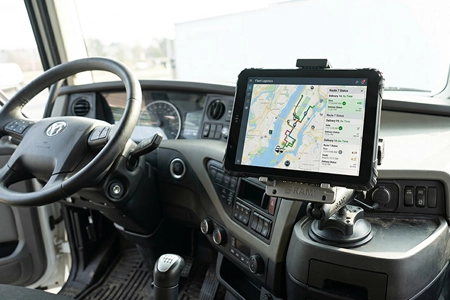
A logistics fleet operator in Antwerp had a recurring problem: the same truck was broken into three times in six months. The target was not the truck. It was the vehicle-mounted tablet fixed to the dash, visible through the windscreen. After switching to a hardware platform that leaves the vehicle with the driver, break-ins stopped. Here is the engineering behind that change.

Table of Contents
Field Observation
Fixed in-vehicle hardware attracts two types of operational friction that never appear on a spec sheet:
Multi-driver vehicle sharing where the previous driver's configuration is still active
About the Author
TOPICON Hardware Engineering Team
Hardware specialists working with system integrators on fleet deployment architectures — focusing on physical security, driver-centric fleet models, and vehicle dock engineering across European and North American logistics fleets.
A Device That Stays in the Cab Is a Device That Can Be Stolen
Fleet security discussions tend to focus on software — MDM lock screens, remote wipe, encrypted storage. Those measures protect data. They do nothing to prevent the physical removal of a tablet from a vehicle at 3 a.m. with a crowbar. A shattered side window costs the fleet a day of downtime. A missing tablet costs a compliance-critical device and potentially hours of unrecovered logs.
Physical security on a vehicle dock does not come from lock screens. It comes from making the device absent. A tablet that is not in the cab cannot be stolen from the cab. The most effective anti-theft mechanism for vehicle-mounted hardware is a dock that releases in one second — because if undocking takes no effort, drivers do it every time they leave the vehicle. No training module required. No policy enforcement. The behaviour is built into the mechanical design.
This is the opposite of a permanently installed vehicle terminal, which remains in the cab regardless of risk. A bolted-down device requires the fleet to accept the theft risk, invest in additional physical barriers, or absorb the operational cost of replacement. A hand-latch quick-release dock eliminates the target entirely.
How Dock Mechanics Shape Driver Behaviour
Drivers do not read deployment manuals. They interact with physical interfaces. If undocking requires two hands, a specific sequence of latches, or any tool, the tablet stays in the cab — not because the driver made a conscious decision, but because the friction of removal exceeds the perceived benefit. Over weeks of operation, that small friction compounds into a device that is permanently present, permanently visible, and permanently at risk.
A one-hand quick-release dock changes that calculation. The driver arrives, docks the tablet. Finishes the shift, undocks it in the same motion as picking up their phone. The device leaves the vehicle because removing it is physically effortless. The security benefit is a by-product of ergonomics, not a policy.
In field deployments observed across several European logistics fleets, docks requiring a two-hand latch release showed tablet removal rates below 30% at end of shift. Quick-release docks exceeded 90%. The difference was not training. It was the number of seconds and hands required to undock. This is a physical design variable, not a behavioural one.
One Dock, Multiple Drivers — The Hot-Desking Fleet Model
In municipal waste collection, regional parcel delivery, and multi-shift long-haul operations, the vehicle is shared. Three drivers may rotate through the same cab in a 24-hour period. If the fleet management tablet is fixed, all three share one device. Bluetooth pairings from the previous driver persist. App login sessions linger. Personal navigation preferences override the next driver's workflow. The device becomes a shared resource with no user boundary.
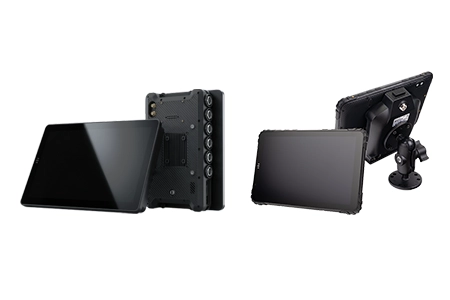
A quick-release dock with a hand-latch mechanism changes the architecture: the dock stays in the vehicle. The tablet moves with the driver. Each driver carries their own device — configured with their own MDM profile, their own app layout, their own Bluetooth pairings. They insert it into whichever vehicle they are assigned that shift. The dock is shared infrastructure. The tablet is personal equipment. This is the same architectural principle behind driver‑swappable in‑vehicle terminals that follow the operator, not the vehicle.
This is not a software feature. It is a consequence of a separable hardware architecture. The dock provides power, vehicle I/O, and mechanical mounting. The tablet provides the user session. Separating the two means the fleet can standardise on one dock type across its vehicle pool, while drivers maintain individual devices that follow them across assignments. No device sharing. No configuration resets at shift change. No Bluetooth conflicts.
Physical Separation vs Software Lockdown
MDM-enforced kiosk modes, remote lock, and GPS-based geofencing can secure a device after it is stolen. They cannot prevent the theft. A device that is physically absent from the vehicle requires no software security layer to protect against vehicle break-ins. This is not an argument against MDM — it is an argument that the dock mechanism sits earlier in the security chain than any software policy.
All-metal docks add a second physical layer. A plastic dock left empty in the cab looks like a mounting bracket. An all-metal hand-latch dock signals that the hardware is industrial-grade — hardened equipment that is less likely to be targeted for opportunistic theft. The dock itself, being a passive mechanical structure with no electronics, has no value to a thief. It remains bolted to the RAM mount, ready for the driver's return.
This layered approach — physical removal as the primary defence, all-metal construction as a secondary deterrent, MDM as a tertiary data-protection layer — reflects how docked vehicle tablets with hand-latch release fit into an overall fleet security architecture. None of the layers alone is sufficient. Together, they reduce the risk surface to near zero.
Single Point of Failure
A stolen tablet is not a property loss — it is a vehicle out of service. Without the device that runs ELD compliance, dispatch communication, and route navigation, the truck cannot operate legally. The driver cannot log hours. The fleet cannot track the vehicle. The replacement device must be procured, enrolled in MDM, configured, and installed — a process that can take days. During that time, the vehicle generates no revenue. The cost of the hardware is the smallest line item on the incident report.
Frequently Asked Questions
Does a quick-release dock compromise mounting security while driving?
No. The dock's locking mechanism — whether pogo-pin friction fit on standard docks or a hand-screw latch on all-metal variants — is designed to hold the tablet against sustained vehicle vibration, including the shock loads from potholes and unpaved roads. The release motion is deliberate and cannot be triggered by vibration alone. MIL-STD-810G vibration testing includes docked configurations to validate this.
What happens if a driver forgets to undock the tablet?
The device remains in the vehicle, and the fleet is exposed to the same risk as a fixed installation. No hardware design can eliminate human error entirely. However, docks that require zero-effort removal make undocking part of muscle memory — drivers who remove the tablet every day for a week rarely forget on the eighth day. Some fleets pair the quick-release design with a reminder in their MDM workflow: a prompt on the driver's mobile device if the tablet GPS shows it still in the yard after shift end.
Is an all-metal dock worth the additional cost compared to a composite dock?
For fleets operating in high-vibration environments — mining, heavy construction, agricultural machinery — an aluminium dock body resists the fatigue cracking that eventually affects composite materials under sustained cyclical loading. For standard logistics operations on paved roads, a composite quick-release dock provides equivalent security and sufficient durability. The material choice should follow the vibration profile of the vehicle, not the purchase price of the dock.
Can a quick-release dock work with existing RAM mount installations?
Yes. The dock base plate uses standard RAM mount bolt patterns. Fleets with existing RAM mounting arms can swap the dock without replacing the vehicle-side mounting infrastructure. The dock itself is a passive mechanical component — no wiring changes are required unless the fleet is also upgrading from a USB-charged device to a 9-36V direct-wire power architecture through the dock.
Evaluating Fleet Tablet Security? Start with the Dock Mechanism.
A quick-release dock that lets the driver remove the device in one second changes the security equation before any software policy is applied. Combined with all-metal hand-latch construction and standard RAM mount compatibility, this architecture supports both theft prevention and multi-driver hot-desking in a single mechanical design.