RS232 vs RS485 for Industrial Vehicle — Distance, Isolation, and Multi-Drop Architecture
A forklift integration adds a weight sensor on the carriage, a receipt printer on the console, and a temperature probe in the battery compartment. The RS232 cable run from the printer to the tablet exceeds five metres. Data drops appear intermittently — a corrupted line on the printout, a missed reading, an error the driver cannot reproduce. The problem is not the software. The problem is that RS232 was designed for short point-to-point runs, and the deployment has outgrown it. This article explains what each serial standard actually supports, how the wiring differs, and how the choice affects tablet hardware selection.
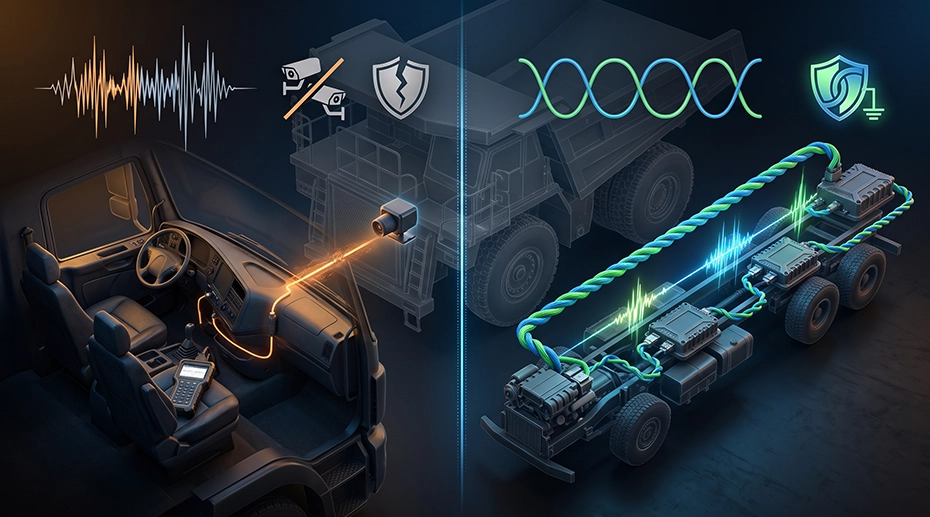
Table of Contents
1. The Integration Scenario
A warehouse fleet operator retrofits a fleet of reach trucks with a tablet-based workflow. The tablet runs a fork-mounted terminal application that reads weight from a carriage sensor, prints a receipt at the console, and logs temperature from a battery-compartment probe. Three serial peripherals, each with an RS232 output, each within a few metres of the tablet.
The first deployment uses RS232 for all three. The weight sensor reads reliably — it is 1.5 metres away. The printer at 4 metres works but occasionally produces garbled lines. The temperature probe at 6 metres produces intermittent data. The pattern is consistent: the longer the cable, the worse the reliability.
The engineering explanation is not complicated. RS232 is a single-ended signal standard. The receiver reads the voltage on a single wire relative to ground. Any noise picked up along the cable — from the motor controller, the hydraulic pump, the ignition system — adds directly to the signal. Longer cables pick up more noise. At some length, the receiver can no longer distinguish a valid logic level from noise. RS485 solves this by using two wires with opposite signals. Noise affects both wires equally, and the receiver reads the difference — which cancels the noise. The trade-off is a different wiring topology and a different transceiver.
2. RS232: Simple, Short, Point-to-Point
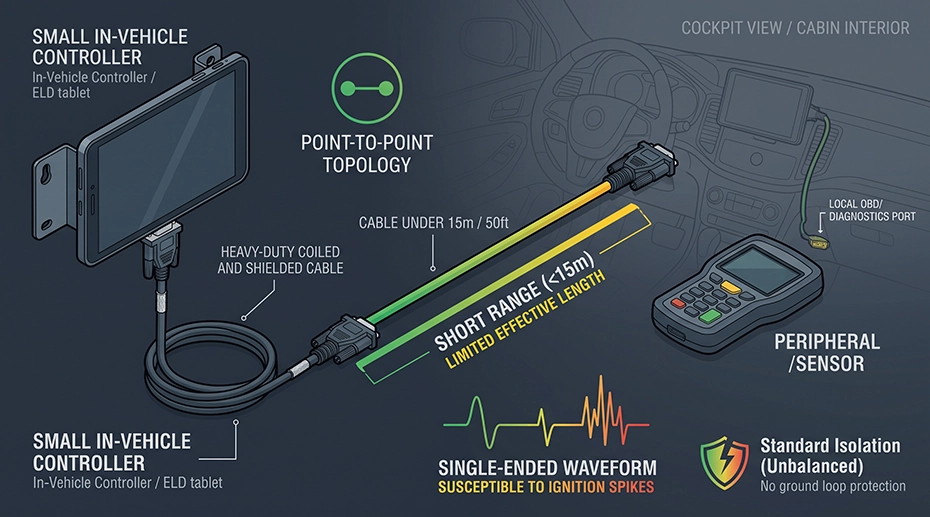
RS232 is one of the oldest serial standards still in active use. It defines a single-ended signal: a voltage on the TX line relative to a common ground. Logic levels are typically ±3V to ±15V, which provides reasonable noise margin over short distances. The standard does not specify a cable length — it specifies a maximum capacitance of 2500 pF, which in practice translates to roughly 15 metres at standard cable capacitance and low baud rates.
The topology is strictly point-to-point. One transmitter, one receiver. There is no provision for multiple devices on the same bus. If three peripherals need to connect, the tablet needs three RS232 ports, or a switch, or the peripherals need to be daisy-chained with a protocol that supports it — which RS232 does not.
This is why RS232 is the right choice for short runs and dedicated connections: a diagnostic dongle plugged into the tablet, a printer sitting on the same console, a sensor mounted within arm's reach. It is the wrong choice for anything that involves distance, noise, or multiple devices on the same bus. The RS232 serial tablet platform documentation covers the port configuration and the device compatibility list.
3. RS485: Differential, Multi-Drop, Longer Run
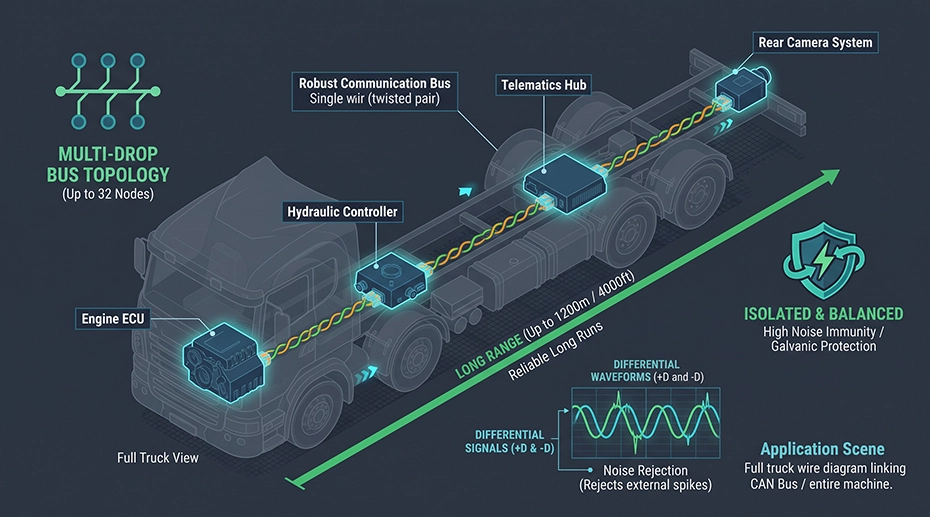
RS485 uses two wires — commonly labelled A and B, or D+ and D- — carrying opposite signals. The receiver reads the difference between them. Noise that couples onto the cable affects both wires roughly equally, so the difference at the receiver remains unchanged. This is what allows RS485 to run over hundreds of metres in electrically noisy environments.
• Topology: Multi-drop. Up to 32 devices on a single bus without repeaters, more with repeaters. This is the key advantage over RS232.
• Termination: A 120-ohm resistor at each end of the bus. Without termination, reflections corrupt the signal, especially at higher baud rates.
• Common-mode range: Typically -7V to +12V. This is the range of ground potential difference the receiver can tolerate while still reading the differential signal correctly.
The multi-drop capability is what makes RS485 useful in vehicle deployments. A single bus can carry a sensor network — temperature probes, load cells, door sensors — each with its own address, all sharing two wires back to the tablet. Instead of running a separate cable for every peripheral, the deployment runs one bus and taps into it at each point. The serial applications in fleet telematics covers how RS485 is used alongside CAN Bus in commercial vehicles.
4. Isolation and Vehicle Ground
In a vehicle, the tablet ground and the chassis ground are not necessarily at the same potential. Heavy loads — starter motor, hydraulic pump, winch — pull hundreds of amps through the chassis, and the resulting voltage drops across the chassis resistance create potential differences of several volts between two points on the same vehicle.
If the tablet and the peripheral are grounded at different points, that potential difference appears as a common-mode voltage on the serial cable. RS232 has a limited common-mode range — the single-ended signal is referenced to ground, and if the ground shifts, the signal shifts with it. An isolated RS232 transceiver breaks the ground connection between the two sides using an optocoupler or a digital isolator, so the signal is transferred without a galvanic connection.
RS485 has a wider common-mode range by design, but it is not unlimited. An isolated RS485 transceiver extends the range further and protects both ends from transients. For vehicle deployments, isolation is not optional when the serial cable runs near the ignition system, the alternator, or any high-current switching device. The DC-DC converter analysis covers the isolation architecture for the power side, which parallels the serial side.
TOPICON MDT880 / MDT865 Vehicle Docking Guide
Vehicle docking installation with serial cable routing and 9–36V wiring harness for RS232/RS485 integration.
5. How This Changes Tablet Selection
The serial protocol decision determines the port configuration the tablet needs. Three specifications matter.
• Port type: RS232 and RS485 are not interchangeable at the connector level. A tablet that provides only RS232 cannot drive an RS485 bus without an external converter. The tablet must expose the correct transceiver type on each port.
• Isolation: An isolated transceiver breaks the ground loop between the tablet and the vehicle chassis. This prevents data corruption and protects the transceiver from voltage transients. For any deployment where the serial cable runs near ignition or high-current wiring, isolation is required.
The MDT1065 provides dual RS232 and RS485 in the TYPE-A and TYPE-B configurations, with GPIO and camera options. The MDT865 provides dual RS232 and RS485 alongside CAN Bus J1939, covering deployments that need both vehicle network access and serial peripherals. The fleet telematics serial guide covers the application-level configuration for both protocols.
6. Deployment Checklist
Before specifying tablet hardware for a serial integration, confirm the following on the target vehicle:
• Cable length: RS232 is practical up to roughly 15 metres at low baud rates. Beyond that, RS485 is the appropriate choice.
• Bus topology: If RS485 is used, is the bus terminated at both ends with 120-ohm resistors? Are stub lines short?
• Baud rate: Higher baud rates reduce the maximum practical cable length. Confirm the peripheral's baud rate and the tablet's serial port configuration match.
• Ground reference: Is the tablet ground bonded to the vehicle chassis at the same point as the serial peripheral ground?
• Isolation: Does the tablet's serial transceiver provide galvanic isolation? If not, is an external isolator required?
• Cable routing: Does the serial cable run parallel to ignition or high-current wiring? If so, shielded cable with a single-point ground is required.
The RS232 serial tablet platform documentation covers the port configuration and the isolation architecture. The docking station matrix maps each tablet model to the serial-capable docks and cable options.
Single Point of Failure
A serial port that drops data is worse than a serial port that fails completely. A complete failure is obvious — the peripheral stops working, the driver reports it, the technician investigates. An intermittent failure is invisible until it matters: a corrupted weight reading that gets logged as valid, a temperature spike that gets filtered out as noise, a receipt line that prints wrong. In a fleet deployment, these failures accumulate silently and surface only when a customer disputes a delivery record or an audit flags inconsistent data. The serial interface is the physical layer underneath the application. If it is not engineered for the vehicle environment — correct protocol, correct cable length, correct isolation — the application layer cannot compensate. Serial architecture is not a procurement detail. It is the foundation the data integrity stands on.
7. Frequently Asked Questions
Can RS232 and RS485 share the same connector?
They can share a physical connector only if the pinout and transceiver are designed for both modes. RS232 is single-ended and point-to-point. RS485 is differential and multi-drop. Mixing them on one port usually requires a switchable transceiver or separate ports. Most industrial tablets provide separate RS232 and RS485 channels. The RS232 serial tablet platform covers the port configuration options.
When does RS485 need termination?
RS485 needs a 120-ohm termination resistor at each end of the bus when the cable run is long or the data rate is high. Short stub lines should be minimized. Without proper termination, reflections can corrupt data, especially at 115200 baud or above. For in-vehicle deployments, the bus is typically short enough that termination is not strictly required at low baud rates, but it is good practice to include it.
Why is isolation important for vehicle serial ports?
Vehicle chassis ground can differ from the tablet ground by several volts during engine cranking or load switching. A non-isolated serial port can create a ground loop, corrupt data, or damage the transceiver. Isolated RS485 and RS232 ports break that loop and keep the differential signal within common-mode range. The ground loop diagnosis guide covers the physical mechanism, which applies equally to CAN Bus and serial interfaces.
How many RS485 devices can share one bus?
The RS485 standard specifies up to 32 unit loads on a single bus. Many modern transceivers are fractionally loaded, allowing more devices. For vehicle deployments, the practical limit is usually determined by the addressing scheme and the polling rate of the application, not the electrical limit. A typical sensor network on a vehicle has fewer than 10 devices.
Can a tablet use RS232 and CAN Bus at the same time?
Yes. RS232 and CAN Bus use different transceivers and different protocols. A tablet can read CAN Bus J1939 engine data through one interface and RS232 peripheral data through another at the same time. The MDT865 provides dual RS232, RS485, and dual CAN Bus in a single platform. The CAN Bus vehicle tablet platform covers the CAN-side configuration.
Integrating Serial Peripherals into a Vehicle Platform?
The serial protocol requirement — RS232, RS485, or both — determines the tablet port configuration and the isolation architecture. Request a hardware evaluation kit or discuss the serial integration for your deployment.