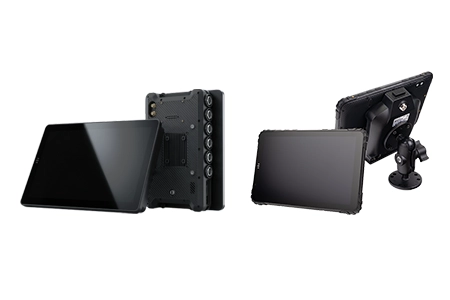
How to Prevent Tablet Vibration Damage – Vehicle Mounting Best Practices for Fleet Deployments
Vibration doesn't just shake a tablet loose from its mount. It kills electronics through mechanisms most installers never see — resonance amplification, fretting corrosion on connectors, and BGA solder joint fatigue. Here's how to mount fleet tablets so they survive years of continuous vibration, not months.
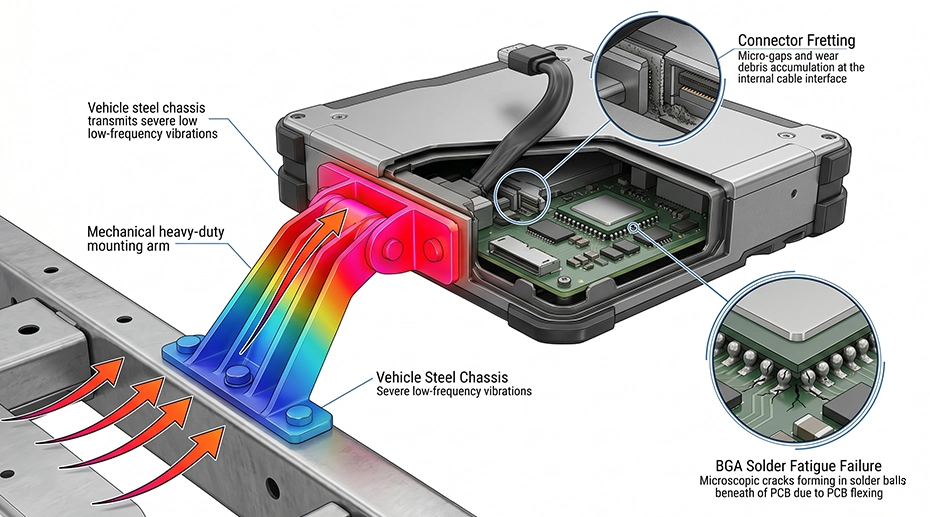
Table of Contents
1. Vibration: The Silent Killer of Fleet Electronics
A tablet bolted to a truck dashboard looks stable. But inside the chassis, the PCB is flexing at a microscopic level with every engine rotation, every pothole, every gear shift. Over thousands of operating hours, this flexing causes three distinct failure modes — none of which are covered by a standard drop test, and none of which produce visible external damage until the device stops working. This is why rugged tablets designed for vehicle mounting are engineered differently at the component level — from BGA underfill to connector plating specifications. For fleet managers deploying vehicle-ready fleet computing hardware, understanding these failure modes is the first step toward a reliable deployment.
1. Resonance Amplification
Every mounting arm has a natural frequency. When the vehicle's vibration matches that frequency — even at low amplitude — the arm becomes a mechanical amplifier. A 0.5mm chassis vibration becomes a 5mm oscillation at the tablet. This is why some mounting positions destroy tablets faster than others, even on the same vehicle.
2. Fretting Corrosion
At connector contact points, microscopic vibration causes the tin or gold plating to wear through. The exposed base metal oxidizes, creating a high-resistance layer. The connector that passes continuity testing at installation develops intermittent failures after 6-12 months of vibration.
3. BGA Solder Joint Fatigue
The processor and storage chips are attached to the PCB by hundreds of tiny solder balls. Under sustained vibration, these balls develop microscopic cracks. The device works — until the crack grows enough to break contact intermittently. Then: random reboots, storage errors, or complete failure with no visible damage.
"We had tablets failing on our mining trucks every 3-4 months. The mounts looked fine — nothing was loose. Turned out the mounting arm we were using had a resonance at 85Hz, which was exactly the frequency the truck's transmission generated at operating speed. We switched to a shorter, stiffer arm and the failures stopped within one maintenance cycle."
— Maintenance engineer, open-pit mining operation
2. What MIL-STD-810 Vibration Testing Actually Means
MIL-STD-810H Method 514.8 is the standard vibration test for military and industrial equipment. But it's not a single test — it's a family of test procedures, each simulating a different vibration environment. A device certified to MIL-STD-810H for vibration has been tested against a specific procedure, not all of them. Understanding which one matters for your deployment. For heavy-duty applications, specifying a vehicle-mounted computing solution that carries the correct MIL-STD-810 procedure for your vehicle type eliminates this guesswork.
TOPICON MDT865 and MDT880 are certified to MIL-STD-810G for vibration (Procedure I, general vibration), validating their ability to withstand the continuous vehicle vibration typical of truck cabs and fleet vehicle dashboards. For applications requiring Procedure III (composite wheeled vehicle) — such as tracked mining equipment or military deployments — consult our engineering team for application-specific validation. A fixed-mount vehicle terminal with aviation connectors is often the preferred architecture for these extreme environments.
3. Different Vehicles, Different Vibration Signatures
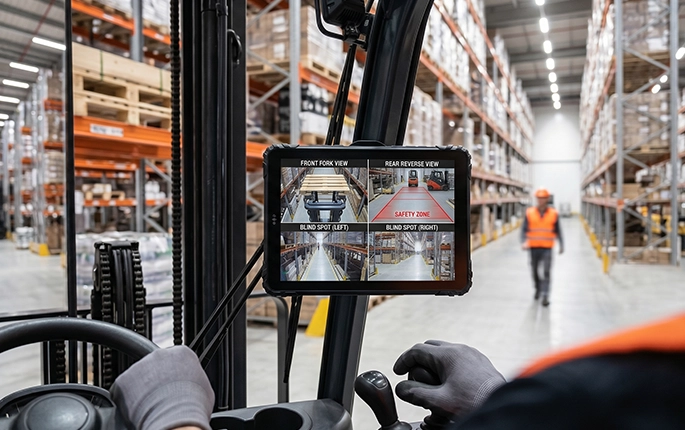
A tablet mounted in a forklift experiences a fundamentally different vibration environment than one in a long-haul truck. The mounting solution that works perfectly on a highway tractor may fail within weeks on a forklift operating over concrete expansion joints. Understanding the vibration signature of your target vehicle determines what mounting approach is appropriate. For vehicle mount tablets, matching the mounting hardware to the vehicle type is as important as the tablet's own ruggedness rating.

Long-Haul Trucks
Frequency range: 5-500 Hz, primarily engine harmonics and road surface transmission.
Amplitude: Moderate — highway surfaces generate relatively consistent, predictable vibration.
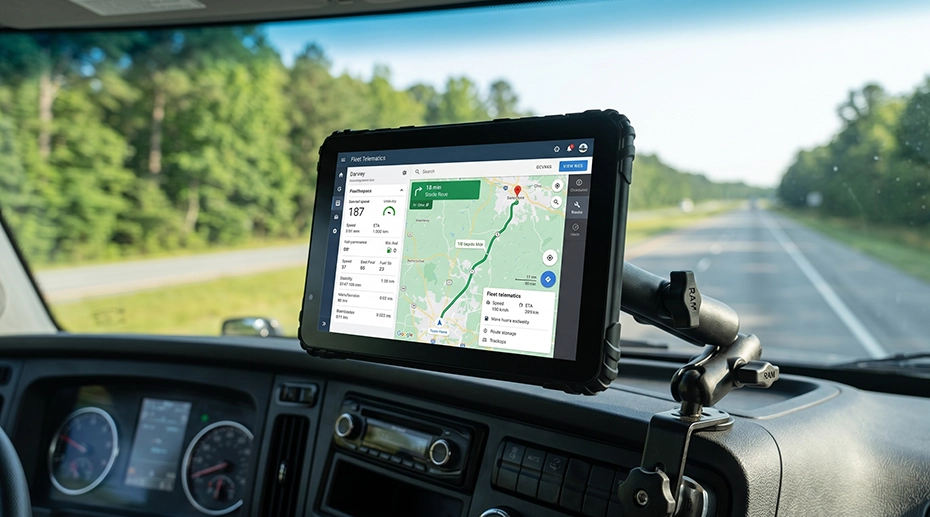
Mounting approach: Standard RAM mount arm with medium-length extension. Locking dock with pogo-pin contacts rated for sustained highway operation. Cable strain relief essential for long-duration runs. An in-vehicle computing platform pre-tested for highway vibration ensures years of trouble-free service.
Forklifts
Frequency range: 10-2000 Hz, with high-amplitude impact events from floor joints and uneven surfaces.
Amplitude: High — solid tires transmit every surface irregularity directly to the chassis.
Mounting approach: Short, stiff mounting arm to minimize resonance amplification. Overhead ROPS mounting preferred — reduces direct transmission path from wheels. Reinforced dock with positive locking mechanism.
Mining & Heavy Equipment
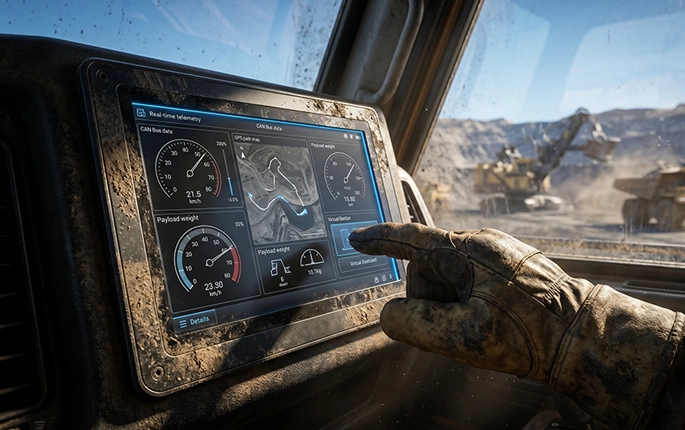
Frequency range: Broad-spectrum, 5-2000 Hz with continuous high-amplitude input from engine, tracks/wheels, and material handling impacts.
Amplitude: Extreme — sustained high-G vibration plus periodic shock events.
Mounting approach: Fixed bolt-on mounting with no articulating arms. Aviation connector (GX16/M12) interface instead of pogo-pin contacts for maximum vibration resistance. Panel PC form factor preferred over detachable tablet for permanent installations.

Buses & Transit Vehicles
Frequency range: 5-500 Hz, dominated by engine vibration and road surface transmission through air suspension.
Amplitude: Low to moderate — air suspension absorbs most high-frequency road vibration.
Mounting approach: Standard RAM mount compatible. Dashboard or console mounting. Pogo-pin docking sufficient for this vibration level. Driver-facing for transit operations.
4. Mounting Best Practices by Vibration Severity
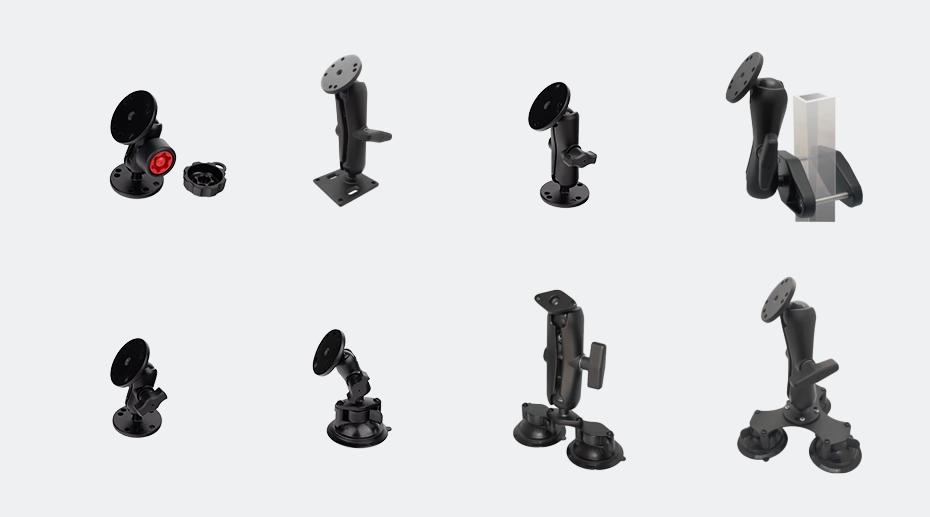
Low to Moderate Vibration (Trucks, Buses, Delivery Vans)
RAM mount with standard-length arm — provides flexibility and adjustability while maintaining adequate stiffness. Avoid extra-long arms (over 15cm) that amplify low-frequency vibration.
Pogo-pin docking station — rated for 10,000+ mating cycles. The spring-loaded contacts maintain consistent pressure through vibration. Clean contacts every 6 months as preventive maintenance.
Cable strain relief loop — leave a 5-8 cm service loop at the dock connection. Secure cables every 15-20 cm. The most common post-installation failure is a cable that fatigued at the connector due to unsupported weight.
Thread-locking compound on all fasteners — Loctite Blue (medium strength) on RAM mount ball joints and bracket screws. Re-torque at 3-month intervals during the first year of deployment.
High Vibration (Forklifts, Construction Equipment)
Short, stiff mounting arm — minimize the lever effect. A 5cm arm experiences significantly less resonance amplification than a 15cm arm under the same vibration input.
Overhead mounting on ROPS cage — the ROPS structure is isolated from the worst of the chassis vibration by the vehicle's own suspension mounting points. Better than dashboard mounting for forklifts.
Positive-locking dock with secondary retention — in addition to the standard dock latch, add a safety tether for deployments where an undocked tablet could become a projectile during operation.
Vibration-dampening washers — install rubber or polyurethane washers between the dock bracket and the vehicle mounting surface. These absorb high-frequency vibration before it reaches the tablet.
Extreme Vibration (Mining Equipment, Rock Crushers, Tracked Vehicles)
Fixed bolt-on installation — no articulating arms. Any joint or adjustment point is a resonance amplifier and a potential failure point. Use a rigid bracket bolted directly to the vehicle structure.
Aviation connectors (GX16/M12) instead of pogo-pin docking. Thread-locked connectors cannot vibrate loose. For tablet-style devices, use a locking dock with reinforced latch mechanism — but recognize that fixed-installation Panel PC architecture is inherently more vibration-resistant than any detachable tablet solution. For extreme environments, industrial rugged tablets with aviation connector interfaces provide the highest level of vibration resistance.
Panel PC form factor preferred. The PC1080 Panel PC with aviation connectors is designed specifically for this environment — no moving dock mechanism, no pogo-pin contacts, and BGA underfill for solder joint reinforcement under sustained vibration.
Isolation mounting platform — for the most extreme environments, mount the entire device on a vibration-isolating plate with tuned elastomeric mounts. This decouples the device from the vehicle's vibration frequencies. Consult engineering for custom isolation solutions. Fixed-installation vehicle mount terminals with aviation connectors eliminate the connector vibration failure points that limit docked architectures in these environments.
5. See Vibration Resistance in Action
MIL-STD-810G Drop, Vibration & Temperature Testing — MDT865/MDT880
Reliability Test — Drop, Vibration & Temperature
MDT865 and MDT880 undergoing MIL-STD-810G validation — sustained vibration, multiple-axis drop testing, and thermal cycling to verify in-vehicle durability.
→ These are the same test procedures referenced in the MIL-STD-810G certification above. What you see in the video is what the device survived before being deployed to your fleet.
6. Frequently Asked Questions
How do I know if my tablet mount is amplifying vibration?
The simplest diagnostic: place your hand on the tablet while the vehicle is running at its typical operating RPM. If the tablet feels like it's vibrating more than the dashboard it's mounted to, the mount is amplifying vibration — the arm length, material, or mounting position is creating a resonance condition. Switch to a shorter arm, a stiffer material, or a different mounting location. For a vehicle-mount tablet with locking dock, a stiffer bracket eliminates this amplification.
Pogo-pin dock or aviation connector — which handles vibration better?
For sustained high-vibration environments, aviation connectors are more reliable — thread-locked contacts cannot vibrate loose. Pogo-pin docks are excellent for moderate vibration (trucks, buses, vans) where the convenience of one-hand docking is valuable. For mining equipment, tracked vehicles, or rock crushers, aviation connectors or fixed Panel PC installation is the safer choice.
Does MIL-STD-810G certification guarantee vibration survival?
It guarantees the device survived a specific vibration test procedure in a lab — not that it will survive every vibration environment indefinitely. The certification is a validation baseline, not a deployment guarantee. Mounting design, maintenance, and matching the device to the actual vehicle vibration profile are equally important. TOPICON MDT865 and MDT880 are MIL-STD-810G certified for Procedure I (general vehicle vibration).
What's the most overlooked vibration protection measure?
Cable strain relief. The vast majority of post-installation failures in fleet deployments are cable-related, not device-related. A cable that's zip-tied too tightly, left hanging unsupported, or routed without a service loop will fatigue at the connector — causing intermittent failures that are extremely difficult to diagnose because they're vibration-dependent. Source a rugged MDT with proper cable management →
Deploying Tablets in High-Vibration Vehicles?
TOPICON rugged MDTs are MIL-STD-810G certified for vehicle vibration, with locking docking stations, aviation connector options, and fixed-mount Panel PC architecture for the most demanding environments.
Related Deployment & Hardware Resources