eSIM in Fleet Telematics — Cross-Border Connectivity and Vibration Reliability
A truck running between Rotterdam and Prague crosses four national networks in a single shift. The vehicle-mounted tablet in the cab maintains a cellular session through all four — until one morning it doesn't. The driver reports intermittent loss of dispatch. The integrator checks the antenna, the firmware, the carrier settings. The actual failure is inside the SIM socket: a spring contact that has been micro-abrading against the card edge for eighteen months of road vibration, and has finally reached the resistance threshold where the modem loses the card intermittently.

Field Observation
SIM-related connectivity failures in fleet deployments present with the same symptom every time — intermittent loss of service that resolves on its own:
The issue never appears in the depot, only on certain routes
Replacing the SIM card temporarily resolves it — for a few months
The socket itself is the failing component, not the card
About the Author
TOPICON Hardware Engineering Team
Specialists in cellular connectivity architecture for vehicle-mounted hardware, eSIM integration, and cross-border fleet deployments across European and North American markets.
Why the SIM Socket Is a Wear Component
A physical SIM card is held in place by six to eight spring-loaded contacts inside a metal or plastic socket. The card is not rigidly fixed — it must be removable by the driver or technician. That removability is the failure mechanism. Every vibration cycle causes micro-movement at the contact interface. Over months, the gold plating on the contacts wears through, exposing the base metal underneath. Contact resistance rises. The modem begins to report card errors intermittently.
This failure mode is well documented in the diagnosis guide for fleet tablet cellular disconnection, but the underlying cause is mechanical, not electronic. Replacing the SIM card does not solve it — the socket contacts are what have degraded. And a socket replacement requires opening the enclosure, which on an IP67-rated device means breaking the seal and invalidating the environmental protection.
The second failure mode is operational rather than mechanical. A fleet operating across multiple countries needs either a roaming plan (expensive outside the EU, limited within it under fair-use policies) or multiple physical SIM cards, one per country or region. Managing a library of SIM cards across a fleet of 200 vehicles means tracking which card is in which device, provisioning new cards when a route changes, and physically visiting vehicles to swap them. Every swap is another socket insertion cycle — which accelerates the wear described above.
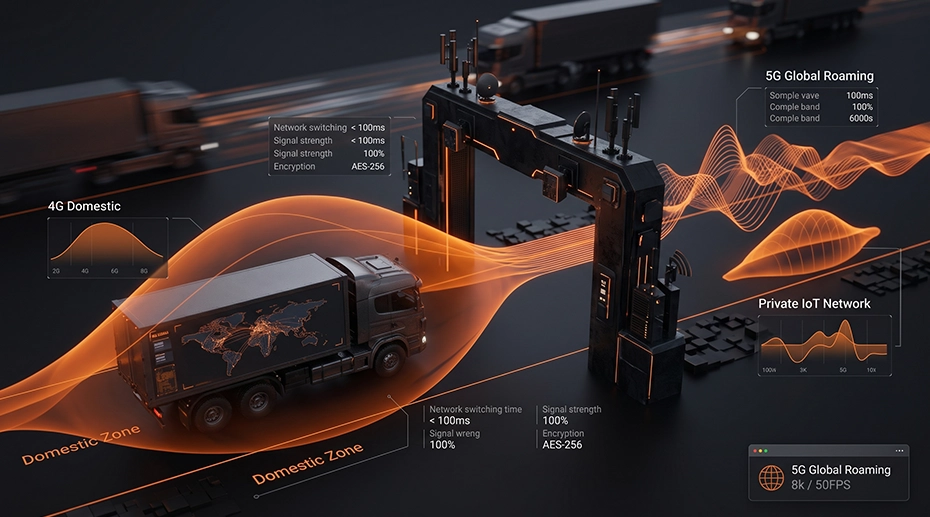
eSIM Removes the Socket and the Card Swap
An eSIM is a soldered chip. There is no socket, no spring contact, no removable card. The subscriber profile is stored in the chip's secure element and is provisioned over the air. For a vehicle that experiences continuous vibration, the mechanical argument is immediate: a component with no moving parts and no mechanical interface cannot suffer contact wear.
The operational argument is equally direct. With Remote SIM Provisioning, the carrier profile on the device can be changed from a management platform without touching the vehicle. A fleet that needs to switch carriers for a new route, or add a second profile for cross-border operation, does not send a technician to 200 vehicles. The change is issued remotely, the device downloads the new profile, and the swap completes without physical intervention.
For fleet management hardware deployed across multiple countries, this changes the cost model of connectivity. SIM card logistics — procurement, inventory, distribution, physical replacement — disappear from the operational budget. What remains is the carrier contract itself, which the fleet negotiates directly.
For fleet management hardware deployed across multiple countries, this changes the cost model of connectivity. SIM card logistics — procurement, inventory, distribution, physical replacement — disappear from the operational budget. What remains is the carrier contract itself, which the fleet negotiates directly. Applications that depend on continuous data — map tile downloads, live traffic updates, route recalculation — benefit from the same architecture. The hardware requirements for navigation and GIS deployments cover the GNSS and display side of that equation.
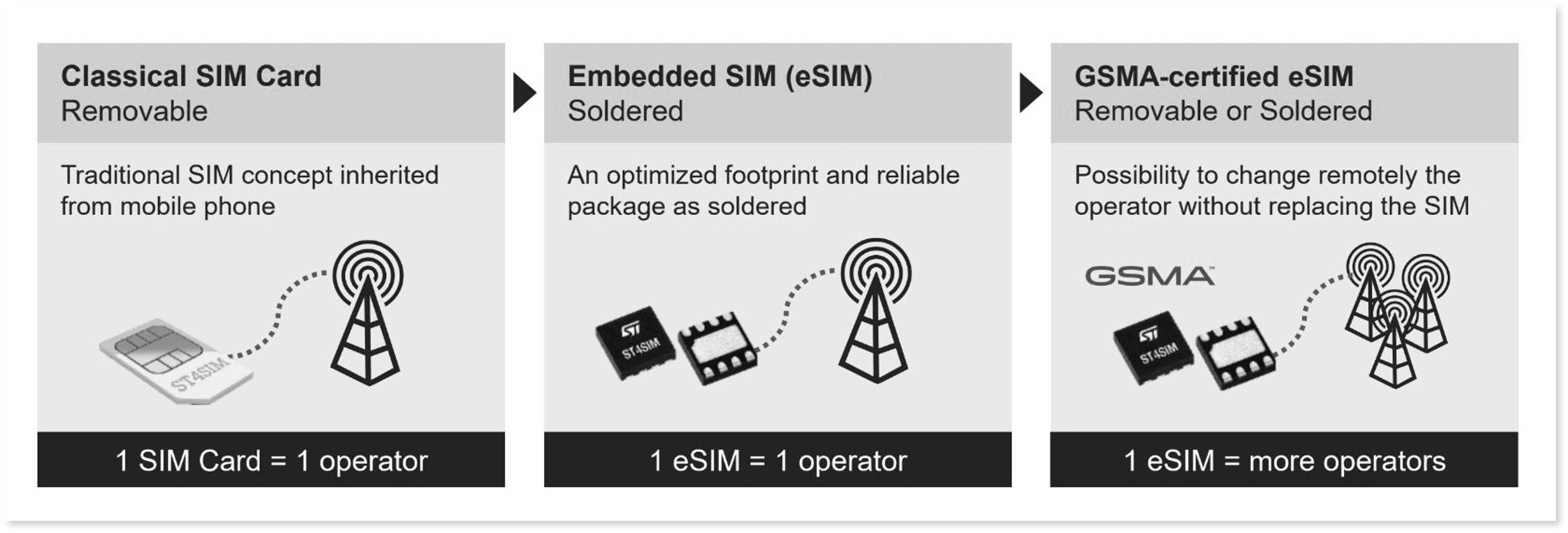
SGP.22 vs SGP.32: Why Consumer eSIM Does Not Fit Fleet Hardware
The eSIM standard most people encounter is SGP.22 — the consumer specification used in smartphones. It works by displaying a QR code that the user scans to download a carrier profile. The process assumes a human is present, the device has an active internet connection (usually WiFi), and someone can interact with a screen to confirm the download.
None of those assumptions hold for a fleet device. The tablet may be installed in a vehicle with no WiFi available, no one present to scan a code, and no screen interaction possible during initial provisioning. A consumer eSIM approach would require a technician to visit every vehicle with a phone, scan a code, and wait for the profile download to complete over cellular — which is the connection that has not yet been established.
GSMA SGP.32 is the IoT-specific specification built to solve this. It defines two components that SGP.22 does not have. The IPA — IoT Profile Assistant — runs either on the device or on the eSIM chip itself and provides the interface between the device and the remote management system. The eIM — eSIM IoT Remote Manager — is the server-side component that triggers profile management across a single device or an entire fleet.
The practical difference is bootstrap connectivity. An SGP.32 device ships with a bootstrap profile pre-loaded — a minimal connectivity profile whose only purpose is to establish the first cellular session and download the actual operational profile. The device powers on, connects through the bootstrap profile, receives its assigned carrier profile, and switches to it. No human interaction, no WiFi, no QR code. This is the same zero-touch principle that applies to MDM enrollment for fleet tablets, applied to the cellular layer.
What Hardware-Side eSIM Support Includes — and What It Does Not
This distinction matters at the procurement stage, because fleet operators frequently assume that an eSIM-capable device includes cellular service. It does not. The hardware provides the technical capability. The carrier relationship remains a separate commercial contract between the fleet operator and their chosen mobile network operator.
Included in the Hardware
The GSMA-certified eSIM chip soldered to the board. The IPA firmware implementing the SGP.32 device-side interface. The bootstrap profile slot for initial connectivity. Firmware support for profile download and switching. Integration with the device's modem and cellular stack.
Not Included
The carrier subscription or data plan. The operational carrier profile itself. The eIM server if the customer does not already operate one. The commercial agreement with the mobile network operator. These are the customer's responsibility and are established separately from the hardware purchase.
For system integrators building a fleet solution, this means the hardware platform provides the technical foundation. The connectivity service is a commercial layer the integrator or their end customer arranges. In practice, the integrator often bundles both — offering the fleet a complete solution that includes hardware and a managed connectivity plan — but the underlying contract with the MNO is signed by the integrator, not the hardware manufacturer.

Current Deployment Status
The MDT880 5G ships with eSIM functionality in production. The device supports SGP.32 v1.2 and includes the hardware and firmware components described above. Integrators ordering the MDT880 for fleet deployment receive a device that is ready for remote SIM provisioning from day one.
For fleets running mixed hardware, the eSIM capability is being extended across the fleet platform. The MDT865, MDT1065, and MDT680 are covered under the planned rollout — the goal is a consistent eSIM architecture across the product line so that integrators can standardise on one connectivity approach regardless of which model they deploy in each vehicle class.
Managing eSIM profiles across a fleet requires two layers of remote management: the device layer (firmware, configuration, application control) and the carrier layer (profile provisioning and switching). Both are handled through the same platform. The TOPICON MDM platform includes built-in eIM functionality — the server-side role defined by SGP.32 for triggering profile management across a fleet. There is no separate eIM server to deploy, no third-party subscription, and no integration project required to connect the two layers. The integrator manages device configuration and carrier profiles from one console.
Single Point of Failure
A SIM socket that fails intermittently is a single point of failure that no diagnostic tool reports clearly. The modem logs an occasional card error. The device re-registers. The session resumes. The event is not severe enough to trigger an alert, and the pattern only becomes visible when someone reviews months of logs. By then, the degradation is advanced. The device is out of warranty. The fleet has been operating with intermittent connectivity for a period no one can identify precisely. A soldered eSIM has no equivalent failure mode — there is no mechanical interface to degrade, so the device does not develop this class of fault over time.

Frequently Asked Questions
Does the device include a cellular data plan?
No. The hardware includes the GSMA-certified eSIM chip, the IPA firmware, the bootstrap profile slot, and access to the built-in eIM function on the MDM platform. What is not included is the cellular subscription itself — the operational carrier profile and the commercial agreement with a mobile network operator. That remains a separate contract between the fleet operator and their chosen carrier. The hardware provides the provisioning infrastructure; the connectivity service is negotiated independently.
Can the carrier be changed after the device is deployed?
Yes. This is the primary operational benefit of SGP.32. A new carrier profile is pushed to the device remotely through the eIM. The device downloads the profile, switches to it, and the previous profile is deactivated. No physical visit, no card replacement, no socket insertion cycle. The change is recorded in the eIM's audit log. For fleets that add a new operating country or want to renegotiate connectivity terms, this avoids the logistics of a physical SIM swap across the fleet.
Which mobile network operators are supported?
The eSIM chip used in the platform is certified to the GSMA eUICC specifications and supports the standard remote provisioning interfaces. Carrier availability depends on the operator's support for SGP.32 profile delivery and their commercial willingness to provide profiles for IoT devices. The hardware does not restrict the customer to a specific operator — the profile can be provisioned from any MNO or MVNO that supports the standard. Specific carrier agreements are a commercial matter between the fleet operator and the carrier.
Can a device with eSIM also accept a physical SIM card?
Depends on the model. Some devices in the platform support a hybrid architecture — one physical SIM slot plus one embedded eSIM, allowing the fleet to run a local physical card alongside an eSIM profile for cross-border use. This configuration is useful during transition periods when a fleet is migrating from physical to eSIM, or where a specific local carrier only offers physical SIMs. Consult the specific model's specification for the exact configuration.
Does eSIM affect MDM functionality?
No. The remote management platform for fleet devices operates over whatever cellular connection the modem establishes, whether that connection comes from a physical SIM or an eSIM profile. MDM functions — firmware updates, configuration sync, remote screen control — work identically in both cases. The eSIM capability is a layer underneath MDM, not a replacement for it.
Where eSIM Changes the Deployment Model
The cross-border and vibration arguments apply most directly to operations where vehicles or equipment move between network coverage areas, or where physical card handling is operationally difficult:
• Mining equipment moving between remote sites with different carrier coverage
• Intercity bus fleets crossing regional network boundaries on fixed routes
• Construction equipment rotating between project sites with different network environments
• Long-haul fleets where vehicle vibration degrades physical SIM socket contacts over time
Deploying a Cross-Border Fleet? eSIM Removes the Card Logistics Entirely.
The MDT880 5G ships with production eSIM support built on GSMA SGP.32. No socket to wear, no card to replace, no technician visit to change carriers. The hardware side is ready — the carrier contract stays with you.