EU Regulation 165/2014 and Fleet Tablet Hardware — What the Daily Walkaround Inspection Means for Device Selection
A driver in Rotterdam begins every shift the same way: walk around the truck, check tyres, lights, mirrors, brakes, load securing, and documentation. Under EU Regulation 165/2014, this inspection must be documented. The hardware that captures it — whether a fixed terminal that stays in the cab or a vehicle tablet that undocks for the walkaround — determines whether the inspection is recorded digitally, duplicated on paper, or skipped when time pressure mounts.

Field Observation
EU fleets report three consistent patterns in walkaround inspection compliance:
Dedicated handheld devices that are lost, broken, or left at the depot
Fixed terminals that force drivers to re-enter inspection data manually after completing a paper form outside
About the Author
TOPICON Hardware Engineering Team
Specialists in European fleet deployment compliance, walkaround inspection workflow integration, and vehicle tablet hardware selection for EU member state operations. Supporting system integrators and fleet operators across Germany, the Netherlands, Belgium, and France.
What Regulation 165/2014 Actually Requires
EU Regulation 165/2014 governs tachographs in commercial vehicles. It defines how driving time, rest periods, and vehicle movement must be recorded. For fleet operators, the practical consequence is that every vehicle must have a functioning, tamper-resistant recording system, and drivers must be able to demonstrate compliance during roadside inspections. The regulation does not mandate a specific walkaround inspection device, but Directive 2014/47/EU — which establishes the roadside inspection framework — requires that vehicles be in a roadworthy condition at all times. The walkaround inspection is how drivers and operators evidence this.
In Germany and the Netherlands, enforcement officers from BAG and ILT conduct roadside checks that include examination of the vehicle's physical condition. A driver who cannot produce evidence of a completed pre-trip inspection faces fines, and the operator may be issued a compliance notice. The inspection record is not a formality — it is the operator's defence against liability when a defect is discovered at the roadside.
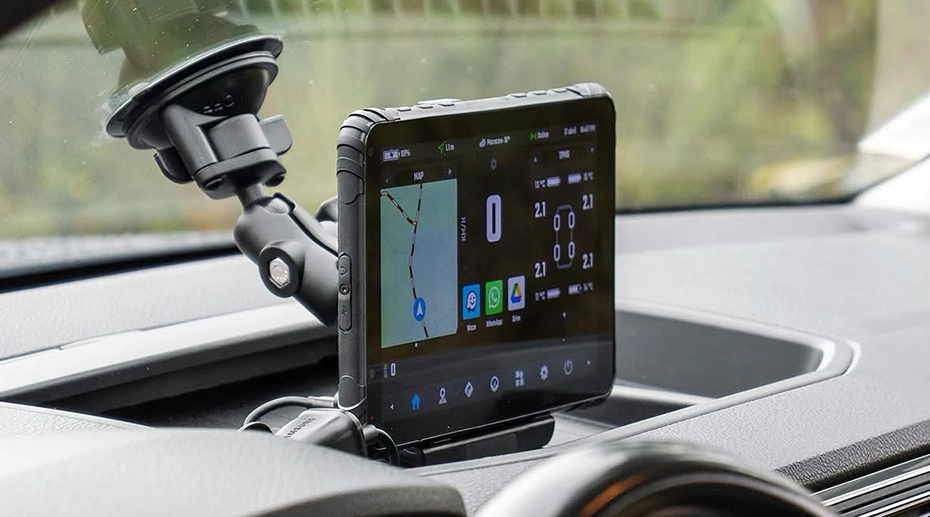
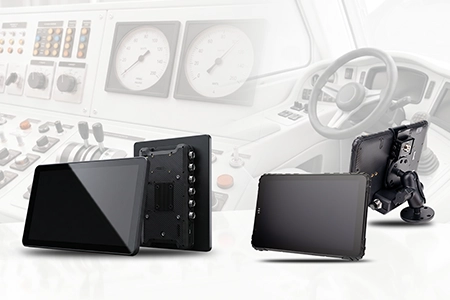
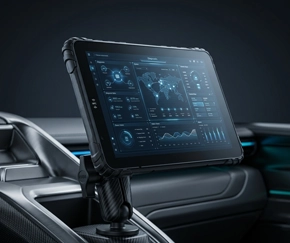
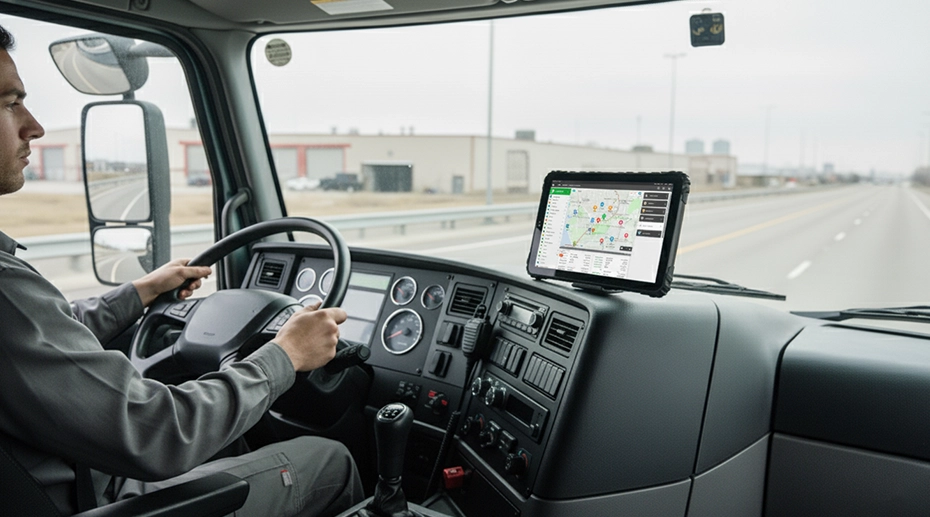
The hardware implication is direct: the device that captures the inspection must be usable outside the cab, in daylight, in rain, and with gloved hands. A fixed in-vehicle computing platform that stays bolted to the dashboard can display an inspection checklist, but it cannot follow the driver around the vehicle. A detachable tablet with a quick-release dock can. The distinction between these two hardware architectures is the difference between a digital workflow and a paper one.
The Workflow Problem: Where Inspection Documentation Breaks Down
A walkaround inspection has eight to twelve checkpoints: front lights, left side tyres, left side lights, rear lights, right side tyres, right side lights, mirrors, windscreen, load securing, brake lines, couplings, and documentation. The driver moves around the vehicle. The device that records the inspection must move with them.
With a fixed terminal, the driver stands outside the vehicle with a paper form or a separate handheld device, records the inspection, returns to the cab, and re-enters the data into the terminal. The double entry introduces error: a defect noted on paper may be missed in the digital record, or the driver may simply record "no defects" without completing the physical inspection because the terminal is ten metres away and the pressure to depart is real.
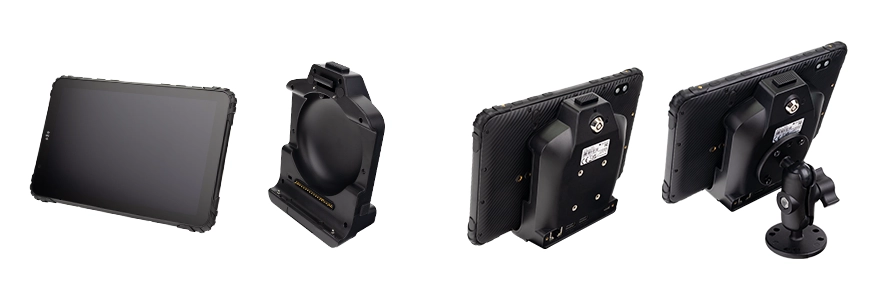
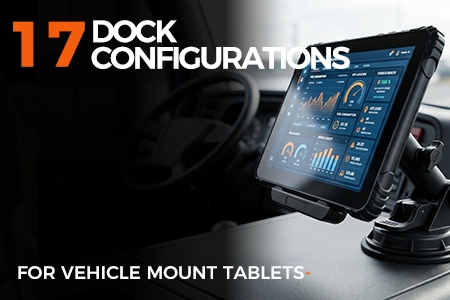
With a detachable vehicle tablet with a hand-latch quick-release dock, the driver undocks the device in one second, walks the inspection route, taps each checkpoint as it is physically verified, photographs any defects, and re-docks the tablet upon returning to the cab. The inspection record is complete, digital, time-stamped, and geographically verifiable. The data never leaves the device. There is no paper form. No double entry. No "no defects" checkbox that the driver cannot support if challenged.
The workflow difference is mechanical, not procedural. The driver does not need to be trained to use two devices. The dock design determines whether the digital workflow is physically possible. This is why fleet management hardware selected for EU operations must be evaluated against the walkaround workflow, not just against a specification sheet.
Five Hardware Requirements for 165/2014-Compliant Inspection Workflows
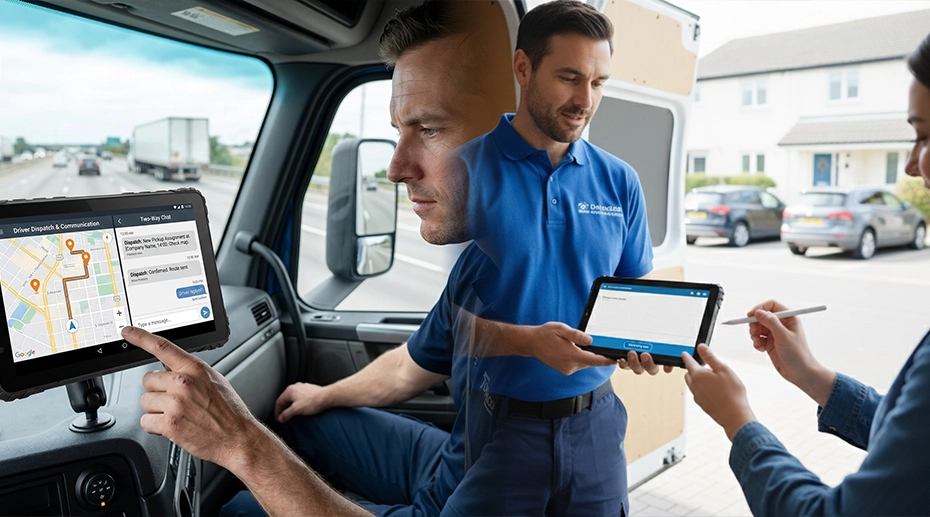
Based on deployment experience across EU member states, five hardware characteristics determine whether a walkaround inspection workflow succeeds or fails in daily operation.
1. One-Hand Quick-Release Dock
The dock release must require one hand and approximately one second. If undocking requires two hands or a tool, drivers will not do it at 6 a.m. in the rain. The mechanical friction of the dock determines whether the digital inspection happens at all.
2. Daylight-Readable Display
The inspection happens outside, in daylight, often in direct sun. A 700-nit anti-glare or 1000-nit display is the minimum for reading checklist items and photographing defects without stepping into shade. A 300-nit consumer display is unreadable at 2 p.m. on a concrete yard.
3. IP67 Weather Sealing
Northern European winters mean rain, sleet, and snow. The device will be exposed to weather during the inspection. IP67 sealing ensures the dock connector, speaker grille, and charging port survive repeated wet-weather use without corrosion or water ingress.
4. Glove-Compatible Touchscreen
At -5°C, the driver wears insulated gloves. A capacitive touchscreen without glove mode is unusable. The driver removes a glove, taps the screen, and loses dexterity. Glove mode must be a hardware specification, not a software workaround.
5. 9-36V Ignition-Sensed Power
The device must power on when the vehicle starts and enter suspend when the engine stops. Continuous charging through the dock with ignition sensing prevents overnight battery degradation and ensures the tablet is charged and ready for the next morning's inspection.
Digital Inspection vs Paper: What Enforcement Officers See
A paper checklist filled in at 5:30 a.m. and a digital inspection record with GPS timestamps are both "documentation" in the broad sense, but they carry very different weight at the roadside.
For a fleet operator with 50 vehicles, the cumulative liability protection of digital inspection records is substantial. When a defect is found at the roadside — a worn tyre, a cracked light lens — the operator's defence against negligence is the inspection record from that morning. If the record is paper, the defence is weak. If it is a GPS-time-stamped digital record with a photograph showing the component in acceptable condition at 6:12 a.m., the defence is strong.
Single Point of Failure
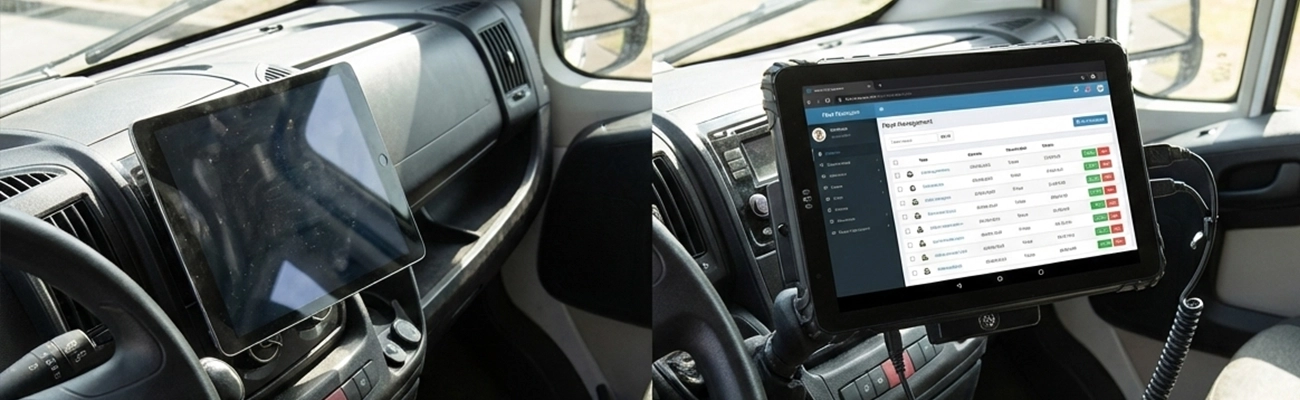
The gap between the in-cab terminal and the outside inspection route is a single point of failure that paper fills. When the device cannot follow the driver around the vehicle, the inspection data must cross a boundary — from outside to inside, from paper to digital, from handheld to terminal. Every crossing is an opportunity for omission, error, or fabrication. The driver who re-enters data after the fact is not lying; they are reconstructing a workflow that the hardware forced them to split. A detachable tablet closes the gap by keeping the inspection data on the same device that navigates, logs hours, and communicates with dispatch — no boundary, no crossing, no loss.
Frequently Asked Questions
Does Regulation 165/2014 require a specific type of device for walkaround inspections?
No. The regulation does not specify a particular device or software platform for walkaround inspections. It mandates that vehicle roadworthiness be demonstrable, and Directive 2014/47/EU establishes the roadside inspection framework. The device selection is a fleet operator decision — but the practical requirement is that the inspection record must be credible evidence that withstands scrutiny during enforcement stops.
Can a fixed in-cab terminal be used for walkaround inspections without a separate handheld?
Technically yes, but operationally the workflow forces double entry. The driver performs the inspection outside, records findings on paper or memory, returns to the cab, and enters the data into the fixed terminal. This creates a boundary between the physical inspection and the digital record. A detachable tablet with a quick-release dock eliminates the boundary by keeping the device with the driver throughout the inspection.
What happens during a BAG or ILT roadside inspection if the walkaround record is missing?
The driver may be issued a fine, and the operator may receive a compliance notice requiring evidence of systematic inspection procedures. Repeated violations can lead to operating licence sanctions. In Germany, failure to demonstrate pre-trip inspection compliance is treated as an operational deficiency, not a minor paperwork error. The inspection record is the operator's evidence, and its absence transfers the burden of proof to the operator.
How does a quick-release tablet integrate with the MDM system for audit purposes?
The TOPICON MDM platform provides device-level audit trails: firmware version, configuration state, and operation history are logged server-side with timestamps. For inspection workflows, the MDM can enforce kiosk mode to lock the device to the inspection app, restrict app whitelisting, and track device usage patterns. The audit trail is accessible through the web console and can be exported for compliance reporting.
Deploying Fleet Tablets for EU Compliance? The Walkaround Workflow Must Be Digital End-to-End.
A detachable tablet with a one-hand quick-release dock keeps the inspection data on the same device throughout the walkaround — no paper, no double entry, no data boundary to lose information. Combined with MDM audit trails and ignition-sensed power, the workflow produces records that survive enforcement scrutiny.