FMCSA ELD Compliance and Fleet Tablet Hardware — What the Mandate Means for Device Selection
A long-haul carrier operating across state lines faces roadside inspections where the ELD record — not the driver's word — determines whether hours-of-service violations are issued. The hardware that runs the ELD application must be tamper-resistant, continuously powered, and installed so that it cannot be removed without leaving evidence. Here is how the FMCSA mandate translates into specific device selection criteria for in-vehicle computing platforms used for ELD compliance.

Table of Contents
Field Observation
US fleets report three recurring ELD hardware failure patterns that surface only at roadside inspections:
Suction-cup mounts that fail, leaving the ELD device on the cab floor during a Level 1 inspection
USB-powered tablets that drain the vehicle battery overnight or fail to charge during continuous operation
About the Author
TOPICON Hardware Engineering Team
Specialists in US fleet compliance hardware, ELD integration, and vehicle power architecture. Supporting system integrators and fleet operators across the United States with hardware that survives roadside inspections and daily commercial vehicle operation.
What the FMCSA ELD Mandate Actually Requires of Hardware
The FMCSA ELD rule requires that commercial motor vehicles subject to hours-of-service regulations use an electronic logging device that automatically records driving time, engine hours, vehicle movement, and location. The device must be integrally connected to the vehicle's engine — either through the diagnostic port or through a direct data link — and must be tamper-resistant. The ELD provider must be registered with the FMCSA, and the hardware must be capable of displaying the record of duty status to the driver and transmitting it to law enforcement during roadside inspections.
The hardware implications are not stated in the regulation as a specification sheet, but enforcement practice has made them clear. A tablet that is not securely mounted does not meet the intent of the rule, even if the software is ELD-certified. A device that loses power when the engine is cranked cannot maintain a reliable record. A tablet that can be removed and replaced without evidence — or whose ELD application can be closed by the driver — undermines the tamper-resistance requirement.
For fleet management tablets deployed for ELD compliance in US fleets, the selection process must evaluate hardware characteristics that go beyond processor speed or screen size. The device is part of a regulatory evidence chain. Its physical installation, power architecture, and tamper-resistance features are as important as the ELD software it runs.
Five Hardware Requirements for FMCSA-Compliant ELD Deployments
Based on roadside inspection patterns and fleet deployment experience, five hardware characteristics determine whether an ELD deployment survives enforcement scrutiny.
1. Secure, Fixed-Mount Installation
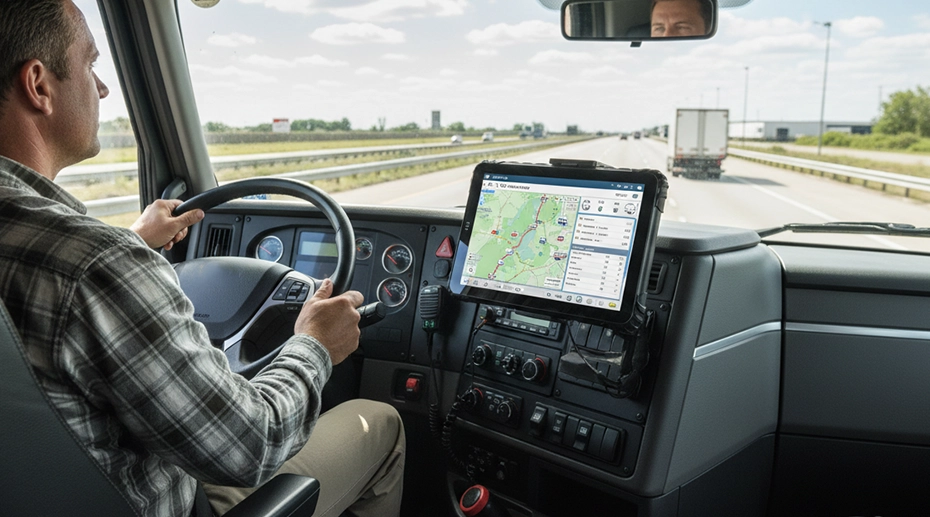
The ELD device must be mounted in a fixed position that keeps it visible and accessible to the driver without obstructing vehicle controls. Suction-cup mounts and loose cradles do not meet the intent of the rule. The dock must hold the tablet against sustained vibration and prevent it from becoming a projectile in a collision.
2. Ignition-Sensed Vehicle Power
The device must be powered from the vehicle's electrical system — not a USB cable — with ignition sensing that starts the device when the engine is running and suspends it when the engine stops. This prevents battery drain and ensures the device is always ready when the vehicle is in operation. A 9-36V wide voltage input covers the 12V and 24V electrical systems found across US commercial vehicles.
3. Tamper Resistance Through Kiosk Mode
The ELD application must not be closable by the driver. Android kiosk mode locks the device to the ELD app, prevents access to system settings, and blocks installation of unauthorized applications. The MDM server enforces this policy remotely and can restore it if the device is factory reset. A device that runs the ELD app as a background process while allowing the driver to open other apps does not meet the tamper-resistance requirement.
4. Daylight-Readable Display
The driver must be able to read hours-of-service status at a glance, in direct sunlight, without taking their eyes off the road for more than a moment. A 700-nit anti-glare or 1000-nit display is the minimum for practical in-cab readability. A 300-nit display requires the driver to lean forward and squint — a distraction that becomes a safety issue during operation.
5. Survivable During Engine Cranking
When the driver turns the key, the starter motor draws hundreds of amps and causes a momentary voltage drop. A device without proper power conditioning will reboot during this drop — losing the ELD session, corrupting the log, and requiring the driver to re-enter data. The hardware must include hold-up capacitance or equivalent power conditioning to survive cranking without interruption.
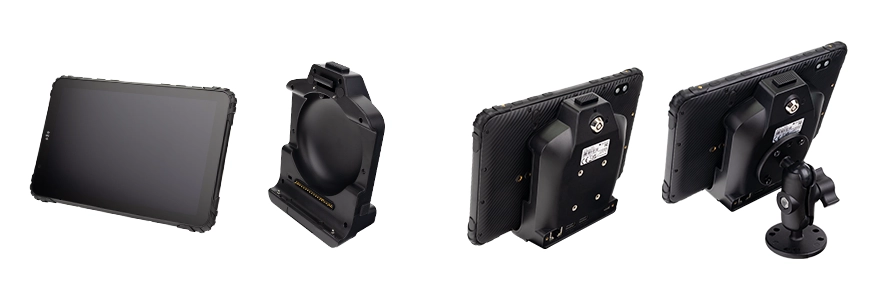
Fixed Terminal vs Detachable Tablet: The ELD Workflow Tradeoff
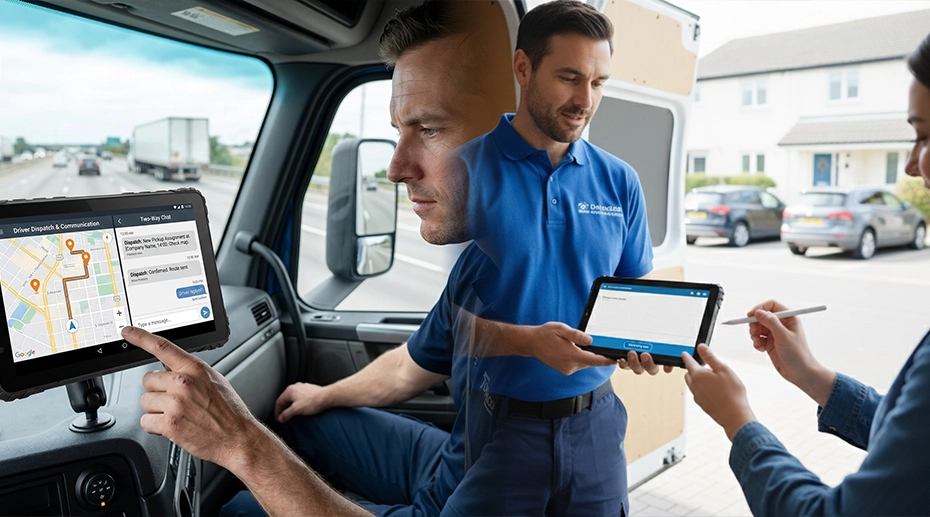
US fleets running ELD applications face the same physical workflow issue as EU fleets with walkaround inspections: the device that logs hours-of-service must be in the cab while driving, but the driver may need the same device outside the cab for pre-trip inspections, DVIR, or signature capture at delivery.
A fixed terminal solves the mounting and tamper-resistance requirements but forces the driver to use a second device for any off-cab task. A detachable tablet with a quick-release dock that survives daily undocking solves both: the device stays mounted and tamper-proof while driving, and undocks in one second for the DVIR walkaround. The dock remains fixed. The tablet moves with the driver.
For a fleet operating in the United States, where ELD violations carry fines of $1,000+ per offense and repeated violations can trigger carrier compliance reviews, the hardware decision is not academic. The device that runs the ELD app is part of the carrier's compliance infrastructure. Its mounting, power, and tamper-resistance characteristics are auditable, and its failure is visible on the carrier's SMS (Safety Measurement System) score.
Single Point of Failure
An ELD device that reboots during engine cranking is a single point of failure that corrupts the compliance record at the moment the vehicle starts moving. The driver turns the key, the voltage drops, the tablet restarts, and the ELD session is lost. The record of duty status no longer reflects the actual trip. The driver must manually reconstruct the log — an action that, if detected during a roadside inspection, appears as tampering. The hardware must be specified to survive the electrical environment of a commercial vehicle, not just the software environment of the ELD application.
Frequently Asked Questions
Can any Android tablet run a registered ELD app?
Technically yes, but the FMCSA requires that the ELD be integrally connected to the vehicle engine and tamper-resistant. A consumer tablet running an ELD app via USB power and a suction-cup mount does not meet the intent of the rule, regardless of whether the software is registered. The hardware installation is part of the compliance framework, not separate from it.
What happens if the ELD tablet loses power during a roadside inspection?
The inspector will ask the driver to demonstrate the record of duty status. If the device cannot power on, the driver is considered to have no ELD record for the current trip, and hours-of-service violations may be cited. The operator receives a compliance violation that appears on the carrier's SMS score. A device with ignition-sensed 9-36V power and hold-up capacitance prevents this failure mode by ensuring the device remains powered whenever the vehicle is in operation.
How does kiosk mode prevent ELD tampering?
Kiosk mode locks the device to a single application — in this case, the ELD app. The driver cannot close the ELD app, open other applications, or access system settings. The MDM server enforces kiosk mode remotely, and a factory reset triggers automatic re-enrollment through zero-touch or AOSP pre-configuration. This prevents the driver from disabling the ELD app, deleting logs, or installing unauthorized software that could interfere with the ELD data stream. The TOPICON MDM platform manages kiosk mode across the entire fleet.
Can a detachable tablet with quick-release dock meet the fixed-mount requirement?
The fixed-mount requirement applies to the installation architecture, not to whether the tablet is physically removable by the driver. The dock remains fixed to the vehicle via RAM mount, while the tablet is removable for off-cab tasks such as DVIR. As long as the dock provides secure mounting during vehicle operation and the ELD app remains in kiosk mode when the tablet is docked, the architecture meets the intent of the rule. The vehicle mount tablet platform with one-hand quick-release is designed for exactly this use case.
Deploying ELD Tablets for US Fleets? The Hardware Must Survive the Inspection, Not Just the App.
Ignition-sensed power, kiosk mode tamper resistance, daylight-readable display, and a dock that holds under vibration — these are the hardware requirements that keep FMCSA ELD deployments compliant at the roadside.