Rugged Tablet Screen Surface — Chemically Etched Anti-Glare vs Glossy, and Where a Screen Protector Fits
Not every rugged tablet uses the same screen surface. A handheld terminal and a vehicle-mount tablet may share the same processor, the same Android build, and the same dock connector, but the glass on top can be different — and that difference determines how the screen behaves in sunlight, how it cleans, and how long it stays readable. This article covers the two surface types used across the TOPICON lineup, the durability difference between chemically etched anti-glare and coated alternatives, and where the SCR-865-GL glossy protector fits as an optional physical protection layer.
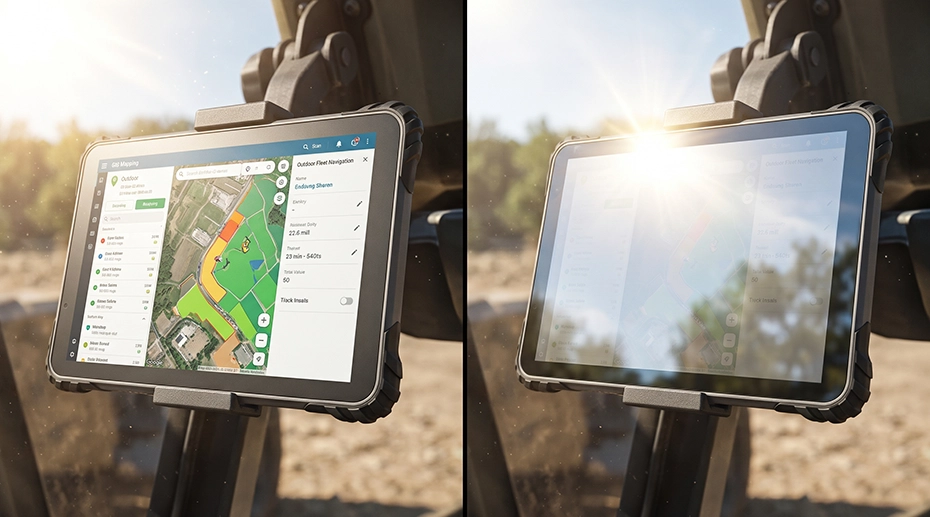
Table of Contents
1. Two Surface Types Across the Lineup
The TOPICON product line uses two display surface types. The distinction is not between “rugged” and “non-rugged” — it is between devices designed primarily for handheld use and devices designed for vehicle mounting.
The vehicle-mount tablets — MDT865, MDT880, MDT1065, and MDT1080 — use chemically etched anti-glare glass. The handheld terminals and Panel PC models use a glossy surface, because the primary viewing condition is not a sunlit windscreen. The complete rugged tablet product catalog lists the surface type for each model. Note that the optional SCR-865-GL protector is itself glossy — it is discussed in section 4 as a physical protection trade-off, not a default upgrade.
2. Why Chemical Etching, Not Coating
Anti-glare surfaces are produced by two main methods: applying a coating to the glass, or etching the glass surface itself. The two look similar at first glance. They behave differently over the life of a fleet deployment.
A coated AG surface is a sprayed or deposited layer on top of the glass. The layer scatters light and reduces specular reflection. Its weakness is durability: the coating can peel, wear unevenly, or degrade under repeated cleaning. The abrasion resistance of a sprayed coating is limited by the adhesion of the layer to the glass underneath.
Chemically etched AG is different. The glass surface itself is treated with an etching agent that creates a controlled micro-roughness, in the range of a few tens of microns. The scattering behaviour comes from the glass structure, not from an applied layer. There is no coating to peel, because there is no coating. The etched surface remains glass, and its service life is comparable to the tempered glass underneath it. Under standard abrasion testing, the resistance is roughly two to three times that of a sprayed coating.
For a vehicle-mount tablet that is cleaned daily and exposed to direct sunlight, the durability difference matters more than the initial optical measurement. A coated surface may measure the same reflectance on day one. A year of wipes separates the two. The 1000-nit sunlight readability guide covers the optical side of the same surface decision.
3. Fleet Failure Modes
Even a chemically etched surface accumulates wear in a vehicle cab. The damage pattern is different from a glossy screen because the etched surface has a matte texture that interacts with dust and cleaning differently.
• Chemical exposure: alcohol-based sanitisers and ammonia-based cleaners do not peel an etched surface the way they can degrade a coating, but they can affect the oleophobic top layer and the overall surface uniformity over many cycles.
• Glove and tool contact: a ring or a tool held in the same hand can chip an edge. The etched surface does not make the glass more fragile, but the matte texture makes edge chips slightly more visible under angled light.
• Protector edge lift: if a screen protector is applied, temperature cycling and vibration can cause the adhesive at the edge to lift. A lifted edge catches dust and produces a visible line across the display.
The handheld models with glossy surfaces have a different failure profile. Glossy glass scratches visibly with deep gouges, but the scratches are more localized and do not produce the diffuse haze that etched surfaces develop. The trade-off is that glossy glass reflects sunlight as a concentrated glare, which is why the vehicle-mount models use etched AG in the first place. The 800-nit vs 1000-nit comparison covers the optical contrast implications.
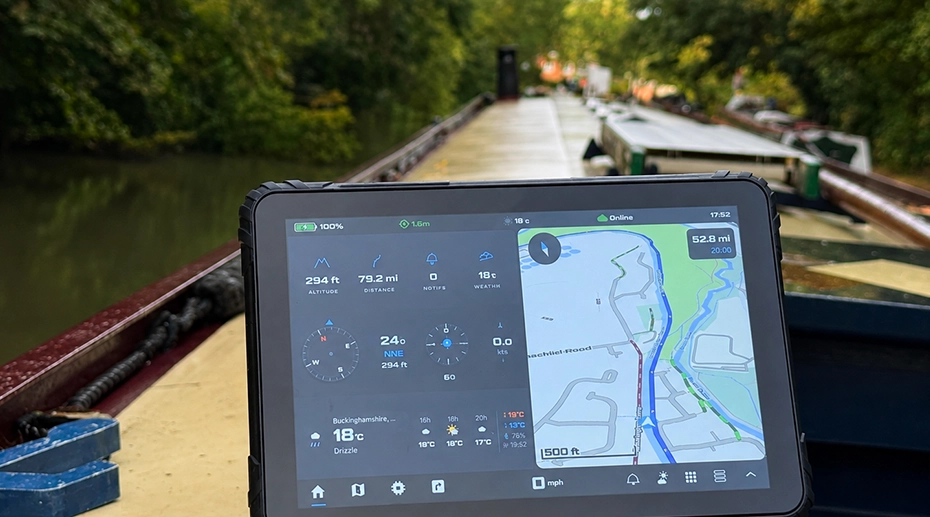
TOPICON MDT880 / MDT865 Sunshield Cap & Anti-Glare Demo
Sunshield installation and anti-glare surface demonstration on the MDT880 / MDT865 display.
4. The SCR-865-GL Glossy Protector
The SCR-865-GL is a 7H hardness glass screen protector designed for the MDT865 and MDT880. It is a glossy protector, not an anti-glare one. This distinction matters: the MDT865 and MDT880 displays already use chemically etched anti-glare glass, and the protector’s role is physical protection, not optical improvement.
• Glossy, transparent surface: the protector preserves image sharpness and colour fidelity. It does not scatter light the way the etched AG surface does.
• Trade-off: a glossy layer over an AG display reintroduces specular reflection. In direct sunlight, the screen will reflect the sky, the driver’s clothing, or the sun itself as a concentrated highlight — the exact condition the etched AG surface was designed to avoid.
• Model-specific fit: the SCR-865-GL matches the 8-inch chassis of the MDT865 and MDT880. The edge geometry and the camera/sensor cutouts are designed for these two models.
The reason the available protector is glossy rather than anti-glare is practical. The MDT865 and MDT880 ship with a chemically etched AG surface by default, so the demand for an AG protector is low — a fleet that wanted AG already has it on the bare display. What fleets ask for instead is a physical protection layer: a tempered glass protector to absorb impact and abrasion, or a plastic film for lower-cost protection where the glass is not exposed to hard contact. The glossy surface is the result of that demand pattern, not a design oversight.
The protector is therefore not a universal upgrade. It is a trade-off between two properties: physical protection and sunlight readability. A fleet that operates primarily in shaded cabs, indoor warehouses, or night shifts may accept the glossy surface because the image is sharper and the protector extends the life of the factory coating. A fleet that operates in direct sunlight for most of the shift should evaluate the combined surface before committing — the glossy protector may reduce readability more than the protection is worth. If the deployment needs both scratch protection and anti-glare behaviour, the practical configuration is either the bare etched AG display with a disciplined cleaning protocol, or a plastic film protector that adds minimal reflection. The sunlight readability guide covers the reflection calculation, and the SCR-865-GL product page covers the part number and compatibility.
5. Cleaning Chemicals and Surface Life
Chemical etching improves abrasion resistance compared with a sprayed coating, but it does not make the surface immune to chemical exposure. The etched glass is durable; the oleophobic top layer and the surface uniformity are still affected by what the fleet uses to clean the screen.
Alcohol-based sanitisers and ammonia-based glass cleaners are common in fleet cleaning. They do not dissolve the etched glass, but repeated exposure can degrade the oleophobic treatment and leave the surface looking uneven under angled light. A clean microfiber cloth dampened with a compatible cleaner is the recommended method. The cloth itself matters as much as the liquid: a cloth with embedded grit turns every wipe into an abrasion event, regardless of the surface type. The in-vehicle tablet platform documentation covers the cleaning recommendations for the etched AG models. The handheld models — MDT665 and MDT680 — use glossy glass and follow a different cleaning profile.
Single Point of Failure
A surface that is specified by brand name rather than by treatment type is a specification gap that surfaces after deployment. “Anti-glare” is not a single technology. A sprayed coating, a deposited film, and a chemically etched glass surface all carry the label, but they do not age the same way under daily cleaning and sunlight. The vehicle-mount models in the TOPICON lineup use chemical etching because the surface is the glass, not a layer on top of it — there is no coating to peel, and the abrasion resistance is higher than that of a sprayed AG surface. The screen protector adds a sacrificial layer on top, but it is only effective if it is inspected and replaced, and the glossy protector changes the optical behaviour of the display. The surface stack — etched glass, oleophobic treatment, and optional protector — is a deployment specification, not an accessory list.
6. Specification Checklist
Before specifying a rugged tablet for a fleet deployment, confirm the following surface characteristics.
• Etching depth and durability: for etched AG, is the etching depth and the abrasion resistance documented by the supplier? Chemical etching produces a surface whose life is comparable to the tempered glass itself, but the supplier should be able to describe the process and the abrasion test method.
• Protector surface type: if the fleet uses a protector, is it glossy or anti-glare? The SCR-865-GL is a glossy 7H protector for the MDT865 and MDT880, suited to shaded or indoor deployments. A glossy protector over an etched AG display reintroduces specular reflection.
• Protector replacement workflow: can the protector be replaced at the depot without special tools? A protector that requires a service return is a second failure point, not a sacrificial layer.
• Cleaning agent compatibility: is the fleet’s cleaning agent compatible with the oleophobic treatment? Alcohol and ammonia-based cleaners accelerate wear over repeated exposure.
• Optical evaluation in the cab: for direct-sun deployments, evaluate the combined surface — etched display plus protector — under actual cab lighting, not on a bench.
The complete rugged tablet product catalog lists the surface type for each model. The OEM customization program covers surface treatment options for volume deployments. The fixed vehicle mount terminal architecture, including the PC1090 panel PC, uses glossy glass for enclosed installations.
7. Frequently Asked Questions
Is chemically etched anti-glare better than a coated anti-glare surface?
For a fleet deployment, yes. A chemically etched surface is the glass itself, not a layer on top of it. There is no coating to peel, and the abrasion resistance is roughly two to three times that of a sprayed AG coating under standard abrasion testing. A coated surface may measure the same reflectance when new; the difference appears after months of cleaning.
Does the SCR-865-GL fit both the MDT865 and MDT880?
Yes. The SCR-865-GL is designed for the MDT865 and MDT880. It is a 7H hardness glossy glass protector, not a universal film cut to size.
Is there an anti-glare version of the screen protector?
An anti-glare protector can be produced, but the demand is low because the MDT865 and MDT880 already ship with a chemically etched AG display. Fleets that want AG already have it on the bare screen; what they ask for as a protector is physical protection, which is why the available part is glossy. For a direct-sun deployment that needs both scratch protection and anti-glare behaviour, the practical options are the bare etched display with a disciplined cleaning protocol, or a plastic film protector that adds minimal reflection.
Will the SCR-865-GL screen protector reduce sunlight readability?
Yes, in direct sunlight. The SCR-865-GL is a glossy protector, and the MDT865 / MDT880 displays use chemically etched anti-glare glass. Applying a glossy layer over an AG surface reintroduces specular reflection, which is the condition the etched surface was designed to avoid. The protector is appropriate for shaded cabs, indoor use, or night shifts, where scratch protection matters more than glare reduction. For direct-sun deployments, the bare etched AG display is the better configuration.
Which models use glossy glass instead of etched anti-glare?
The handheld models — MDT665 and MDT680 — and the Panel PC models — PC1090 and PC890 — use glossy glass. The vehicle-mount models — MDT865, MDT880, MDT1065, and MDT1080 — use chemically etched anti-glare.
Does the etched anti-glare surface need a different cleaning method?
The etched surface is more abrasion-resistant than a coating, but it still has an oleophobic top layer that can be degraded by alcohol and ammonia-based cleaners. A clean microfiber cloth dampened with a compatible cleaner is the recommended method. The cloth matters as much as the liquid — embedded grit turns any wipe into an abrasion event.
Specifying Display Surface Treatment for a Fleet?
The surface type — chemically etched, coated, or glossy — determines how the display ages under cleaning and sunlight. Request a hardware evaluation kit or discuss the surface specification for your fleet.
Surface durability figures are based on internal comparative testing and supplier specifications. Test conditions and methods are available on request.
Related Display & Surface Resources